Introduction to Model Context Protocol (MCP)
The Future Standard for AI Tool Communication
Artificial Intelligence is rapidly evolving from simple chatbots into powerful autonomous systems capable of reasoning, decision-making, and tool execution. Modern AI systems are no longer limited to answering questions; they can now interact with databases, APIs, enterprise software, monitoring systems, browsers, and even other AI agents.
But this transformation introduces a major challenge:
How can AI systems communicate with external tools in a scalable, secure, and standardized way?
This is where the Model Context Protocol (MCP) becomes highly important.
What is MCP?
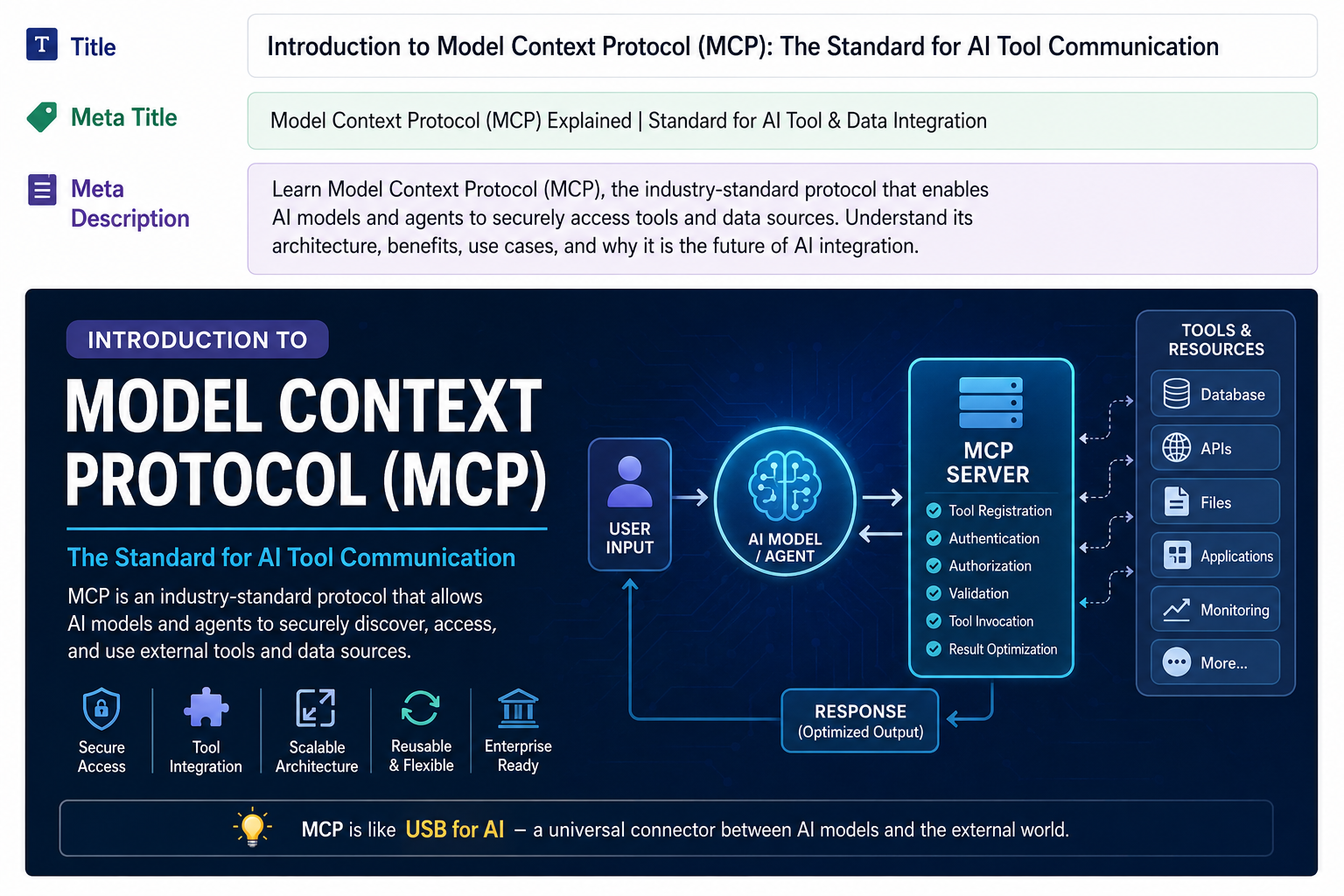
The Model Context Protocol (MCP) is an industry-standard communication protocol designed for AI models and AI agents to securely discover, access, and use external tools and data sources.
In simple words:
MCP acts like a universal connector between AI systems and external applications.
A good analogy is USB technology.
Before USB, every device needed different connectors and drivers. USB standardized communication between devices and computers.
Similarly:
MCP standardizes communication between AI models and tools.
Why MCP is Important
As AI systems become more advanced, enterprises are building:
- AI Agents
- Multi-Agent Systems
- Autonomous Workflows
- AI Assistants
- AI-Powered Enterprise Applications
All these systems need access to:
- Databases
- APIs
- Files
- Monitoring Systems
- Internal Applications
- Cloud Services
- Business Tools
Without a standard communication layer, every AI integration becomes a custom implementation.
This leads to:
- High maintenance
- Poor scalability
- Tight coupling
- Security issues
- Duplicate development efforts
MCP solves these problems by introducing a standard protocol for tool communication.
Evolution of Tool Integration Frameworks
Before MCP, frameworks like:
- LangChain
- LangGraph
were commonly used to integrate tools with AI agents.
These frameworks are extremely powerful for:
- Building AI workflows
- Tool orchestration
- Agent development
- Memory integration
However, they introduce scalability challenges in enterprise environments.
Limitations of Traditional Tool Integration
Imagine an enterprise with:
- 50 tools
- 20 AI agents
- Multiple development teams
In traditional architectures:
- Each agent directly integrates tools
- Tool definitions vary across teams
- Security handling becomes inconsistent
- Tool discovery becomes difficult
- Reusability reduces significantly
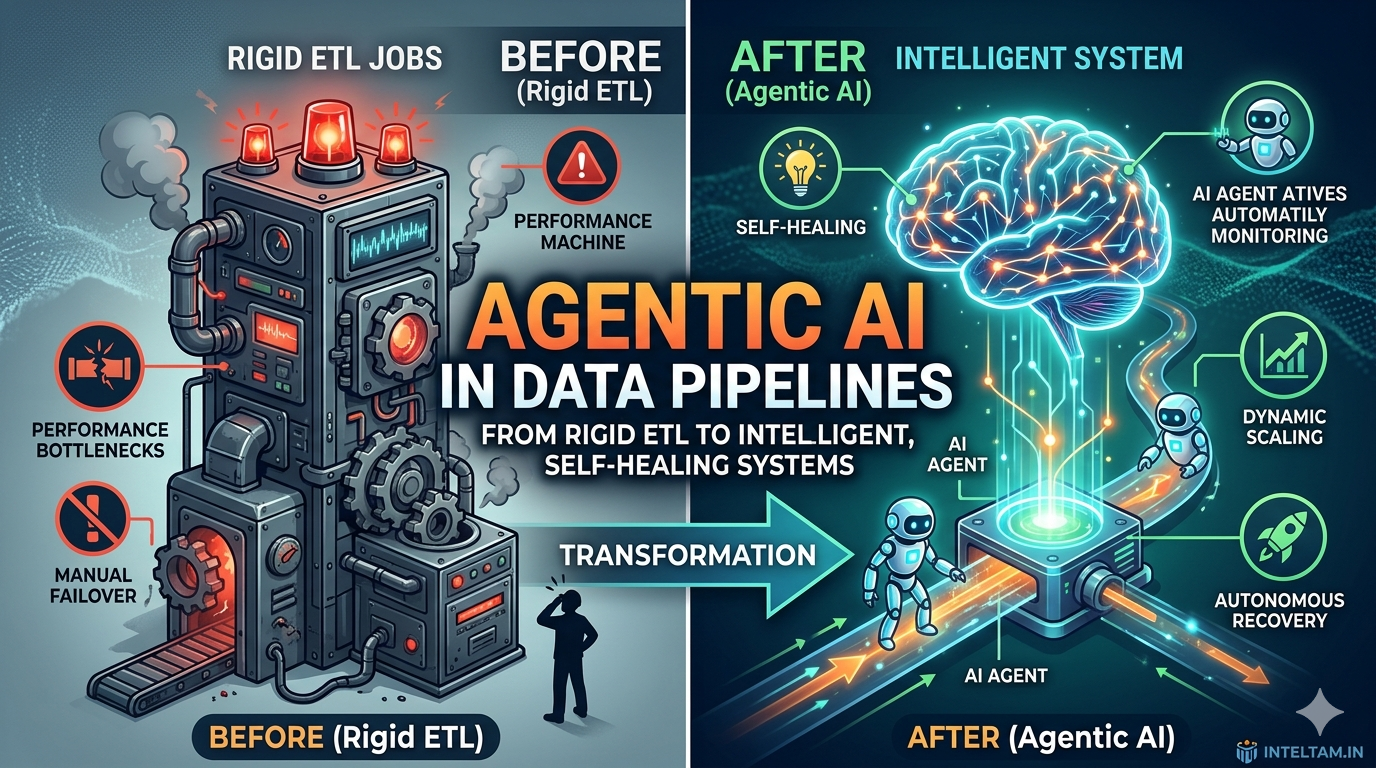
This creates what is called:
Tight Coupling
Where every AI system becomes heavily dependent on direct tool integrations.
As systems grow, maintenance becomes extremely difficult.
MCP Enables Loose Coupling
MCP introduces a loosely coupled architecture.
Instead of agents directly calling tools:
AI Agents communicate with an MCP server.
The MCP server becomes the centralized management layer for tools and resources.
This architecture provides:
- Better scalability
- Centralized governance
- Tool standardization
- Improved maintainability
- Enterprise-grade security
High-Level MCP Architecture
The basic MCP architecture contains the following components:
| Component | Responsibility |
|---|---|
| User | Provides request/input |
| AI Agent / LLM | Understands user intent |
| MCP Client | Sends requests using MCP |
| MCP Server | Manages tools and resources |
| Tools / Resources | Perform actual execution |
MCP Flow Explained
Step 1: User Input
The user asks a question.
Example:
“Show CPU utilization of production servers.”
Step 2: LLM Understanding
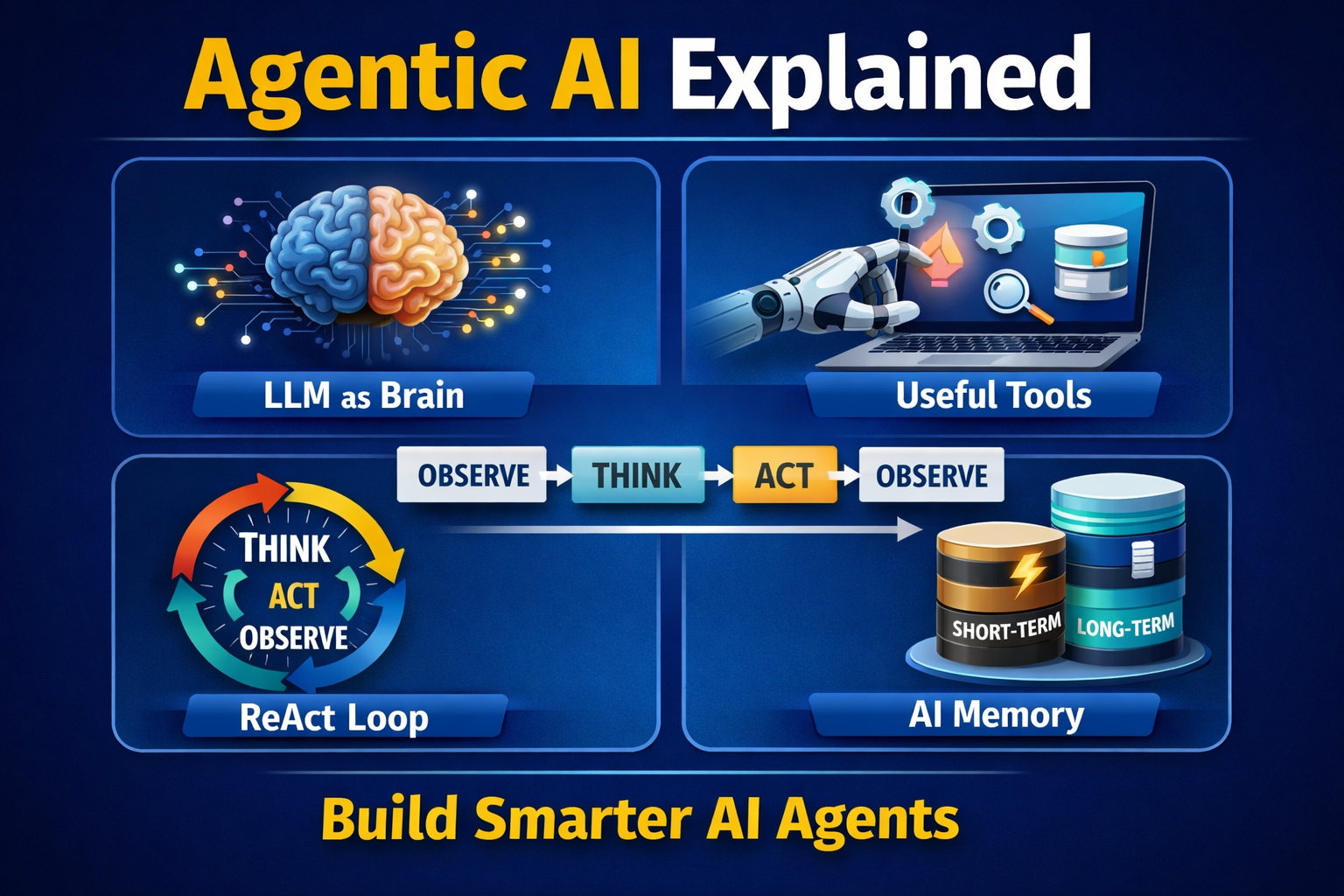
The LLM acts as the brain.
It:
- Understands the request
- Identifies intent
- Decides which tool is needed
Step 3: MCP Request
Instead of directly calling tools, the AI agent sends a request to the MCP server.
The request includes:
- Tool name
- Parameters
- Context
- Authentication metadata
Step 4: MCP Server Processing
The MCP server performs multiple responsibilities.
Responsibilities of MCP Server
1. Tool Registration
The MCP server maintains all available tools.
Examples:
- Database tools
- Monitoring APIs
- Search tools
- Enterprise applications
- File systems
2. Authentication and Authorization
Security is critical in enterprise AI systems.
The MCP server ensures:
- Only authorized agents access tools
- Access policies are enforced
- Sensitive systems remain protected
3. Validation
Before tool execution:
- Input validation occurs
- Request format is verified
- Safety checks are applied
4. Tool Invocation
The MCP server invokes the correct tool based on the request.
Example:
- Monitoring Tool
- Database Query Tool
- Report Generator
- Notification Service
5. Result Optimization
The MCP server collects tool responses and returns them to the AI model.
The LLM then:
- Interprets the result
- Optimizes the response
- Generates user-friendly output
Example MCP Workflow
User Query
“Generate last month’s sales report.”
AI Processing Flow
LLM Decision
The LLM identifies:
- Sales database required
- Reporting tool required
MCP Communication
The request is sent to MCP server.
Tool Invocation
MCP invokes:
- Sales Database Tool
- Report Generator Tool
Final Response
The AI presents:
- Sales insights
- Charts
- Business summary
Loose Coupling vs Tight Coupling
Tight Coupling (Traditional Approach)
AI → Direct Tool Integration
Problems:
- Hardcoded integrations
- Difficult maintenance
- Poor scalability
Loose Coupling (MCP Approach)
AI → MCP → Tools
Advantages:
- Centralized management
- Reusable tools
- Easier scaling
- Better governance
MCP in Multi-Agent Systems
Modern AI systems often use multiple specialized agents.
Examples:
| Agent | Responsibility |
|---|---|
| Monitoring Agent | System health |
| Database Agent | Query execution |
| Analytics Agent | Business insights |
| Notification Agent | Alerts & communication |
Using MCP:
- All agents can share tools
- Tools become reusable
- Communication becomes standardized
This is extremely important for enterprise AI scalability.
Why Enterprises Prefer MCP
1. Standardization
Every team follows the same communication protocol.
2. Scalability
New tools can be added without changing existing agents.
3. Security
Centralized authentication and authorization.
4. Reusability
One tool can serve multiple AI systems.
5. Governance
Administrators can monitor:
- Tool usage
- Agent behavior
- Access patterns
MCP vs APIs
A common question is:
“How is MCP different from APIs?”
APIs expose functionality.
MCP standardizes how AI systems:
- Discover tools
- Communicate with tools
- Invoke tools
- Exchange structured context
In simple words:
APIs provide capabilities.
MCP standardizes AI interaction with those capabilities.
MCP and the Future of Agentic AI
The future of AI is moving toward:
- Autonomous agents
- Multi-agent collaboration
- Enterprise AI ecosystems
- AI operating systems
MCP is expected to become a foundational layer for this evolution.
Many experts compare MCP to:
- HTTP for web systems
- USB for hardware communication
Because MCP provides:
A universal communication mechanism for AI applications.
Final Thoughts
Generative AI introduced intelligence.
Agentic AI introduces autonomy.
MCP introduces connectivity and standardization.
Together, they form the foundation of next-generation enterprise AI systems.
As organizations continue building:
- AI assistants
- Autonomous workflows
- Enterprise AI platforms
- Multi-agent ecosystems
MCP is likely to become one of the most important architectural standards in AI engineering.
Conclusion
The Model Context Protocol (MCP) is not just another framework.
It represents a shift toward:
- Scalable AI infrastructure
- Enterprise-grade AI communication
- Standardized tool integration
- Reusable AI ecosystems
For developers, architects, and enterprises building the future of AI systems, understanding MCP is becoming increasingly important.
The future of AI is not just smarter models.
It is smarter connectivity between models and the real world.