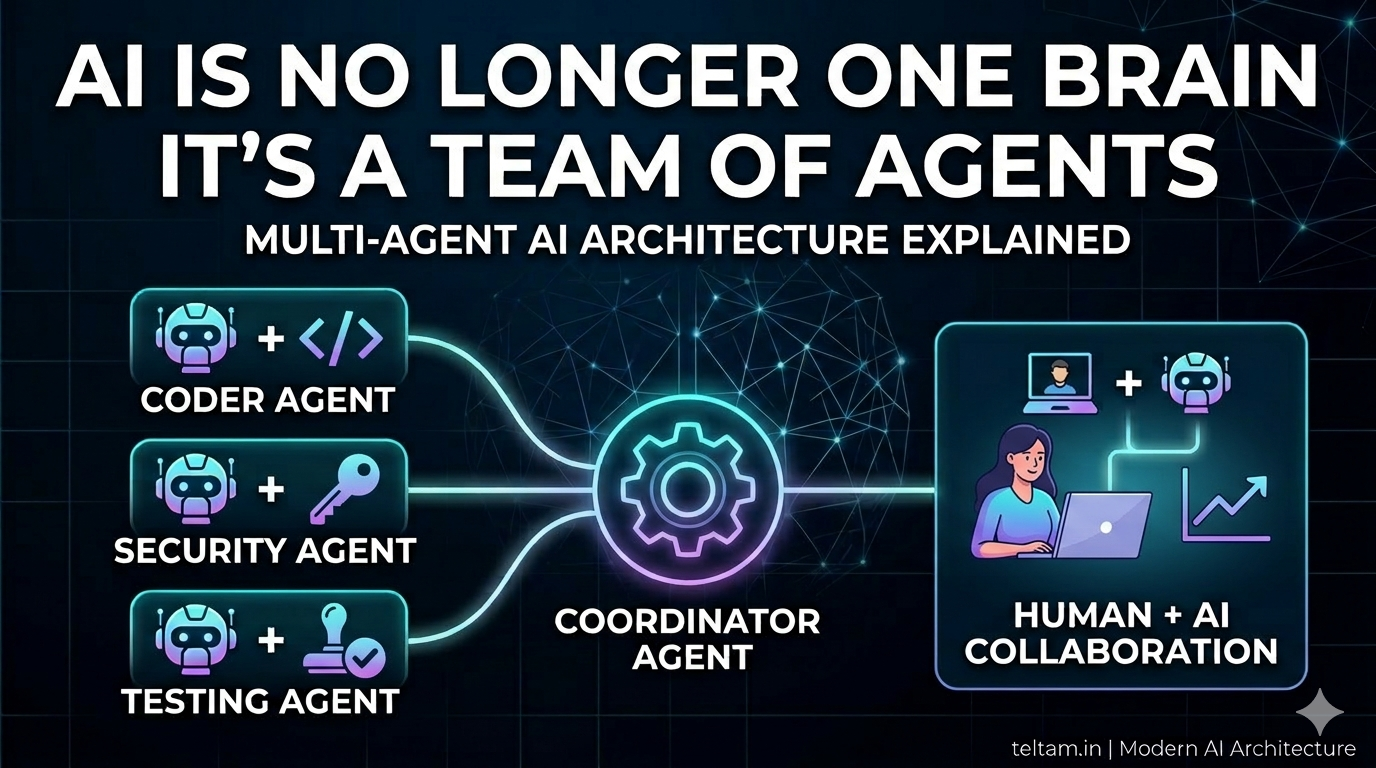
Artificial Intelligence is entering a new phase.
For the past few years, most of us have interacted with AI in a simple way — we open a chat window, ask a question, and receive an answer. Tools like ChatGPT or Perplexity AI made AI accessible to everyone.
But inside modern product companies, AI is evolving beyond this simple interaction model.
In the first session of Modern AI Pro – AI for Product Management, an important idea was discussed:
The future of AI is not a single intelligent system.
It is a team of AI agents working together, alongside humans
Let us walk through these ideas step by step.
Step 1: From a Single AI Assistant to a Team of AI Agents
Most people today interact with AI like this:
You ask a question → AI generates a response.
But complex work rarely happens in isolation. In real organizations, multiple roles collaborate to produce a final result.
For example, in software development we have:
- Developers
- Test engineers
- Security reviewers
- Product managers
The same concept is now being applied to AI systems.
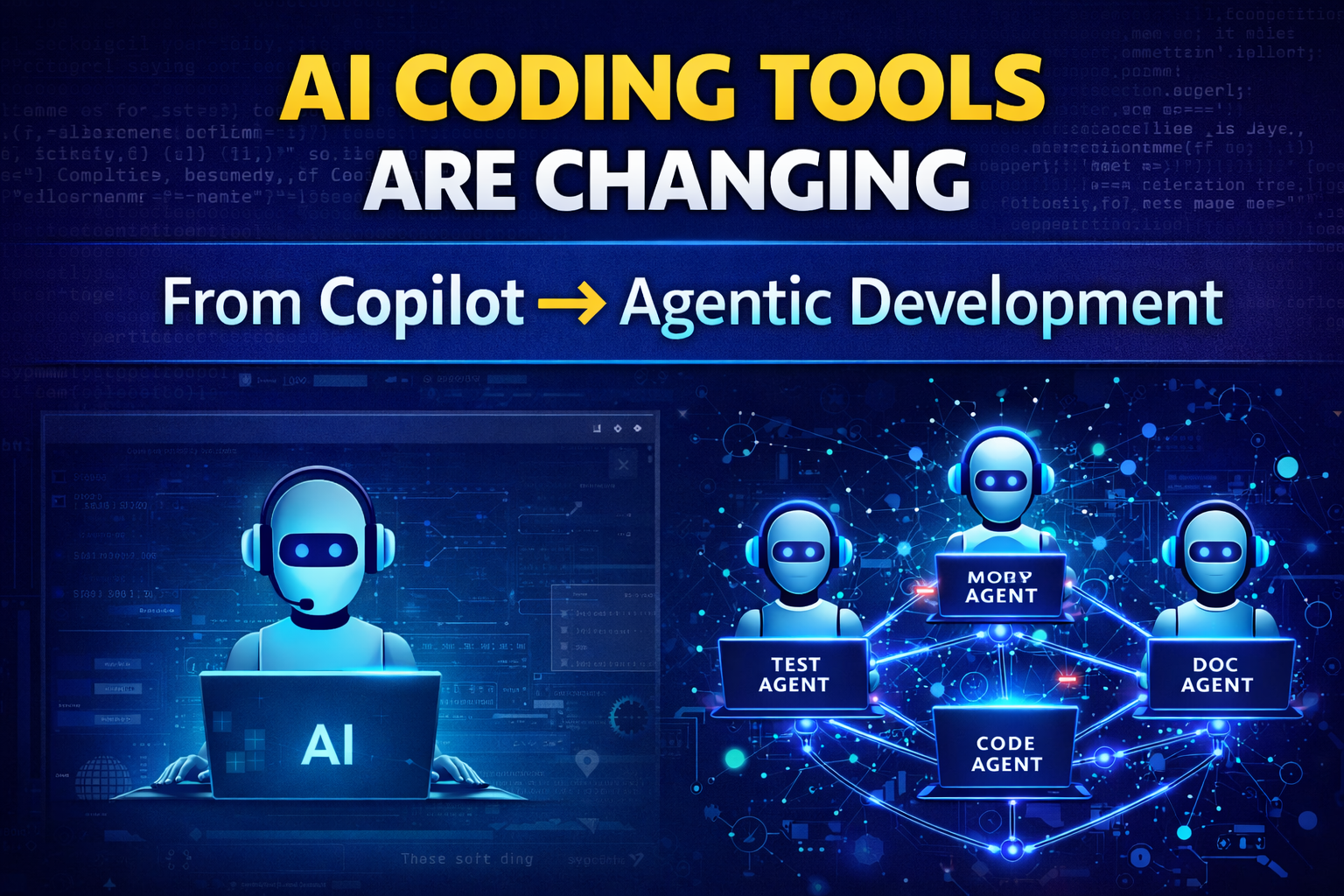
Instead of one AI doing everything, we now create multiple specialized AI agents.
Each agent has a specific responsibility.
For example:
- Coder Agent – writes or generates code
- Security Agent – checks vulnerabilities
- Testing Agent – validates functionality
- Product Agent – ensures requirements are met
These agents work together like a small engineering team.
Diagram 1 – Single AI vs Multi-Agent Architecture
Traditional AI System
---------------------

User
  |
  v
Single AI Model
  |
  v
Final Output


Multi-Agent System
------------------

User
  |
  v
Coordinator Agent
  |
  +------------+-------------+-------------+
  |            |             |             |
Coder Agent  Security     Testing       Product
              Agent        Agent        Agent
  |            |             |             |
  +------------+-------------+-------------+
                   |
                   v
              Final Output
In this architecture, a Coordinator Agent manages the conversation between other agents.
This approach is known as a Multi-Agent System (MAS).
Step 2: AI Agents Can Debate and Refine Solutions
An interesting concept discussed in the session was agent debate.
Instead of blindly accepting one answer, agents can challenge each other.
Example workflow:
- Coder Agent proposes an implementation
- Security Agent checks for vulnerabilities
- Product Agent verifies if business requirements are satisfied
- Testing Agent runs automated tests
If problems are detected, the agents iterate again.
This process produces higher quality outputs, similar to how human teams refine ideas.
Step 3: Humans Are Still Part of the System
One important takeaway from the session was clear:
AI is not replacing humans.
Instead, organizations are moving toward Human-AI Hybrid Teams.
In this model:
Humans provide:
- Strategic thinking
- decision making
- product direction
- ethical judgement
AI agents provide:
- automation
- analysis
- speed
- scale
The result is a human-in-the-loop architecture, where humans supervise AI systems while benefiting from their productivity.
Step 4: The Evolution of the Software Development Life Cycle
Another major topic discussed was the transformation of the Software Development Life Cycle (SDLC).
Traditionally, software development involved many manual steps:
- requirement analysis
- coding
- testing
- deployment
AI was initially used only for small tasks like code suggestions.
But now something much bigger is happening.
Organizations are moving toward something called the Agentic SDLC.
Diagram 2 – Traditional SDLC vs Agentic SDLC
Traditional SDLC
----------------

Planning → Development → Testing → Deployment


Agentic SDLC
------------

Human Product Manager
          |
          v
AI Planning Agent
          |
          v
Code Generation Agent
          |
          v
Automated Review Agent
          |
          v
Testing Agent
          |
          v
Deployment & Monitoring Agents
In this model, AI participates in every stage of the development lifecycle.
Developers are no longer writing every line of code.
Instead, they guide AI systems and review outputs.
Step 5: AI as Raw Material vs AI as the Final Product
Another useful framework discussed in the session was how organizations use AI internally.
AI can play two different roles.
AI as Raw Material
Here AI works behind the scenes.
Examples include:
- processing enterprise data pipelines
- improving ERP sales forecasting
- automating supply chain planning
- predicting inventory requirements
These systems improve internal operations but may not be visible to end users.
AI as the Final Product
In some cases, AI becomes the core user experience.
Examples include:
- AI assistants in banking apps
- healthcare monitoring systems
- AI copilots in productivity tools
In these scenarios, AI is not just supporting the product — it becomes the product.
Step 6: Real-World Use Cases Mentioned in the Session
Participants in the discussion shared several interesting implementations.
ERP Forecasting
Companies are using AI to analyze historical sales data and predict future demand.
This helps businesses optimize production and reduce inventory waste.
Global Digital Audits
AI systems are capable of auditing enterprise processes across dozens of international locations.
Instead of manual audits, AI detects anomalies and inefficiencies automatically.
Aerospace Verification and Validation
In aerospace software, strict safety standards apply.
AI can assist engineers by helping in Verification & Validation (V&V) processes.
However, due to safety requirements, human oversight remains essential.
Healthcare Monitoring
Another fascinating example involved AI-based cardiac risk monitoring systems.
These systems combine multiple sources of data:
- wearable sensors
- cameras
- audio signals
- health devices
This is known as multimodal AI processing.
Such systems can detect early health risks and alert caregivers in real time.
Step 7: The Shift Toward Internal AI Tooling
One surprising trend discussed was the move toward internal AI platforms.
Instead of relying completely on external software providers, many organizations are building their own AI tools.
This approach is sometimes referred to as micro-engineering.
Companies prefer internal tools because they offer:
- better data privacy
- deeper customization
- integration with internal systems
- long-term cost efficiency
Tools like Claude and Perplexity AI are often used as components in these internal systems.
Final Thoughts
The biggest insight from the session is this:
The future of AI is not about a single intelligent model.
It is about ecosystems of intelligent agents collaborating with humans.
Product managers, engineers, and technology leaders need to start thinking about:
- Multi-Agent architectures
- Agentic software development
- Human-AI collaboration
- AI-driven internal tooling
The organizations that learn how to design and manage these systems will define the next generation of digital products.