Introduction
Artificial Intelligence is no longer experimental — it is deeply integrated into enterprise systems, driving decisions, automation, and innovation. But as AI adoption grows, so do the risks associated with it.
Organizations today are not just asking “How do we build AI?”
They are asking:
“How do we control, monitor, and govern AI responsibly?”
This is where the Enterprise AI Governance Stack becomes critical.
It provides a layered architecture that ensures AI systems are:
- Reliable
- Scalable
- Transparent
- Compliant with regulations
In this blog, we will break down the entire governance stack step by step, using visual diagrams and practical explanations tailored for engineers, architects, and decision-makers.
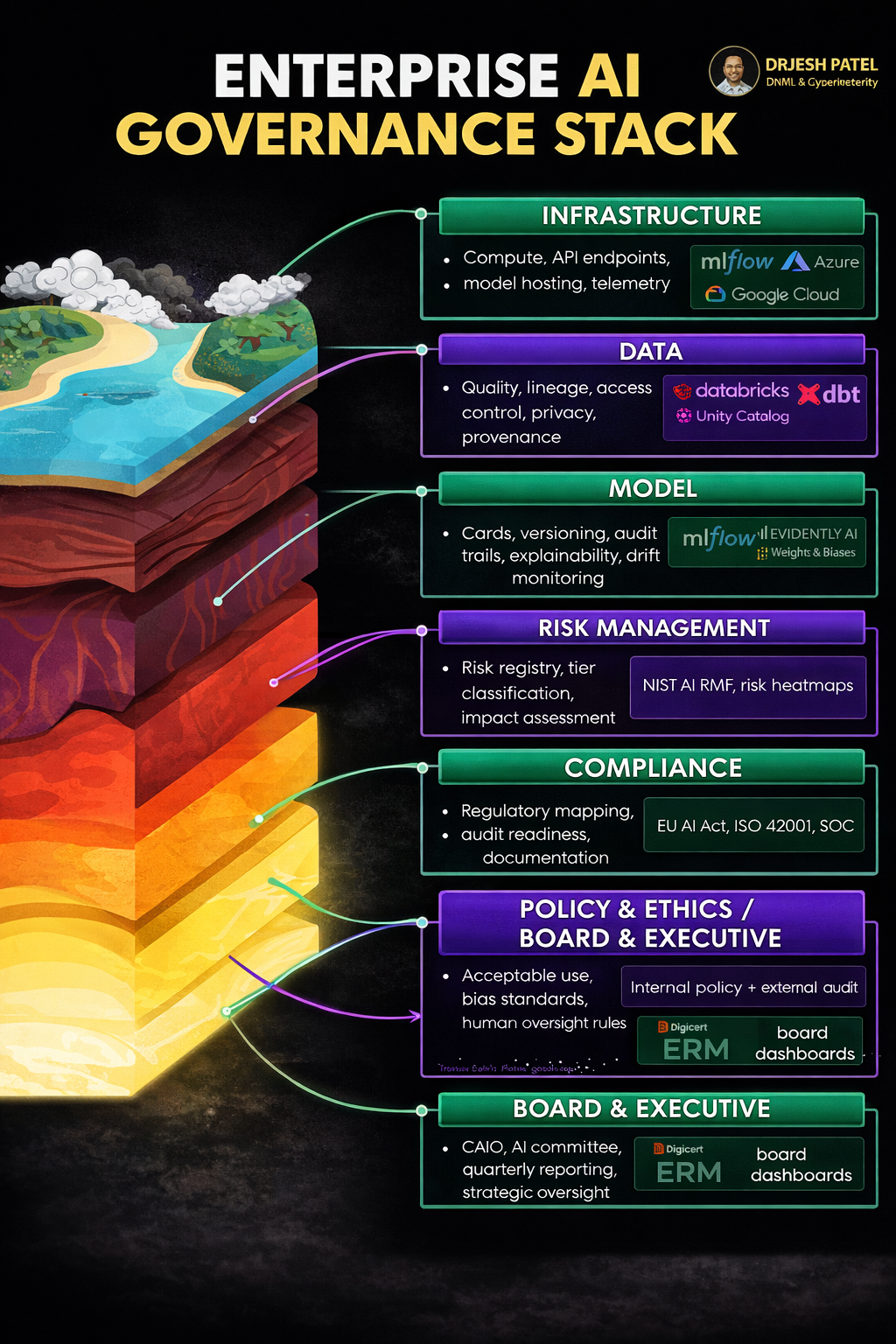
High-Level Enterprise AI Governance Stack
Layered view of Enterprise AI Governance from Infrastructure to Executive Oversight
Understanding the Big Picture
The governance stack is designed like a multi-layered system, where each layer builds on top of the previous one.
Think of it like this:
- Bottom layers → Technical foundation
- Middle layers → Control & monitoring
- Top layers → Business & ethical oversight
Each layer plays a critical role in ensuring AI systems are safe and effective.
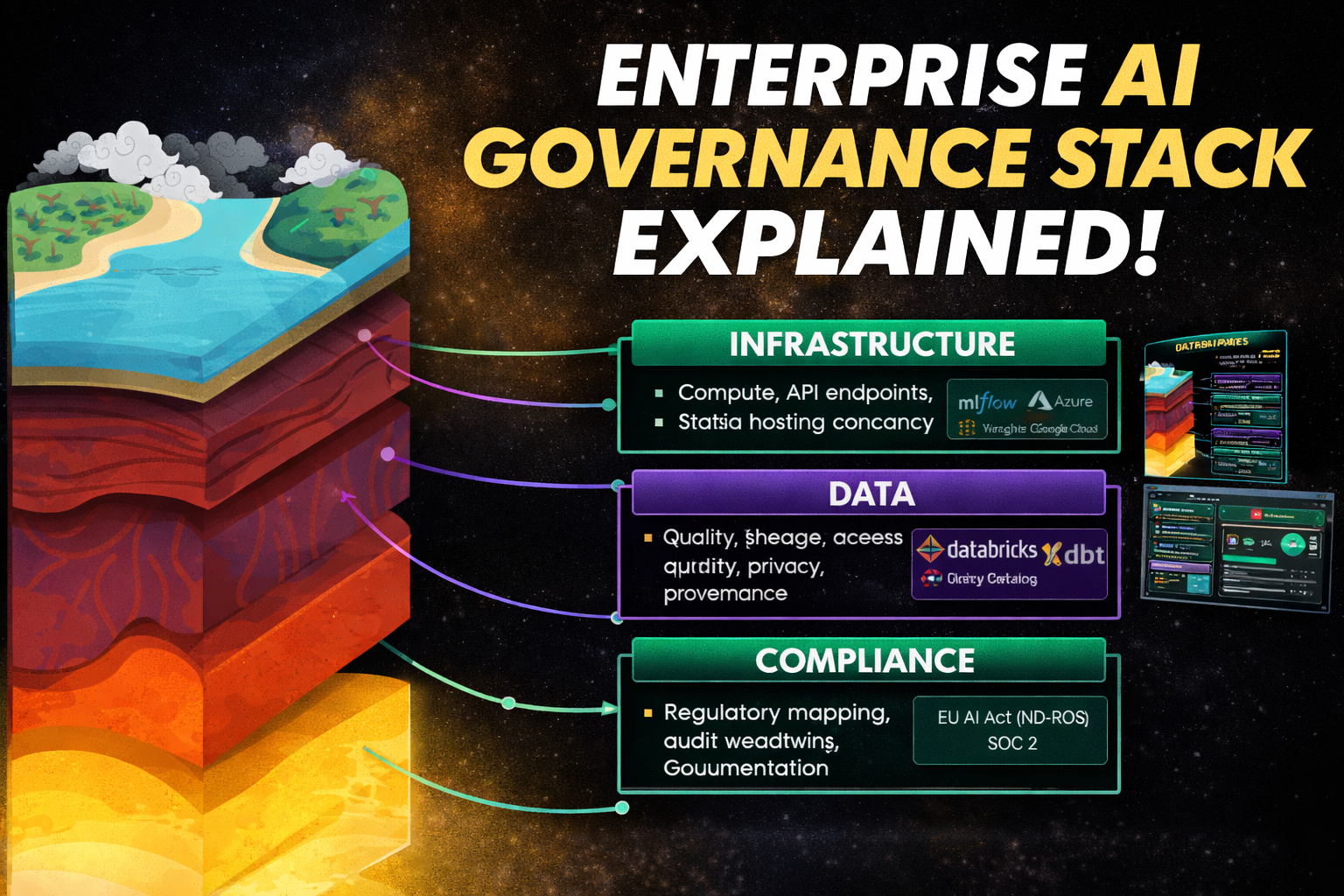
Technical Foundation Layers (Infrastructure → Data → Model)
Core technical layers powering AI systems
Infrastructure Layer
This is the foundation of the entire AI ecosystem.
It includes:
- Compute resources (CPU/GPU clusters)
- API endpoints
- Model hosting platforms
- Monitoring & telemetry
Why it matters:
Without a scalable infrastructure:
- AI models cannot run efficiently
- Real-time systems will fail
- Monitoring becomes impossible
Example Tools:
- MLflow
- AWS / Azure / GCP
This layer ensures performance, scalability, and reliability.
Data Layer
Data is the fuel of AI systems.
This layer ensures:
- Data quality and consistency
- Data lineage (tracking origin)
- Access control and security
- Privacy compliance
Key Functions:
- Data cleaning
- Transformation
- Integration from multiple sources
Example Tools:
- Databricks
- Unity Catalog
- dbt
This layer builds trust in the data pipeline.
Model Layer
This is where AI intelligence lives.
It focuses on:
- Model training and deployment
- Version control
- Explainability
- Drift detection
Why this is critical:
AI models can:
- Degrade over time
- Become biased
- Produce unexpected results
Example Tools:
- MLflow
- Evidently AI
- Weights & Biases
Ensures models remain accurate, explainable, and auditable.
Governance Layers (Risk → Compliance → Ethics → Leadership)
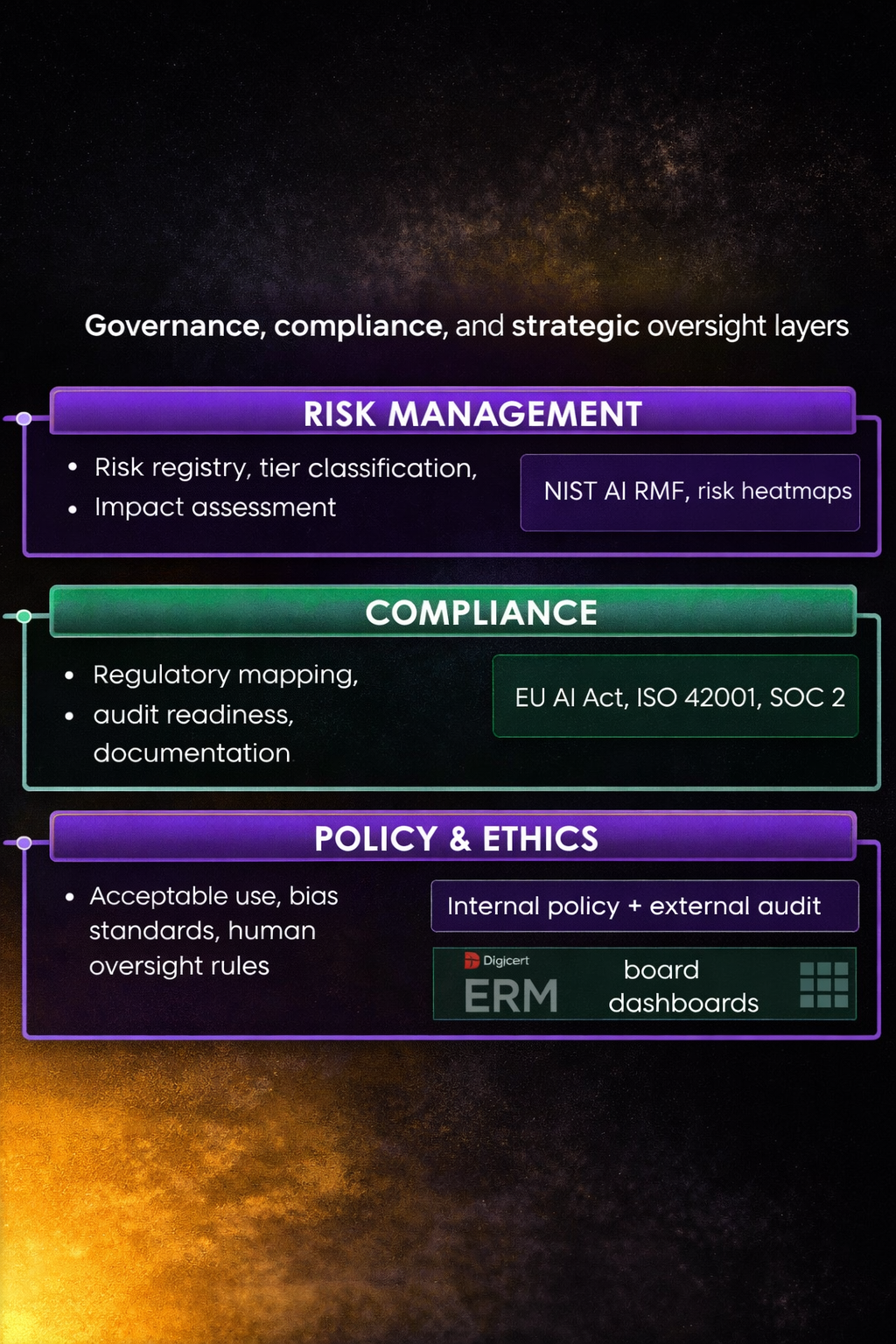
Governance, compliance, and strategic oversight layers
Risk Management
AI introduces new types of risks, including:
- Bias in predictions
- Incorrect automation decisions
- Ethical concerns
This layer focuses on:
- Risk classification
- Impact assessment
- Risk tracking
Framework Example:
- NIST AI Risk Management Framework (RMF)
Helps organizations identify and mitigate risks early.
Compliance Layer
Enterprises must comply with global regulations and standards.
This layer ensures:
- Audit readiness
- Regulatory mapping
- Proper documentation
Standards:
- EU AI Act
- ISO 42001
- SOC 2
Prevents legal and regulatory issues.
Policy & Ethics
AI systems must align with human values and fairness.
This layer defines:
- Acceptable AI usage
- Bias mitigation rules
- Human oversight mechanisms
Why it matters:
Without ethics:
- AI can cause harm
- Trust in systems is lost
Ensures AI is used responsibly and transparently.
Board & Executive Oversight
AI governance is not just technical — it is strategic.
This layer includes:
- Chief AI Officer (CAIO)
- AI governance committees
- Board-level dashboards
Responsibilities:
- Strategic direction
- Monitoring AI impact
- Aligning AI with business goals
Ensures AI drives business value with accountability.
How All Layers Work Together
The power of the AI Governance Stack lies in integration.
- Infrastructure powers everything
- Data feeds models
- Models generate insights
- Risk & compliance control usage
- Ethics defines boundaries
- Leadership drives strategy
Together, they create a robust and scalable AI ecosystem.
Why This Matters for You
Whether you are:
- Data Engineer
- AI Engineer
- Architect
- Business Leader
Understanding this stack helps you:
- Build production-grade AI systems
- Avoid costly mistakes
- Ensure long-term scalability
- Gain trust from stakeholders
Conclusion
- AI is no longer just about building models — it is about building responsible, scalable, and governed systems.
- The Enterprise AI Governance Stack provides a clear blueprint for organizations to:
- Scale AI confidently
- Manage risks effectively
- Stay compliant with global standards
- Build trustworthy AI systems
- As enterprises move deeper into AI adoption, those who invest in governance will not only avoid risks — they will lead the future of intelligent systems.
Call to Action
Want more insights like this?
Follow SomethingTalk1 - youtube.com/@somethingtalk125?si=oFi6JfJ4qRuorv7m
Explore more at teltam.in