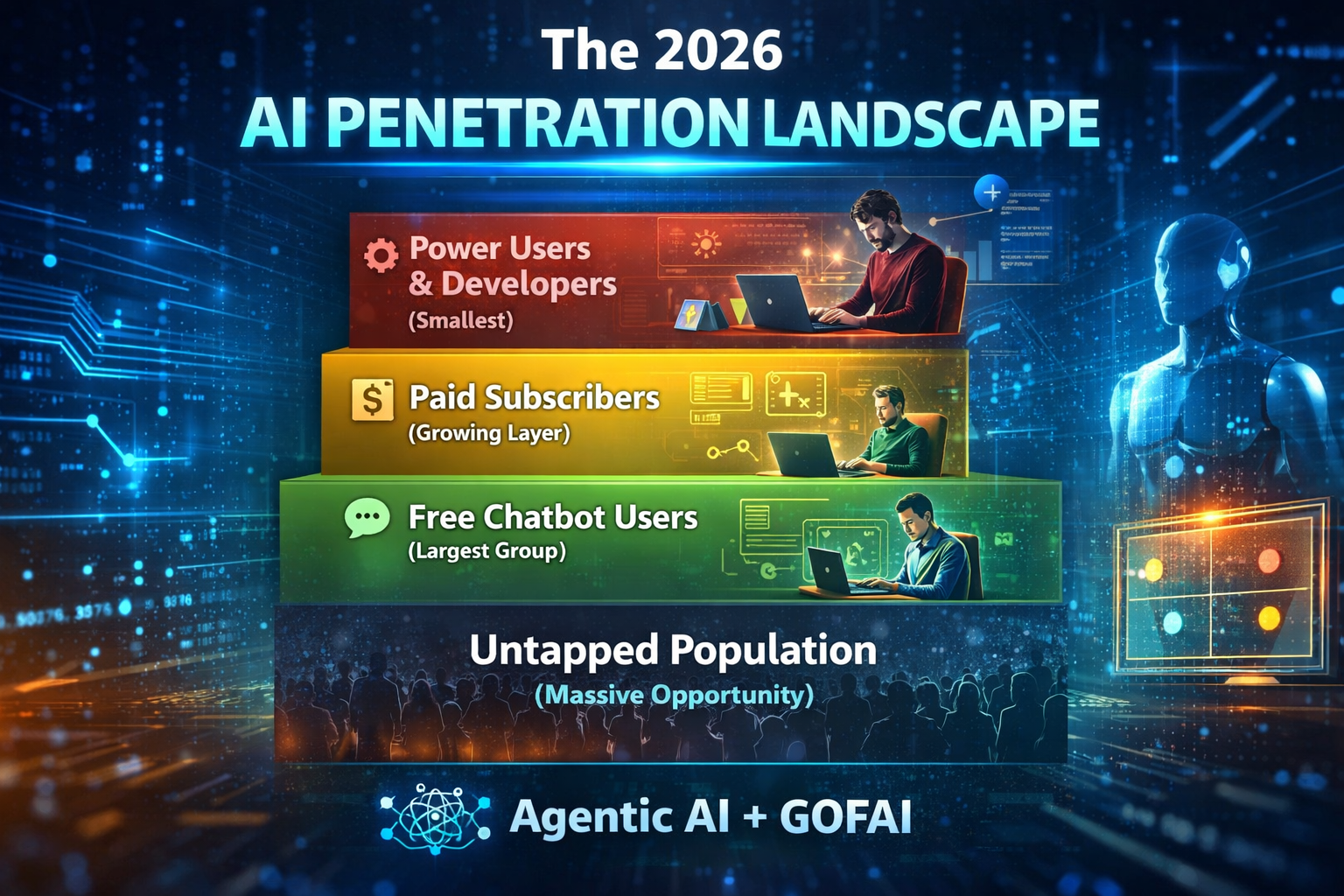
The 2026 AI Penetration Landscape
Who is really using AI… and who is not?
When we talk about AI, it often feels like everyone is using it.
But the reality is very different.
In a recent discussion, Arvind Nagaraj presented a simple but powerful way to understand:
How AI is actually spread across the world
Let’s break this down step by step.
Step 1: Understanding the AI User Layers
Instead of looking at AI as “used vs not used”, we need to look at levels of usage.
There are mainly three types of AI users today.
1. Free Chatbot Users (Largest Group)
These are people who use:
- Basic chatbots
- Free AI tools
- Simple queries (questions, emails, etc.)
Example tools:
- ChatGPT
- Gemini
This is the entry-level layer of AI adoption.
2. Paid Subscribers (Growing Layer)
These users go one step further.
They:
- Pay for premium AI tools
- Use advanced features
- Depend on AI for daily work
This group is smaller than free users, but more serious about AI usage.
3. Power Users & Developers (Smallest but Most Important)
This is where real innovation happens.
These users:
- Build AI systems
- Create agents
- Develop workflows
- Push the limits of AI
This group is very small, but they are shaping the future.
Diagram 1: AI Penetration Landscape
        			🔴 Power Users & Developers
             			(Very Small)


        			🟡 Paid Subscribers
           			(Growing Layer)


        			🟢 Free Chatbot Users
            			(Very Large)


			-------------------------------------
			🚫 Untapped Population (Huge Majority)
Step 2: The Untapped Majority
Here’s the most surprising insight:
A huge portion of the world still has NOT used AI at all
This is not a small gap.
This is a massive opportunity.
What does this mean?
- AI growth is still in early stages
- Education and awareness are critical
- Content creators (like you) have a huge role
This is where platforms like SomethingTalk1 + Teltam become powerful.
Step 3: The Return of GOFAI (Old AI is Back!)
Now let’s move to a deeper concept.
Most people think modern AI = Neural Networks.
But that’s only half the story.
What is GOFAI?
GOFAI stands for:
Good Old-Fashioned AI
It includes:
- Rule-based systems
- Search algorithms
- Symbolic logic
These systems have existed since the 1950s.
Why is GOFAI important again?
Because modern AI systems are combining:
Neural Networks + GOFAI
Diagram 2: How Modern Agentic AI Works
							User Request
     							|
     							v
							Neural Network (LLM)
							(ChatGPT / Claude / Gemini)
     							|
     							v
							Decision Making
     							|
     							+------------------------+
     							|                        |
     							v                        v
							GOFAI Tools              System Commands
							(Search, Logic)          (ls, grep, APIs)
     							|                        |
     							+-----------+------------+
                 							|
                 							v
        							Final Output
Key Insight
As Arvind Nagaraj explains:
The real AI boom is happening at the intersection of Neural AI and traditional systems
Step 4: New Tools Changing Everything
Let’s look at real tools that represent this shift.
Claude Code
- Works in terminal
- Can search, write, and review code
- Highly autonomous
It behaves like a developer assistant
Claude Co-work
- Designed for non-technical users
- Works with Excel, PowerPoint
- No terminal needed
Makes AI accessible to business users
The Most Interesting Part
The desktop app was:
Built using the AI agent itself
This is called a recursive build:
AI builds tools → which help build more AI tools
Step 5: Real Challenges in Companies
Even though AI is powerful, companies face serious challenges.
Problem 1: Speed of Change
AI tools are evolving too fast.
By the time:
- A company evaluates a tool
- Approves budget
A better tool already appears
Solution: AI-First Sandbox Approach
Top companies are doing this:
- Give employees AI budget
- Encourage experimentation
- Run internal hackathons
Instead of slow approvals, they promote fast learning
Problem 2: Security Concerns
Some AI tools require:
- Access to files
- System commands
- Codebases
Example concerns:
- Data leakage
- Unauthorized access
- System risks
This makes companies cautious.
Final Thoughts
The AI world in 2026 is not just about models.
It is about:
✔ Who is using AI
✔ How deeply they are using it
✔ How systems are evolving internally
Simple Summary
- Most people → Still not using AI
- Few people → Using AI seriously
- Very few → Building AI systems
And technically:
The future belongs to:
Neural Networks + GOFAI + Agentic Systems
Closing Thought
We are still in the early phase of AI adoption.
The biggest opportunity is not just building tools.
It is helping people understand and use AI