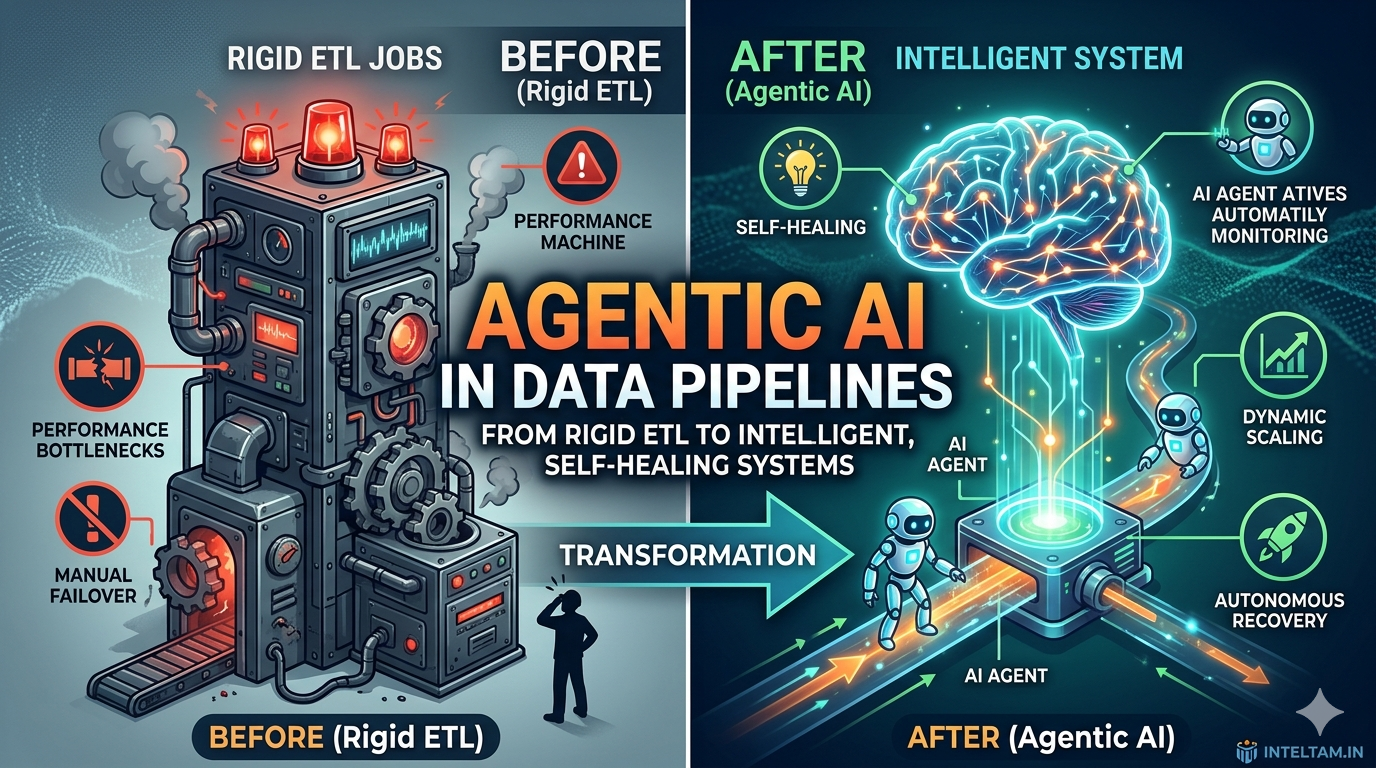
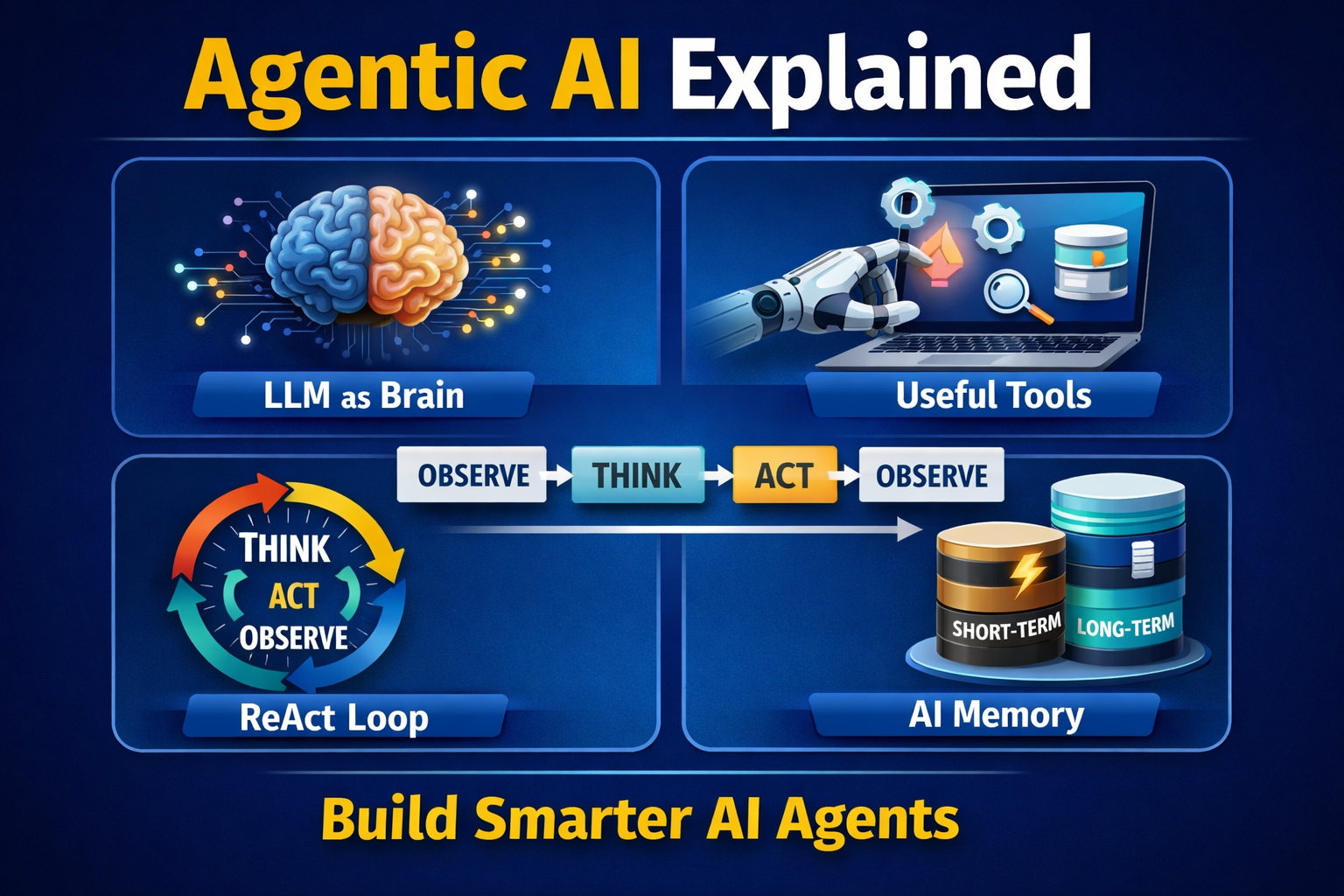
Agentic AI represents the next evolution of artificial intelligence, where systems move beyond passive responses to actively planning, reasoning, and executing tasks. Unlike traditional AI models that simply generate outputs based on prompts, agentic systems can interact with tools, maintain memory, and make decisions in a step-by-step manner. This shift enables the development of intelligent systems capable of solving real-world problems with minimal human intervention. In this guide, we will explore the core concepts of Agentic AI, understand the ReAct framework, and learn how to integrate Large Language Models (LLMs), tools, and memory into a fully functional AI agent.
Core Concepts of Agentic AI
Agentic AI is built on a few fundamental components that define how an AI agent behaves:
Perception
The agent receives input from users or the environment.
Reasoning
The agent analyzes the input and decides what to do next.
Action
The agent performs tasks using tools or APIs.
Memory
The agent stores and recalls past interactions.
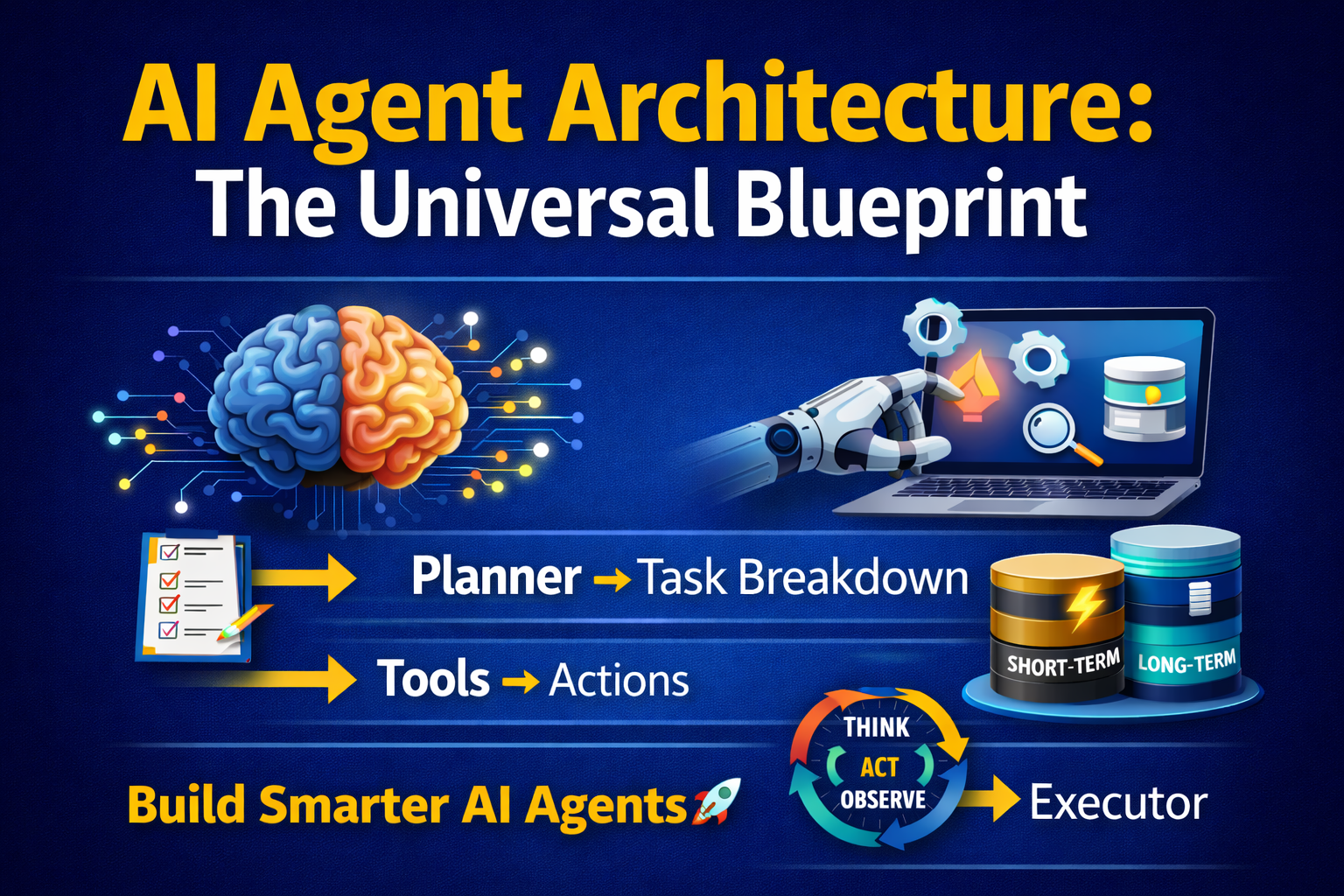
Agent Loop (Think → Act → Observe)
Observation→Thought→Action→Observation
This loop is the foundation of all agentic systems.
ReAct Framework (Reasoning + Acting)
The ReAct framework combines reasoning and action in a structured way.
How it works:
- Thought → AI reasons about the problem
- Action → Calls a tool or function
- Observation → Gets result
- Repeat until solution
ReAct Flow Diagram
User Input
↓
Thought (Reasoning)
↓
Action (Tool Call)
↓
Observation (Result)
↓
Repeat Loop
↓
Final Answer
Example:
- Thought: “I need current weather data”
- Action: Call weather API
- Observation: “32°C in Chennai”
- Final Answer: “It’s 32°C today”
Adding LLM to Agentic AI
- Large Language Models (LLMs) act as the brain of the agent.
Role of LLM:
- Understand input
- Generate reasoning steps
- Decide actions
Step-by-Step Integration
Step 1: Choose an LLM
- Examples: GPT, open-source LLMs
Step 2: Define Prompt Structure
- Include:
- Instructions
- Available tools
- Memory context
Step 3: Enable Reasoning
- Use structured prompts like:
- “Think step-by-step”
“Decide the next action”
Key Insight
Without LLM → No intelligence
With LLM → Agent becomes decision-maker
Adding Tools in Agentic AI
Tools allow the agent to interact with the real world.
Examples:
- APIs (weather, stock, search)
- Databases
- Calculators
- File systems
Tool Usage Flow
User Query
↓
LLM decides tool
↓
Tool Execution
↓
Result returned
↓
LLM processes result
Step-by-Step
- Define tools (functions/APIs)
- Register tools with agent
- Allow LLM to select tool
- Execute tool call
- Return result
Example:
- User: “Calculate 25 * 48”
Agent: - Chooses calculator tool
- Executes
- Returns result
Adding Memory in Agentic AI
- Memory makes agents context-aware and intelligent over time
Types of Memory
1. Short-Term Memory
- Temporary
- Stores current conversation
2. Long-Term Memory
- Persistent
- Stored in database/vector store
Memory Flow Diagram
User Input
↓
Check Short-Term Memory
↓
Retrieve Long-Term Memory
↓
Combine Context
↓
LLM Response
↓
Store Back in Memory
Step-by-Step
Step 1: Implement Short-Term Memory
- Use conversation buffer
Step 2: Add Long-Term Memory
- Use vector DB (FAISS, Pinecone)
Step 3: Retrieve Relevant Context
- Semantic search
Step 4: Feed into LLM
- Improves response quality
Example:
- User: “What is my goal?”
Agent: - Retrieves stored goal
- Responds accurately
Putting It All Together
- An Agentic AI system combines:
- LLM → Brain
- Tools → Actions
- Memory → Context
- ReAct → Control loop
Result:
A system that can think, act, and learn
Conclusion
Agentic AI is transforming how we build intelligent systems by enabling machines to go beyond static responses and actively solve problems. By combining LLMs with structured reasoning frameworks like ReAct, integrating external tools, and incorporating both short-term and long-term memory, developers can create powerful AI agents capable of real-world decision-making. As this field continues to evolve, mastering these core components will be essential for engineers and organizations aiming to stay ahead in the AI-driven future.