Vibe Coding vs Engineering Mindset: How AI Really Impacts Your Career
AI does not decide your future. Your engineering maturity decides how AI affects you.
Why This Topic Matters Now
Over the last few months, Vibe Coding has become a popular term. Many engineers hear statements like:
- “You don’t need deep coding anymore”
- “AI will write everything for you”
- “Prompting is the new programming”
This creates confusion, anxiety, and sometimes dangerous overconfidence.
This blog explains:
- What vibe coding really is
- Where it genuinely helps
- Where it silently fails
- How working professionals should use it safely and effectively
This is written from an engineering-first perspective, not hype.
What Is Vibe Coding (In Simple Terms)
Vibe coding means:
- You describe intent in natural language
- AI generates code or logic
- You iterate based on results
You spend less time typing syntax and more time thinking about what needs to be done.
Important clarification
- Vibe coding is NOT no-thinking coding
- It is thinking at a higher level
AI handles syntax. You still handle responsibility.
Traditional Coding vs Vibe Coding
Traditional Flow
Requirement → Design → Manual Coding → Debugging → Testing → Deploy
Vibe Coding Flow
Requirement → AI Prompting → Generated Code → Human Review → Fix / Refactor → Deploy
What changed?
- Speed increased
- Syntax effort reduced
What did NOT change?
- Responsibility
- Accountability
- Engineering judgment
* In fact, the review step became more important, not less.
Where Vibe Coding Works Very Well
Vibe coding is extremely effective for:
- Boilerplate code
- CRUD APIs
- SQL queries
- Data transformations
- Test cases
- Proof of concepts
- Glue code between systems
If your work sounds like this:
“I know what needs to be built, I just don’t want to type everything”
Then vibe coding is a strong productivity boost.
Where Vibe Coding Fails (And Becomes Risky)
Vibe coding fails when:
- Data volume is large
- Business rules are complex
- Performance matters
- Security is critical
- Backward compatibility exists
AI can:
- Generate inefficient joins
- Ignore edge cases
- Miss null handling
- Introduce silent bugs
- Look correct but fail in production
AI is confident — not accountable.
AI as a Multiplier, Not a Replacement
Think of AI like this:
- Weak engineering skill + AI = unstable systems
- Average engineering skill + AI = mixed results
- Strong engineering skill + AI = massive acceleration
AI amplifies who you already are.
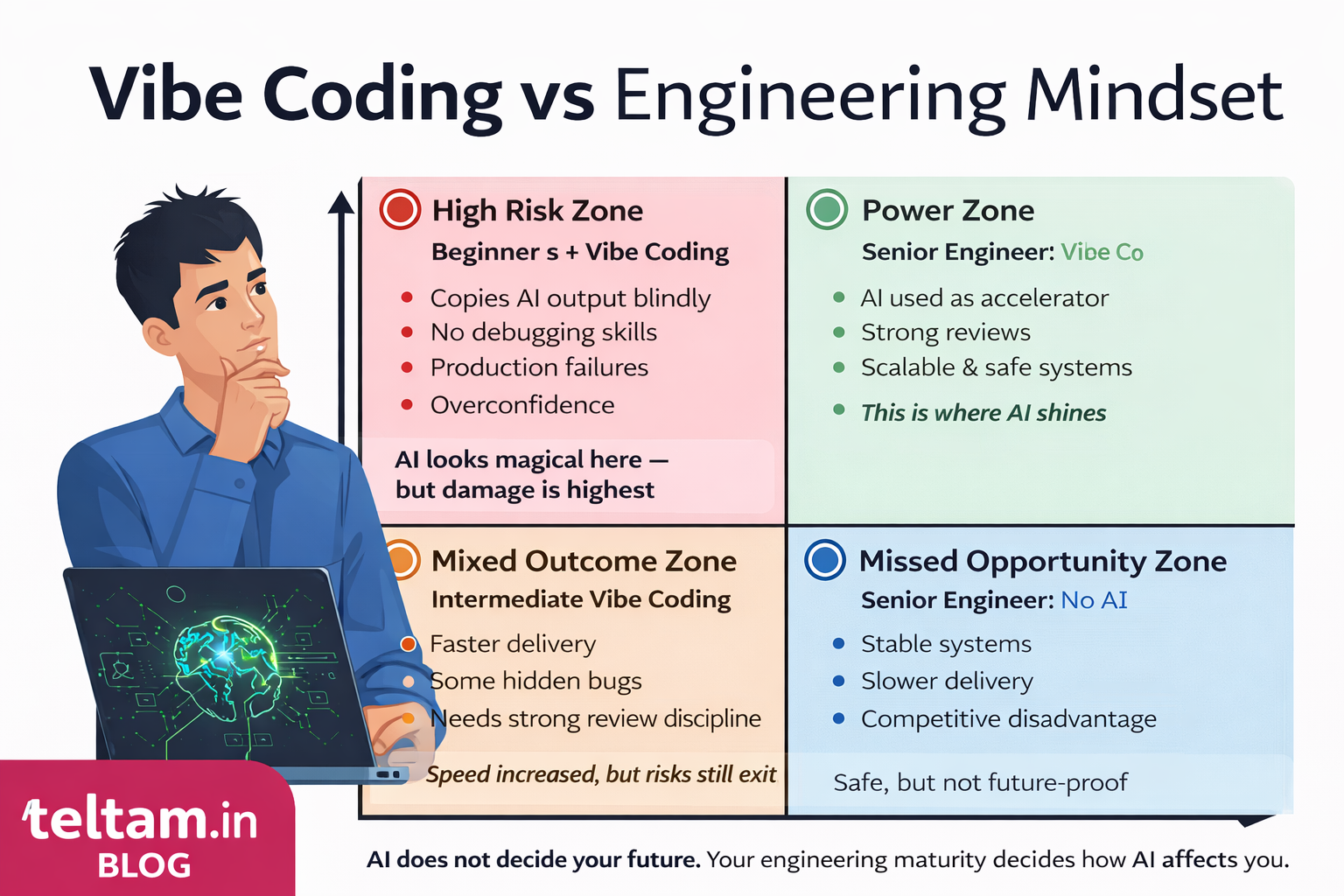
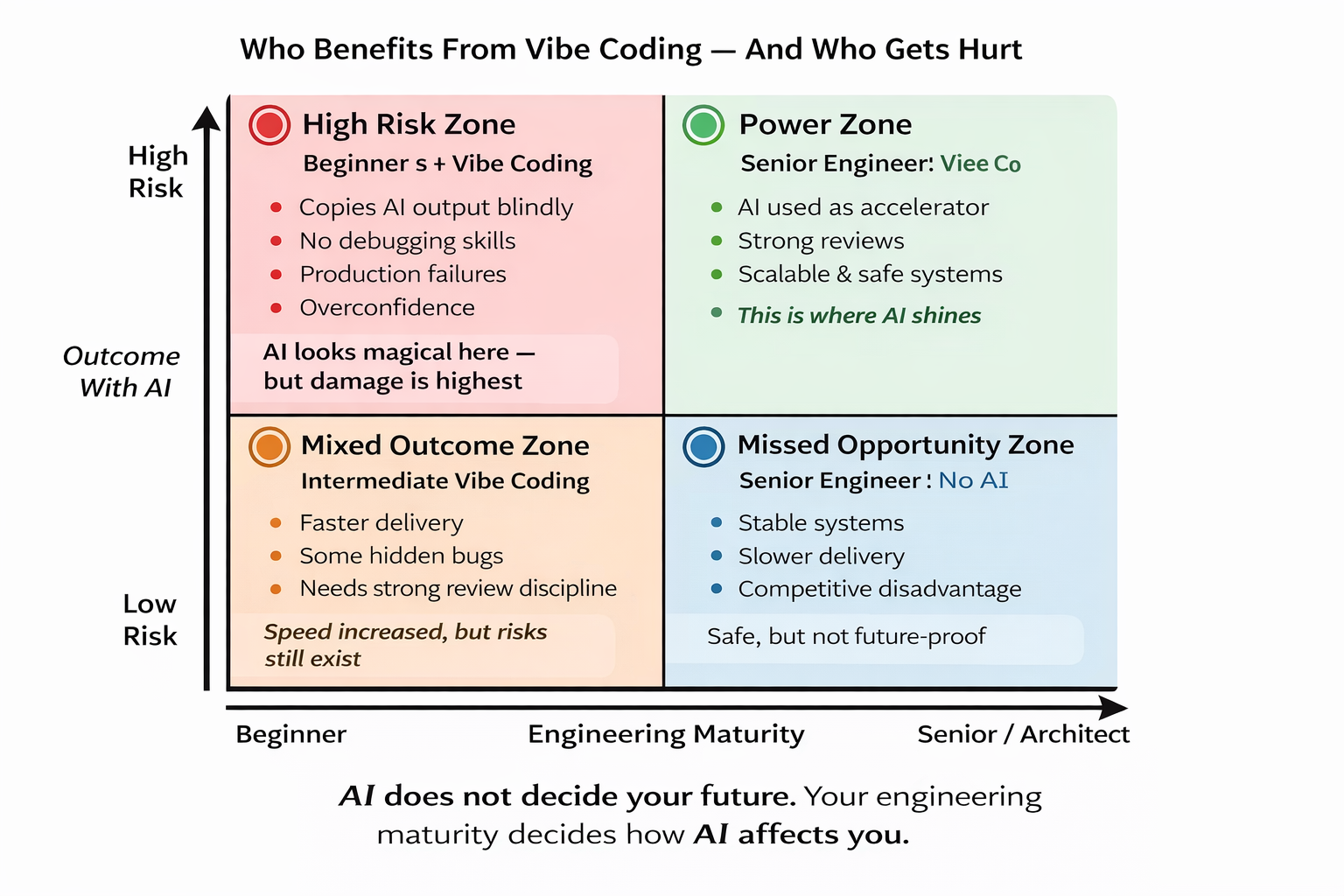
Who Really Benefits From Vibe Coding (Demographic View)
How to read this diagram:
- Beginners using AI blindly face the highest risk
- Intermediate engineers gain speed but must review carefully
- Senior engineers using AI correctly enter the Power Zone
- Seniors ignoring AI miss competitive advantage
AI does not decide your future. Your engineering maturity does.
Why Engineering Mindset Still Wins
AI is very good at:
- Pattern matching
- Speed
- Syntax generation
Humans are still better at:
- Context understanding
- Trade-off decisions
- System-level thinking
- Risk assessment
- Ownership
Production systems fail because of decisions, not syntax.
Why Companies Still Ask for “5+ Years AI Experience”
This does not mean:
- 5 years of model training
- 5 years of deep ML research
It usually means:
- Can you integrate AI safely?
- Can you debug when things go wrong?
- Can you reason about data and scale?
Engineering maturity matters more than AI buzzwords.
Step-by-Step: How Engineers Should Use Vibe Coding
Step 1: Fix the Mindset
- “AI will replace me”
- “AI will accelerate me if I use it correctly”
Step 2: Prompt Like a Designer
Instead of:
- Write code for X
Use:
- Design a scalable solution for X assuming large data volume. Explain assumptions.
Better prompts lead to better architectures.
Step 3: Always Review With These 5 Questions
After AI generates code, ask:
- What are the edge cases?
- What breaks at scale?
- What assumptions exist?
- What is the time and space complexity?
- Where should logging and validation be added?
Step 4: Treat AI as a Junior Engineer
Rule:
AI writes the first draft. You own the final solution.
Never push AI-generated code directly to production.
Step 5: Position Yourself Correctly
Instead of saying:
I have 2 years of AI experience
Say:
I design and integrate AI into real software systems
That language reflects real value.
Final Thoughts
Vibe coding is real.
It is powerful.
But engineering mindset is still the foundation.
The future belongs to engineers who:
- Think clearly
- Understand systems
- Use AI as leverage, not a crutch
Master both — and you stay relevant.
This blog is part of the VIBE-4 series on SomethingTalk1 and Teltam.in.