Engineering Thinking – The Skill That Outlives Tools
Introduction
Tools change. Technologies evolve. Programming languages come and go. But one thing that consistently separates a strong professional from an average one is engineering thinking.
Engineering thinking is not about knowing more tools. It is about how you approach problems, how you break them down, and how you reason before acting. In today’s AI-driven world, this way of thinking is more important than ever.

What Is Engineering Thinking?
Engineering thinking is a structured way of solving problems. It focuses on:
- Understanding the problem deeply before jumping to solutions
- Breaking complex problems into smaller, manageable parts
- Thinking in terms of inputs, outputs, constraints, and edge cases
- Designing solutions that are simple, scalable, and reusable
This mindset applies whether you are writing code, designing systems, learning AI, or even planning your career.
Engineering Thinking vs Tool-Based Learning
Many learners start with questions like:
- Which programming language should I learn?
- Which AI tool is best?
- Which framework has more demand?
These questions are not wrong, but they are incomplete.
Engineering thinking asks different questions:
- What problem am I trying to solve?
- What data or information do I have?
- What are the constraints?
- What is the simplest possible solution?
When you focus only on tools, your growth is short-lived. When you focus on thinking, tools become easy to adapt.
Why Engineering Thinking Matters in the AI Era
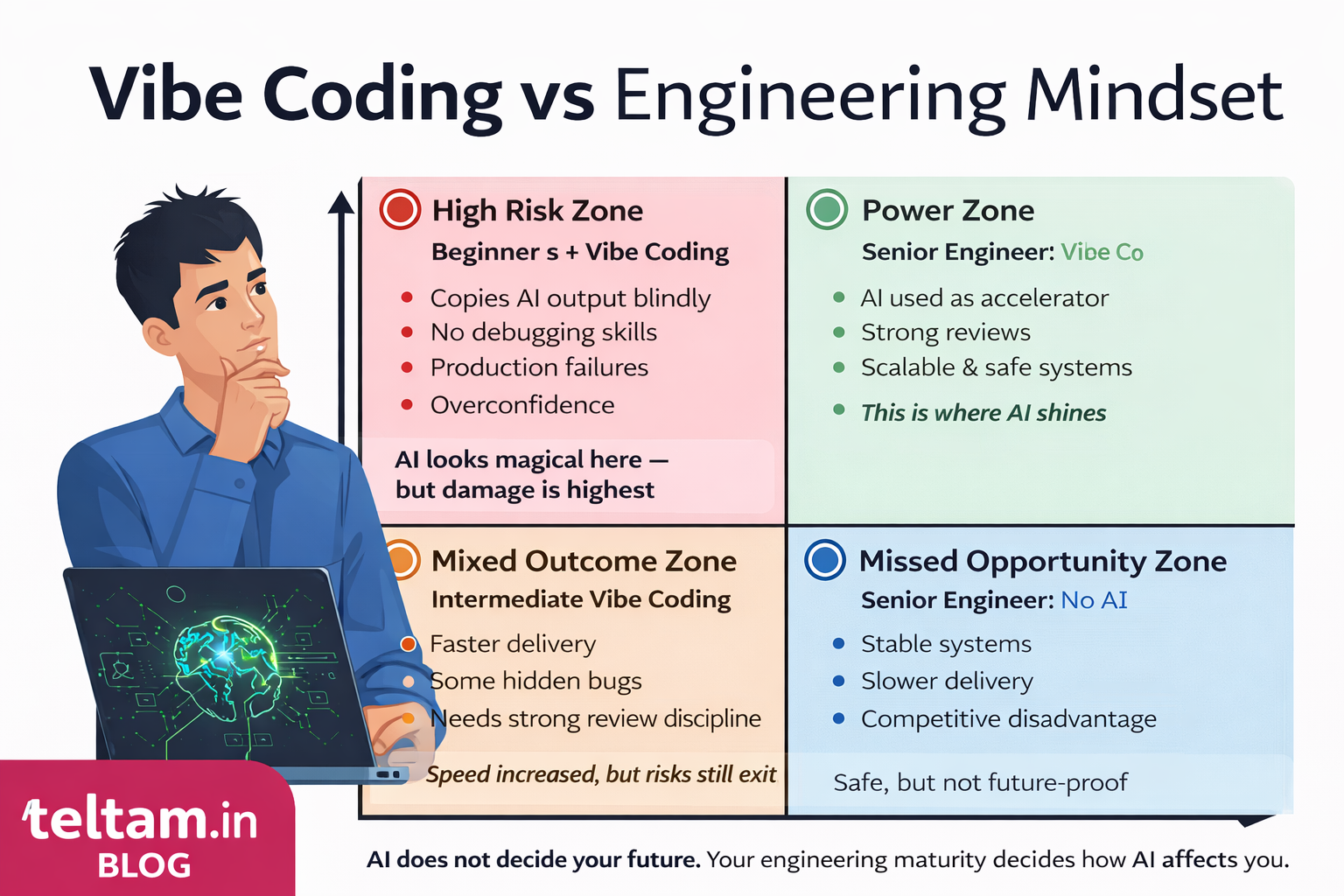
AI can generate code, write content, and automate tasks. But AI does not fully understand:
- Business context
- Trade-offs
- Real-world constraints
- Responsibility and ethics
Humans with strong engineering thinking:
- Ask better questions
- Validate AI outputs
- Design better systems using AI
- Use AI as an assistant, not a replacement
This is why AI replaces tasks, not thinkers.
How Engineering Thinking Connects Maths, Excel, and AI
At first glance, Maths, Excel, and AI may look like separate topics. In reality, they are deeply connected through engineering thinking.
- Maths trains logical reasoning and pattern recognition
- Excel teaches data organization, formulas, and problem-solving with constraints
- AI builds on data, logic, and models to solve complex problems
When learners skip fundamentals and jump directly to AI tools, they struggle. When they build engineering thinking step by step, AI becomes easier to understand and apply.
Real-World Example
Consider a simple business problem: sales are declining.
A tool-focused approach might immediately try:
- An AI dashboard
- A prediction model
- A new analytics tool
An engineering-thinking approach starts with:
- Understanding what exactly is declining
- Identifying possible causes
- Checking data quality
- Testing simple assumptions
Only after this does AI become useful.
Engineering Thinking as a Career Skill
Job roles may change, but thinking skills compound.
Professionals with engineering thinking:
- Learn faster
- Adapt to new technologies
- Communicate better with teams
- Make sound decisions under uncertainty
This mindset is valuable for software engineers, data engineers, managers, students, and anyone working with technology.
Conclusion
In a world obsessed with tools, engineering thinking is a quiet advantage.
If you focus on building the right mindset, tools like AI, Excel, or future technologies will naturally fall into place. This is why strong foundations matter more than trends.
Engineering thinking is not optional anymore — it is the skill that outlives tools.
This blog is part of the learning journey shared through SomethingTalk1 and teltam.in, focused on clarity, fundamentals, and long-term growth.