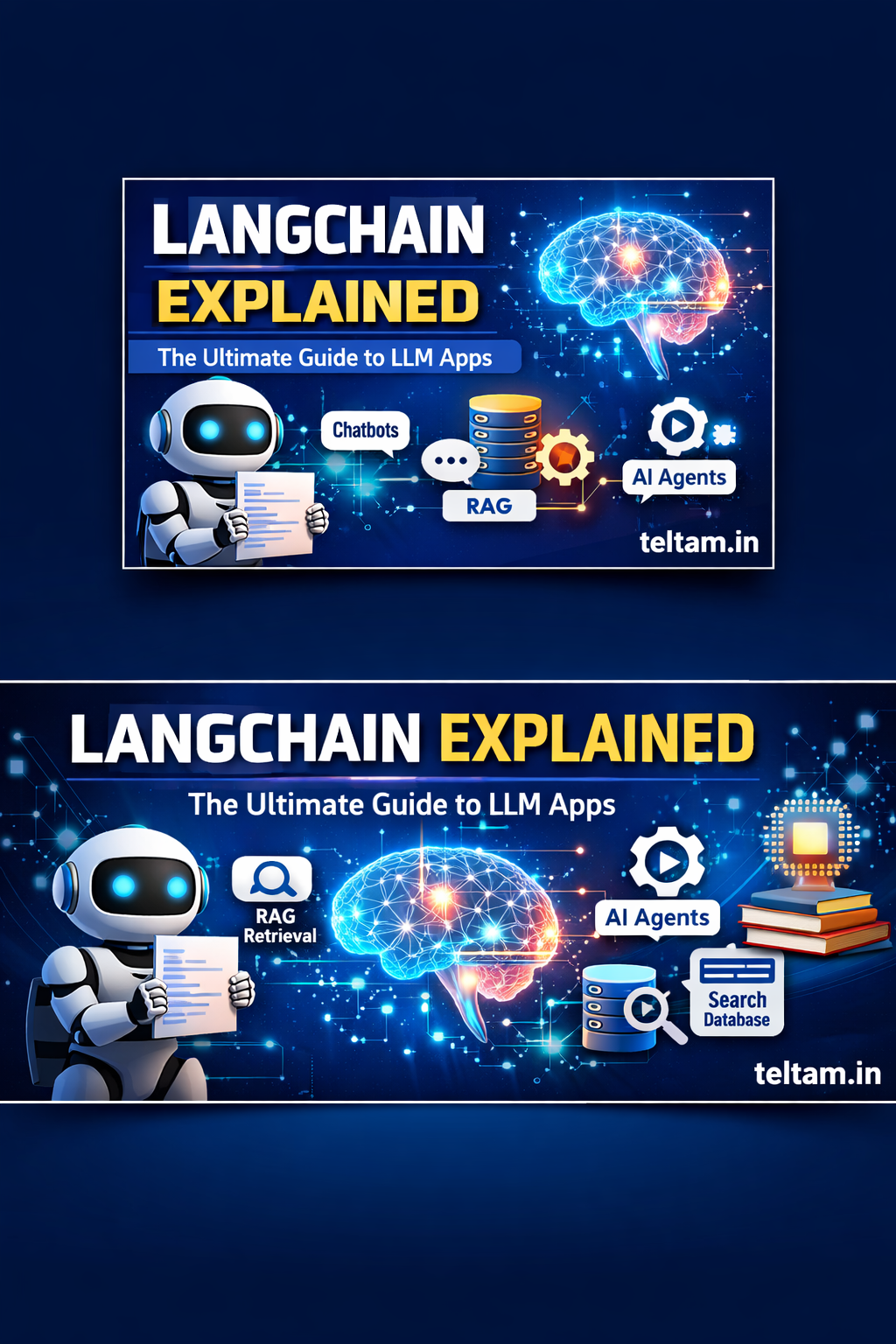
If you're building AI applications today, you've probably heard of LangChain. But what exactly is it, and why is everyone talking about it?
In this guide, we’ll break down LangChain in a simple, practical way — so you can start building real-world AI systems.
What is LangChain?
LangChain is a framework for building applications powered by Large Language Models (LLMs) like ChatGPT.
Instead of just sending prompts to an AI model, LangChain helps you build:
- Smart chatbots
- AI agents
- Document-based Q&A systems (RAG)
- Multi-step AI workflows
In short: LangChain connects AI models with real-world data and logic.
Core Components of LangChain
LangChain is built using several key building blocks:
1. Models
These are the AI brains (OpenAI, Anthropic, etc.).
LangChain does not create models — it connects to them.
Prompts
Prompts are the instructions you send to the AI.
Example:
"Explain {topic} in simple terms"
You can reuse and standardize prompts using templates.
Chains
A chain is a fixed pipeline:
Prompt → Model → Output
Example use cases:
- Translation
- Summarization
- Content generation
Simple and predictable.
Memory
Memory allows AI to remember previous conversations.
Without memory:
User: My name is Ravi
AI: I don’t know your name
With memory:
AI: Your name is Ravi
This is essential for chatbots.
Tools
Tools are external functions the AI can use:
- APIs
- Database queries
- Calculations
Tools give AI real-world capabilities.
Agents
Agents are the most powerful feature.
They can:
- Decide what to do
- Choose tools
- Solve multi-step problems
Think of agents as AI decision-makers.
Chain vs Agent (Key Difference)
| Feature | Chain | Agent |
|---|---|---|
| Flow | Fixed | Dynamic |
| Control | Developer | AI Model |
| Tools | Limited | Multiple |
| Complexity | Simple | Advanced |
Use Chains for simple tasks and Agents for intelligent systems.
What is RAG (Retrieval-Augmented Generation)?
RAG is one of the most important concepts in modern AI.
How it works:
- Convert documents into embeddings
- Store them in a vector database
- Retrieve relevant data
- Send it to the AI
This allows AI to answer questions using your own data.
Embeddings & Vector Stores
- Embeddings → Convert text into numbers
- Vector Stores → Store and search those numbers
This enables semantic search (understanding meaning, not just keywords).
Prompt Templates
Instead of writing prompts again and again, use templates:
"Explain {topic} to a beginner"
Benefits:
- Reusable
- Consistent
- Easy to maintain
Multi-Turn Conversations
- LangChain supports conversations that remember context using:
- Chat models
- Memory
- Chains or Agents
- This makes AI feel more human.
Sequential Chains (Multi-Step AI)
- Example workflow:
- Generate blog outline
- Expand into full article
- Useful for automation and content generation.
Output Parsers
- AI usually returns plain text. Output parsers convert it into:
- JSON
- Lists
- Structured data
- Essential for building real applications.
Callbacks (Monitoring)
- Callbacks help you:
- Debug AI workflows
- Track performance
- Stream responses
Switch Between AI Models Easily
- LangChain lets you switch between:
- OpenAI
- Anthropic
- Groq
- No major code changes required.
LCEL (LangChain Expression Language)
- Modern way to build pipelines:
- chain = prompt | model | parser
- Clean, readable, and powerful.
Runnables
- Everything in LangChain is a “Runnable”:
- Prompts
- Models
- Parsers
- Makes pipelines flexible and modular.
Final Thoughts
- LangChain is not just a library — it's the foundation for building real AI systems.
- It helps you move from:
No, it is not making Simple AI calls
Yes it is making Intelligent, multi-step, real-world applications
One-Line Summary
- LangChain = The bridge between AI models and real-world applications.
If you're serious about AI development:
- Start building a simple chatbot
- Try a RAG-based document Q&A system
- Explore AI agents
- Want hands-on tutorials?
Check out:
Our AI learning series on SomethingTalk1 youtube channel - Link is https://youtube.com/playlist?list=PLaxFq-s26sqB08V28Rlyz0-xuDfvDNffH&si=7vuYVy4RPrM7EHcJ
Stay tuned for more deep-dive tutorials on Agentic AI, RAG, and real-world AI systems.