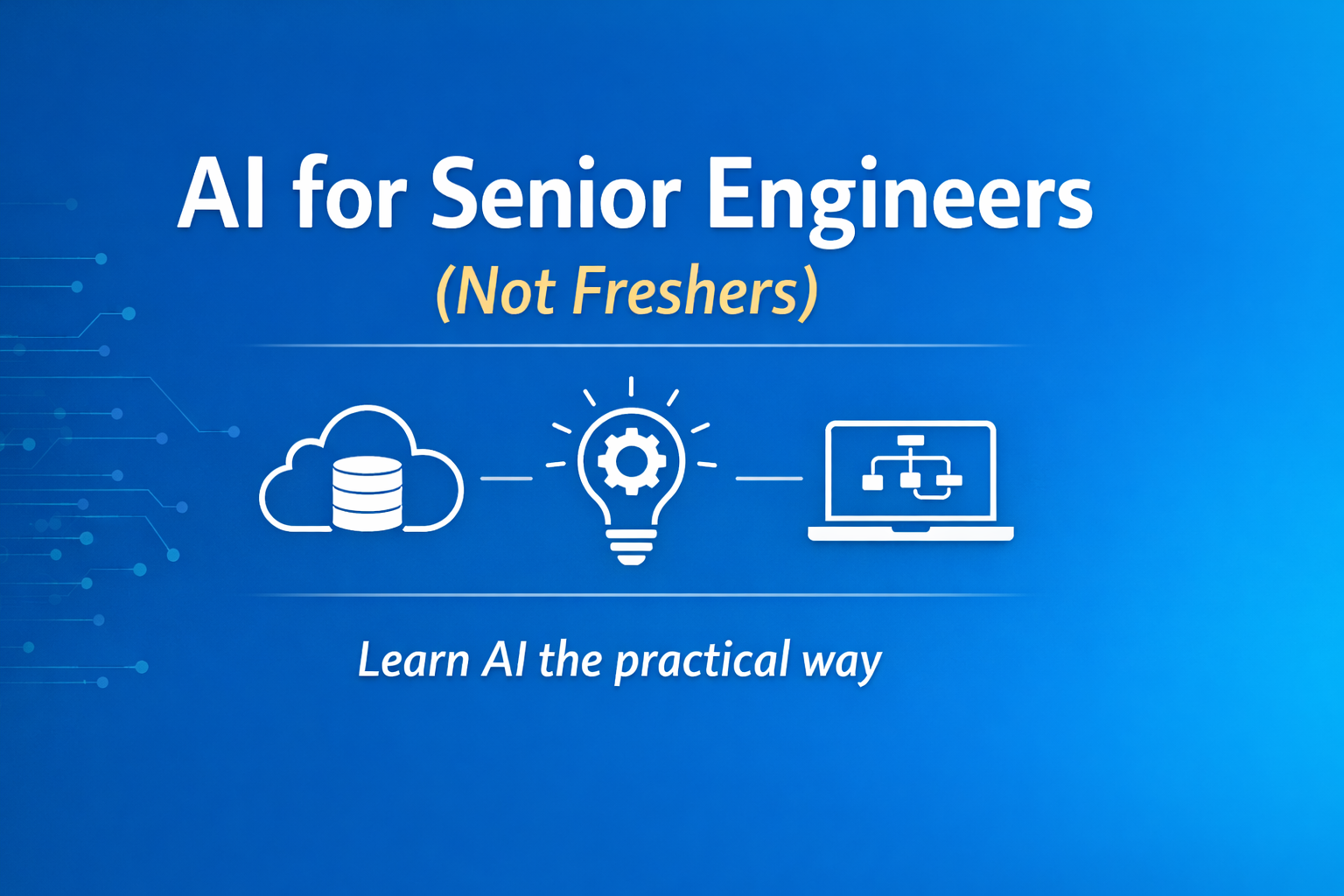
Why Senior Engineers Should Learn AI Differently (Not Like Freshers)
If you have 10, 15, or even 20+ years of experience in software, data, or IT systems, AI probably gives you mixed feelings.
On one hand, everyone is talking about AI — tools, prompts, agents, copilots, models.
On the other hand, you might be thinking:
- Do I really need to learn all this now?
- Am I already late?
- Why does AI learning feel disconnected from real projects?
Let’s start with a simple truth:
Senior engineers should NOT learn AI the same way freshers do.
This is not a limitation.
This is actually your biggest advantage.
The Real Problem: AI Learning Is Built for Beginners
Most AI courses, tutorials, and YouTube videos are designed for freshers and early-career engineers.
They focus heavily on:
- Algorithms
- Model training
- Accuracy scores
- Math-heavy explanations
- Tool-by-tool walkthroughs
For a fresher, this approach makes sense. They are still building technical foundations.
But for senior engineers, this creates:
- Confusion
- Frustration
- Self-doubt
- A false feeling of “I’m behind”
You don’t struggle with AI because you’re incapable.
You struggle because the learning path is not designed for your experience level.
Diagram 1: Fresher vs Senior AI Learning
Freshers Senior Engineers----------------------------------------------------Learn algorithms | Apply judgmentTrain models | Design systemsFocus on accuracy (%) | Focus on business impactTool-centric learning | Architecture-centric thinkingOne problem → one model | End-to-end flow thinkingFreshers learn how AI works.
Senior engineers must learn where AI fits.
That single difference changes everything.
What Senior Engineers Already Have (That AI Can’t Replace)
Before learning anything new, it’s important to recognize what you already bring.
As a senior engineer, you already understand:
- How real systems behave in production
- Why data is always messy
- How requirements change mid-project
- How failures actually happen
- How stakeholders think
- Why “perfect accuracy” is rarely the goal
These are not weaknesses.
These are AI superpowers.
AI does not replace experience.
AI amplifies experience.
Diagram 2: Where AI Really Fits in Real Projects
Data Sources ↓Data Ingestion & Validation ← 70–80% engineering effort ↓Clean & Reliable Data ↓AI / ML / GenAI Components ← 5–10% effort ↓Applications & Decisions ↓Monitoring, Cost, Governance ← Senior judgmentNotice something important.
AI is not the center of the system.
Data quality, reliability, cost, and governance are.
This is why senior engineers are more valuable than ever in the AI era.
Step-by-Step: How Senior Engineers Should Learn AI
Let’s make this practical.
Here is a step-by-step approach that actually works for experienced professionals.
Step 1: Learn AI Concepts, Not AI Mathematics
You do not need to:
- Derive algorithms
- Train models from scratch
- Compete with data scientists
You do need to understand:
- What AI can do
- What AI cannot do
- Why models fail
- Why hallucinations happen
- Where risks come from
Think like an architect, not a researcher.
Step 2: Connect AI to Systems You Already Know
Instead of asking:
“How does this model work?”
Ask:
“Where does this fit in my existing system?”
Examples:
- Can GenAI assist analysts instead of replacing them?
- Can AI improve data validation?
- Can automation reduce manual effort without increasing risk?
This shift in thinking is critical.
Step 3: Learn Prompt Thinking (Not Prompt Tricks)
Prompting is not magic.
It is simply structured thinking expressed in natural language.
Senior engineers are already good at:
- Writing clear requirements
- Explaining edge cases
- Asking the right questions
Prompting is just another interface — nothing more.
Step 4: Focus on AI Readiness, Not AI Models
Most AI initiatives fail before AI even starts.
Common reasons:
- Poor data quality
- No ownership
- No monitoring
- No cost controls
- No governance
Senior engineers should focus on:
- Data contracts
- Validation rules
- Auditability
- Monitoring and controls
This is where real enterprise value is created.
Diagram 3: Wrong vs Right AI Learning Path
Wrong Path Right PathChasing tools | Understanding use casesCopying demos | Designing workflowsModel obsession | Data & decision focusFear of falling behind | Calm, confident learningAI rewards clarity, not panic.
A Real Enterprise Perspective
In large enterprise programs, AI is rarely the starting point.
First comes:
- Data standardization
- Stable pipelines
- Reliable features
- Governance
Only after this does AI make sense.
Many successful AI initiatives succeed not by adding complexity, but by removing it.
This is exactly where senior engineers excel.
Why This Is the Philosophy Behind teltam.in
teltam.in was created with one clear belief:
Experienced engineers don’t need hype. They need clarity.
The goal is not to turn you into a data scientist.
The goal is to help you:
- Understand AI foundations
- Apply AI practically
- Speak confidently about AI
- Make better technical and architectural decisions
AI should feel like a natural extension of your experience, not a threat to it.
Final Thought
If you are a senior engineer feeling uncertain about AI, remember this:
You are not behind.
You are just learning from the wrong angle.
Learn AI the way a senior engineer should:
- Calmly
- Practically
- System-first
That’s how AI becomes a career accelerator, not a career risk.
Explore more practical AI learning at → teltam.in