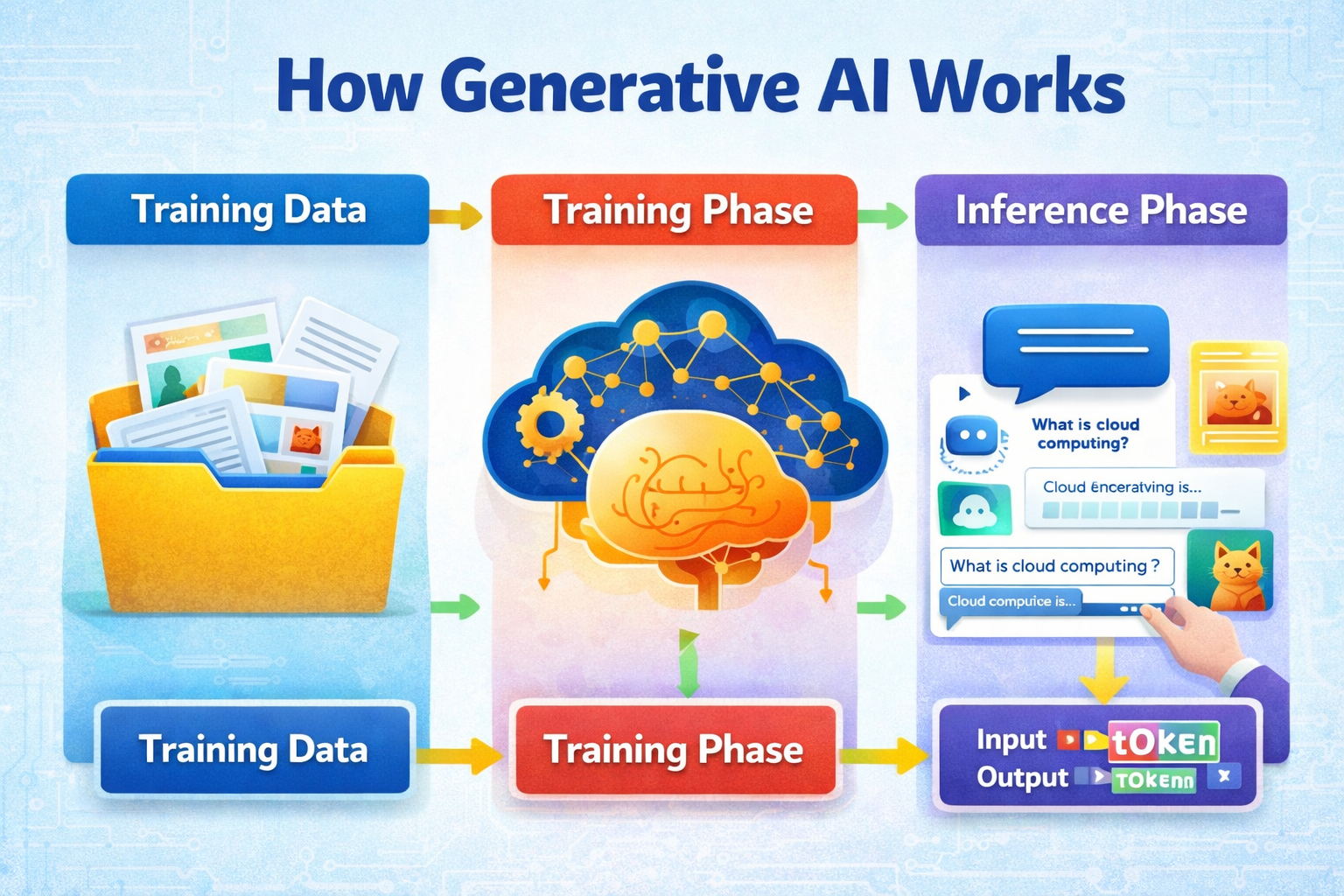
How Generative AI Works – Explained Simply
Generative AI is everywhere today — ChatGPT, image generators, coding assistants, voice tools, and more. But many people still ask the same question:
How does Generative AI actually work?
This blog explains Generative AI in a simple, engineering-friendly way, without hype, heavy maths, or marketing jargon.
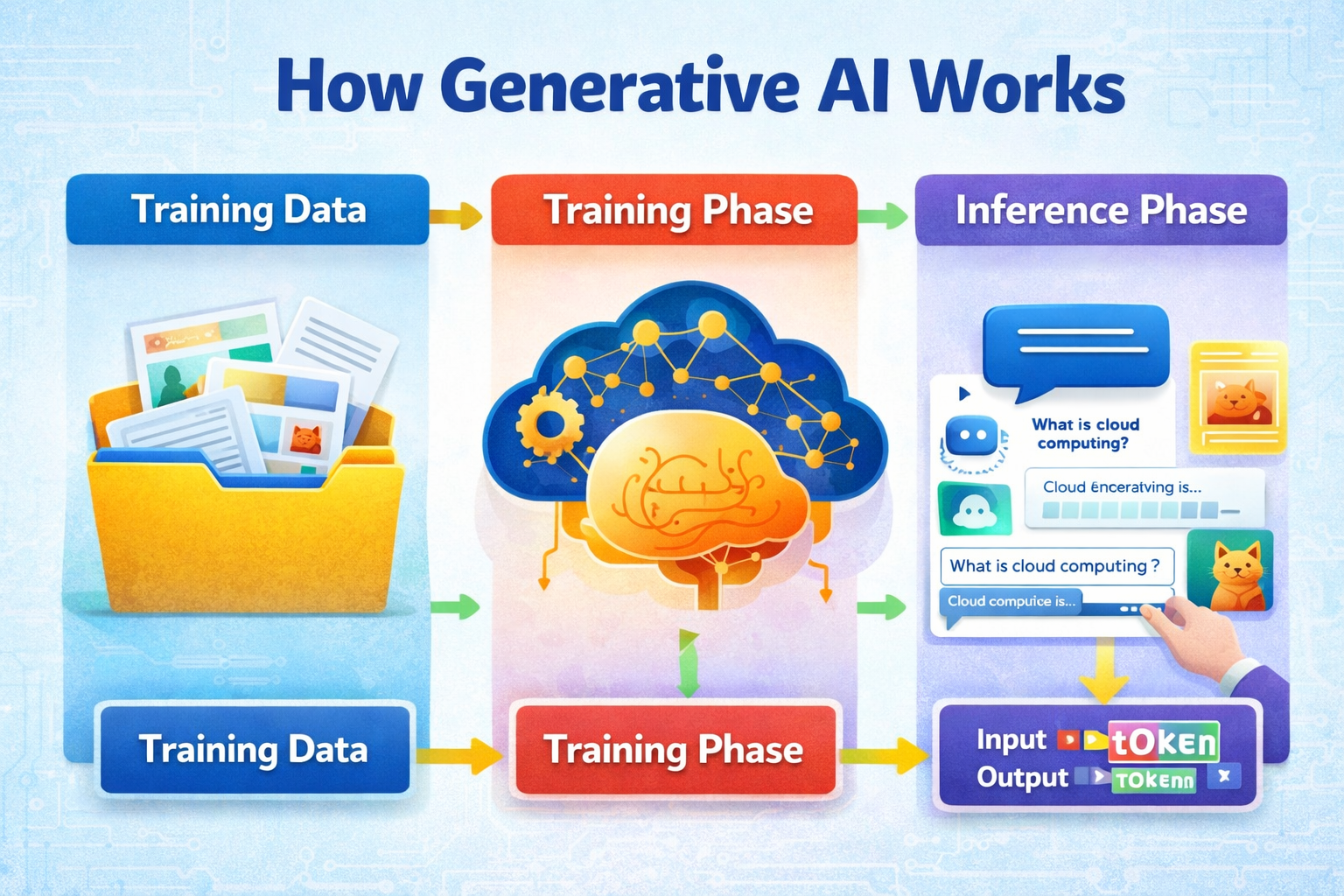
What is Generative AI?
Generative AI is a type of Artificial Intelligence that can create new content instead of just analyzing existing data.
It can generate:
- Text (ChatGPT, Gemini)
- Images (DALL·E, Midjourney)
- Code (GitHub Copilot)
- Audio & video
The key word is “generate” — it produces new outputs that did not exist before.
How is Generative AI different from Traditional AI?
Traditional AI is mostly about prediction and classification.
Examples:
- Will this customer churn?
- Is this email spam or not?
- Is this image a cat or a dog?
Generative AI goes one step further:
It doesn’t just decide — it creates.
Instead of answering yes/no, it creates sentences, images, or code based on learned patterns.
The Core Idea: Learning Patterns from Data
At its heart, Generative AI is trained on large amounts of data.
For text models:
- Books
- Articles
- Code
- Conversations
The model does not memorize content like a database.
Instead, it learns:
- Language patterns
- Relationships between words
- Probability of one word following another
Think of it like this:
A student who studied millions of examples and learned how language flows, not exact answers.
Training Phase – How the Model Learns
Training is the most expensive and time-consuming part.
What happens during training?
- The model reads text one token at a time
- It tries to guess the next token
- It checks if the guess is right or wrong
- It adjusts itself slightly
- This repeats billions of times
This process is called learning from errors.
Over time, the model becomes very good at predicting what comes next.
Tokens – The Building Blocks
Generative AI doesn’t read words like humans.
It reads tokens, which can be:
- Parts of words
- Full words
- Symbols
For example:
- "Engineering" → might become
Engineering
The model works by predicting the next token, one step at a time.
Inference Phase – When You Ask a Question
When you type a prompt like:
“Explain Generative AI simply”
The model:
- Converts your prompt into tokens
- Looks at patterns learned during training
- Predicts the most likely next token
- Adds it to the response
- Repeats until the answer is complete
Important point:
The model does not “know” the answer — it predicts it.
Why the Output Feels Intelligent
Generative AI feels intelligent because:
- It was trained on massive human-created content
- It captures structure, tone, and reasoning patterns
- It maintains context across tokens
But it is still:
- Not conscious
- Not aware
- Not thinking like a human
It is pattern intelligence, not human intelligence.
What is a Prompt?
A prompt is simply input text given to the model.
Good prompts:
- Provide context
- Are specific
- Guide the response
Bad prompts:
- Are vague
- Lack clarity
Prompting is important because:
The model can only work with what you give it.
Hallucinations – When AI Sounds Confident but Is Wrong
Sometimes Generative AI gives wrong answers confidently.
This happens because:
- It predicts based on probability
- It does not verify facts
- It fills gaps with “likely-sounding” text
This is called hallucination.
That’s why human validation is critical, especially in:
- Medical
- Financial
- Legal
- Production systems
Where Generative AI is Best Used
Generative AI is excellent for:
- Drafting content
- Brainstorming ideas
- Code assistance
- Learning support
- Summarization
It should assist humans, not replace responsibility.
Where Engineers Should Be Careful
Engineers should avoid:
- Blind trust
- Direct production usage without checks
- Using GenAI as a single source of truth
Best approach:
Human + AI > AI alone
Final Thought
Generative AI is a powerful tool, not magic.
It works because of:
- Data
- Probability
- Compute
- Engineering
When you understand how it works, you:
- Use it better
- Avoid over-dependence
- Build smarter systems
Want more?
This blog is part of the learning journey from SomethingTalk1 and Teltam.in, focused on clarity, engineering mindset, and real understanding.
If you liked this explanation, a video version is also available for visual learners.