Introduction: The Illusion of “AI Replacing Coding”
After hearing statements like:
“Training models is the new coding.”
Many engineers imagine:
- No more APIs
- No more backend logic
- No more system architecture
That is not true.
What is changing is what we build and how we build it.
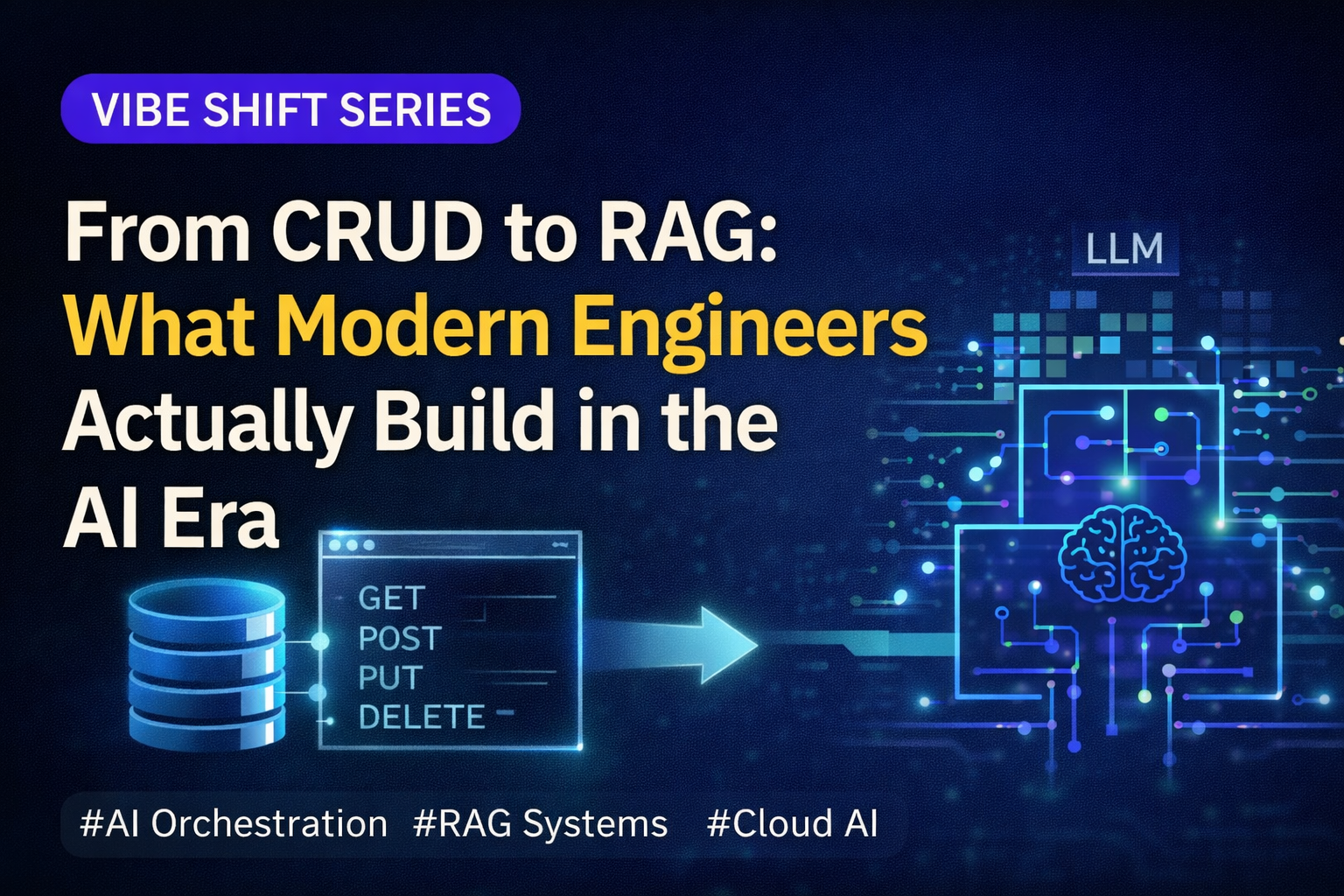
Traditional CRUD systems are no longer the center of engineering value.
AI-integrated systems are.
Let’s understand this technically.
Section 1: The Traditional CRUD Era
For many years, software engineering focused on:
- Create
- Read
- Update
- Delete
Most enterprise applications were:
Frontend
↓
API Layer
↓
Database
Business logic lived in backend services.
This model still exists.
But it is no longer the differentiator.
Section 2: Enter RAG – The Modern AI Pattern
One of the most important AI architecture patterns today is:
RAG – Retrieval Augmented Generation
Instead of hardcoding logic, we:
Store domain knowledge in a vector database
Retrieve relevant context dynamically
Feed that context into an LLM
Generate intelligent responses
Diagram 1: Traditional vs AI System
Traditional System:
User → API → Database → Response
AI System:
User → API → Orchestrator → Vector DB → LLM → Response
Notice:
There is an orchestration layer now.
That layer is where modern engineering lives.
Section 3: What Engineers Actually Build Today
Modern AI engineers build:
Prompt pipelines
Retrieval systems
Embedding workflows
Model routing logic
Guardrail systems
Feedback loops
Monitoring dashboards
Not just database queries.
Section 4: The Rise of Orchestration Frameworks
Tools like:
- LangChain
- LlamaIndex
- Semantic Kernel
Exist for one reason:
AI systems require flow control.
You are not writing a single function.
You are coordinating multiple intelligent components.
Diagram 2: Modern AI Stack
User Input
↓
API Gateway
↓
Orchestration Layer
↓
- Prompt Builder
- Retrieval Engine
- LLM
- Validation Layer
↓
Monitoring & Logging
↓
Cloud Infrastructure
This is not less engineering.
It is more complex engineering.
Section 5: Why CRUD Is No Longer Enough
If your skill set is limited to:
- REST APIs
- ORM queries
- Basic microservices
You are competing with:
- AI code generators
- Low-code platforms
- Templates
But if you understand:
- Vector search optimization
- Model latency trade-offs
- Cost per token management
- Guardrail implementation
- AI observability
You become valuable.
Section 6: Guardrails – The Hidden Layer
AI systems are probabilistic.
That means:
- Hallucinations
- Toxic outputs
- Data leakage risks
Engineers must build:
- Output validation
- Confidence scoring
- Context filtering
- Access control mechanisms
Diagram 3: AI Control Loop
User Query
↓
LLM Response
↓
Validation Layer
↓
If Valid → Return
If Risk → Regenerate / Block
This feedback loop is modern engineering.
Section 7: The Cloud + AI Connection
Modern AI systems are not local experiments.
They are deployed on:
- Azure AI Services
- AWS Bedrock
- GCP Vertex AI
- Kubernetes clusters
So engineers must understand:
- CI/CD for AI
- Model versioning
- Infrastructure scaling
- Cost monitoring
This is where your cloud knowledge becomes powerful.
Section 8: The Career Implication
The shift is not:
Coder → Unemployed
The shift is:
Coder → AI Systems Engineer
Or:
Senior Developer → AI Architect
The engineers who understand orchestration, evaluation, and cloud integration will lead.
Practical Action Steps
To stay relevant:
- Build a simple RAG application.
- Deploy it to Azure or AWS.
- Add monitoring logs.
- Implement output validation.
- Measure token cost and optimize.
This is modern hands-on engineering.
Final Thought
CRUD applications built the last decade.
RAG systems and AI orchestration will shape the next decade.
If Part 1 was about mindset shift,
Part 2 is about technical shift.
Engineering is not shrinking.
It is evolving into AI system design.
This is the real VibeShift.