
Introduction
Modern AI applications such as semantic search, recommendation systems, and intelligent chatbots need to understand the meaning of text, not just match keywords.
Traditional search systems rely on exact word matching, which often produces poor results.
Companies like OpenAI and Google solve this problem using Vector Embeddings.
In this article, we will understand:
- The problem with keyword search
- How vector embeddings solve it
- A practical example
- Python code implementation
- System diagrams
Problem
- Consider a simple search system.
User Query
car repairDocuments in the system
1. automobile maintenance guide
2. how to fix a bike
3. cooking recipes
A traditional keyword search system may not return document 1, because the word car is not present.
But humans understand that:
car ≈ automobileThis is the semantic understanding problem.
The Solution: Vector Embeddings
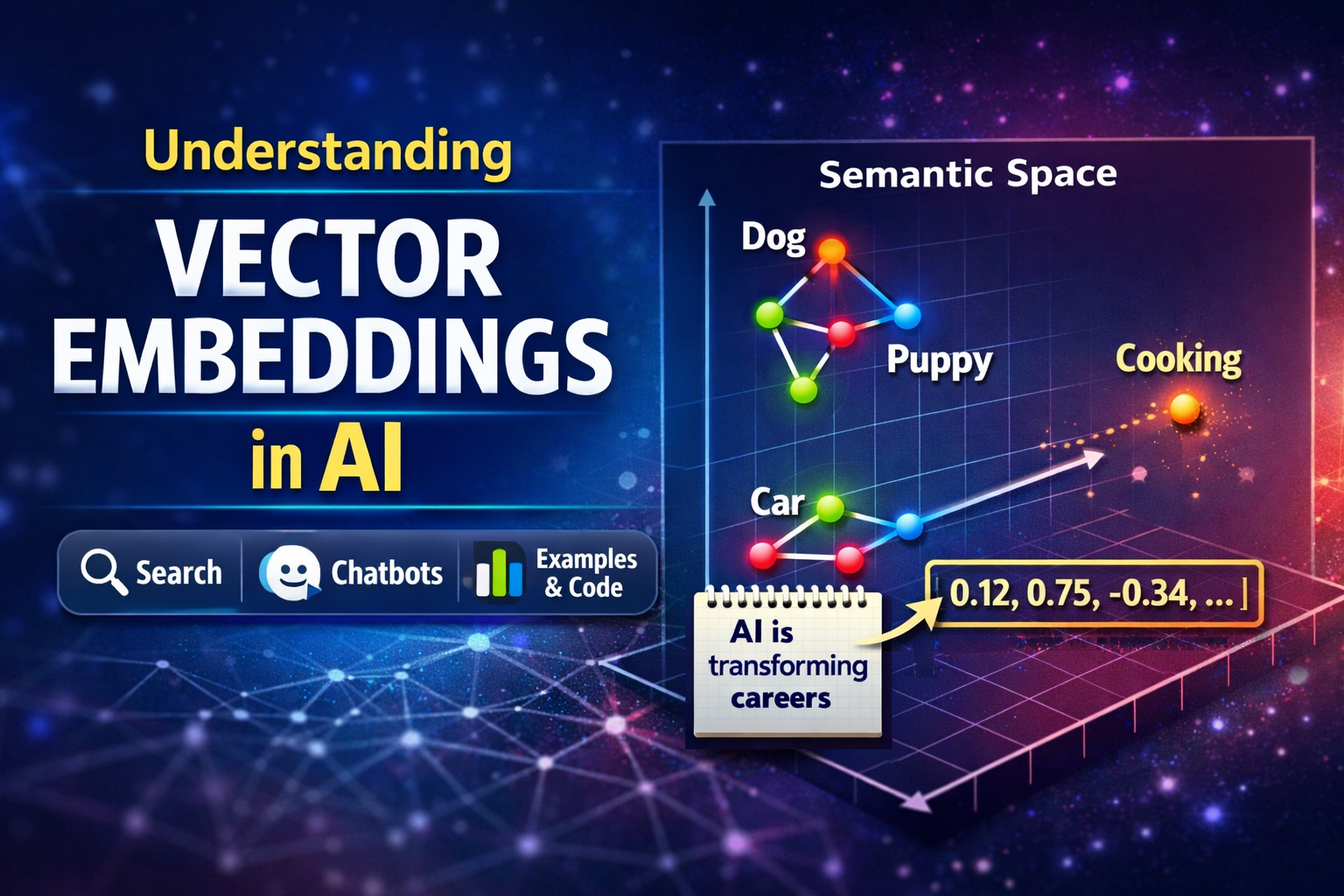
Vector embeddings convert text into numerical vectors that represent meaning.
Example:
car → [0.21, -0.78, 0.44, ...]
automobile → [0.19, -0.80, 0.40, ...]
bike → [-0.55, 0.33, -0.91, ...]
Notice that:
car vector ≈ automobile vectorThis allows AI systems to measure similarity between meanings.
Diagram 1 – Semantic Vector Space
                animal
                   |
         dog ------ puppy
                   |
                   |
                vehicle
           car -------- automobile
                   |
                 truck
Words with similar meanings are closer together in vector space.
Example
Sentences
Sentence A: I love programming
Sentence B: Coding is my passion
Sentence C: The weather is hot today
Similarity
| Sentence Pair | Similarity |
| ------------- | ---------- |
| A vs B        | High       |
| A vs C        | Low        |
The AI system understands that programming ≈ coding.
Diagram 2 – AI Search Architecture
User Query
     |
     v
Convert Query to Embedding
     |
     v
Vector Database
(search similar vectors)
     |
     v
Retrieve Relevant Documents
     |
     v
Send Context to LLM
     |
     v
Generate Intelligent Answer
This architecture is commonly used in AI assistants and RAG systems.
Python Code Example
Below is a simple example using embeddings from OpenAI.
from openai import OpenAI

client = OpenAI()

text = "AI is transforming careers"

response = client.embeddings.create(
    model="text-embedding-3-small",
    input=text
)

embedding = response.data[0].embedding

print("Vector length:", len(embedding))
print("First 10 numbers:", embedding[:10])
Example Output
Vector length: 1536
First 10 numbers: [0.012, -0.342, 0.921, ...]
This vector represents the semantic meaning of the text.
Where Vector Embeddings Are Used
Vector embeddings are widely used in modern AI systems.
Semantic Search
Search based on meaning instead of keywords.
Chatbots
AI assistants retrieve relevant knowledge.
Recommendation Systems
Suggest similar products or movies.
Document Clustering
Group similar documents automatically.
Vector databases used for this include:
- Pinecone
- FAISS
- Weaviate
Key Takeaway
Vector embeddings allow AI systems to move from:
Keyword Matchingto
Semantic UnderstandingThis is one of the foundational technologies behind modern AI applications.
Conclusion
Vector embeddings are a powerful technique that enable machines to understand relationships between words, sentences, and documents.
They play a critical role in:
- AI search engines
- Intelligent chatbots
- Recommendation systems
- Retrieval Augmented Generation (RAG)
Understanding embeddings is an important step for anyone building modern AI applications.