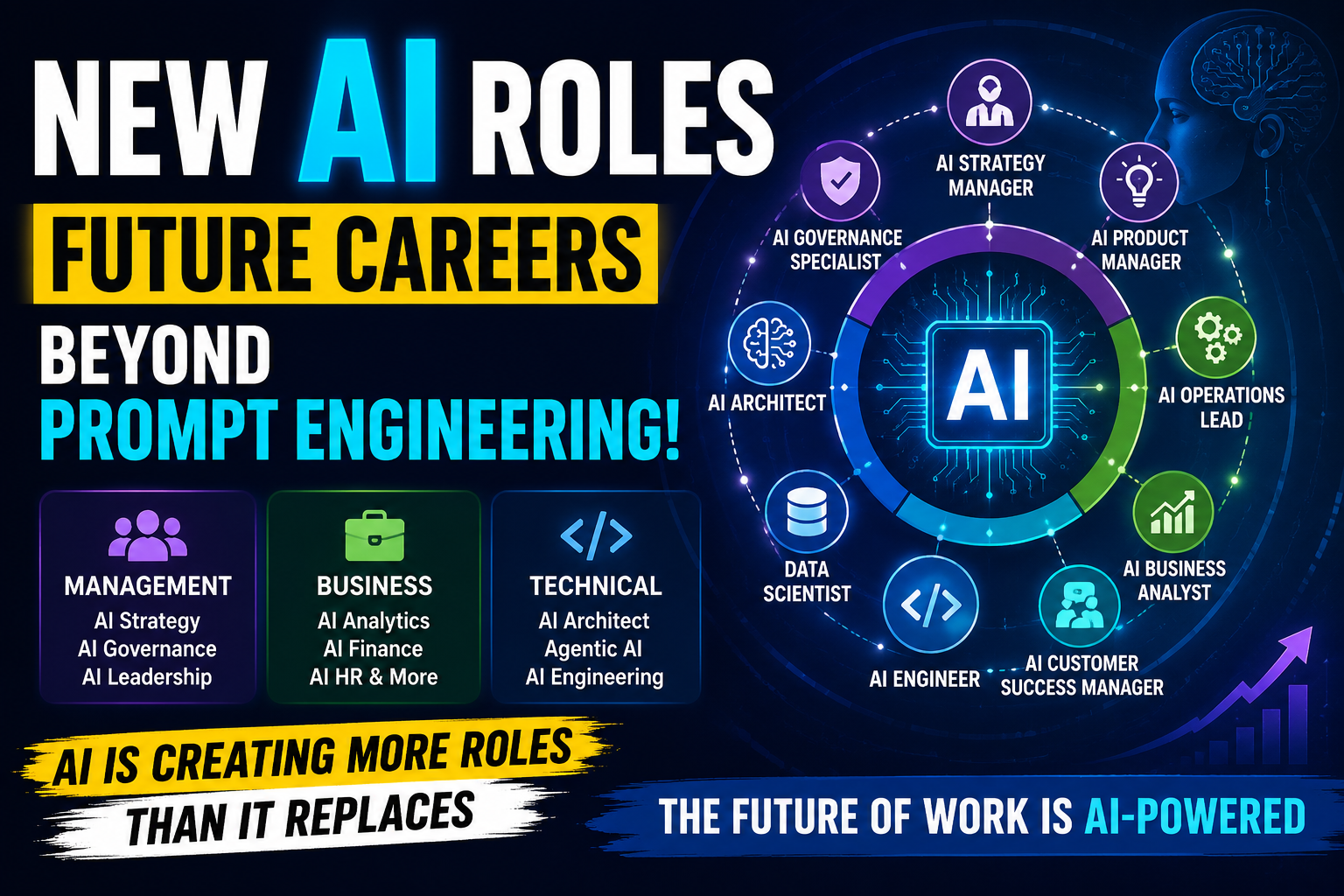
Artificial Intelligence is no longer limited to research labs, science fiction movies, or isolated machine learning teams. Today, AI is transforming how enterprises operate, how decisions are made, and how businesses compete in the digital economy.
Most people still associate AI careers with only a few roles such as:
- Data Scientist
- Machine Learning Engineer
- Prompt Engineer
However, the reality is very different.
AI is creating an entirely new ecosystem of roles across:
- Management
- Business Operations
- Technical Engineering
- Governance
- Compliance
- Strategy
- Customer Operations
- Cybersecurity
- Automation
This transformation is not theoretical anymore. Enterprises across the world are actively restructuring teams around AI capabilities.
The future will not belong only to people who know how to use AI tools.
It will belong to people who understand how to integrate AI into real business systems.
AI Is Becoming a Business Layer — Not Just a Technology
In the early stages of digital transformation, organizations created:
- software teams
- infrastructure teams
- cloud engineering teams
Now enterprises are creating:
AI-native organizations.
This means AI is becoming embedded into:
- decision-making
- operations
- customer engagement
- automation
- compliance
- analytics
- strategy
As a result, completely new job categories are emerging.
Evolution of AI Roles Across Organizations
AI Roles Across Enterprise Layer
MANAGEMNT:
| Chief AI Officer | AI Strategy Manager | Head of AI |
| AI Product Manager | AI Operations Lead | |
| Responsible AI Lead | AI Governance Specialist |
BUSINESS
| AI HR Analyst | AI Financial Analyst |
| AI Compliance Analyst | AI Customer Success Manager |
| AI Payroll Specialist | AI Auditor |
TECHNICAL
| AI Architect | ML Engineer | Prompt Engineer |
| Agentic AI Developer | Data Engineer | |
| AI Platform Architect | AI Automation Engineer | |
| AI Security Analyst | AI Application Developer |
This shift clearly shows that AI is no longer confined to technical departments alone.
Every business function is now becoming AI-enabled.
The Three Major Categories of Future AI Roles
1. Management-Level AI Roles
These roles focus on:
- strategy
- governance
- transformation
- enterprise AI adoption
Examples
Chief AI Officer (CAIO)
Responsible for:
- enterprise AI vision
- governance
- organizational transformation
- AI adoption strategy
This role is becoming increasingly important in large enterprises.
AI Strategy Manager
Focuses on:
- aligning AI with business goals
- identifying AI opportunities
- AI transformation roadmaps
AI Operations Lead
Responsible for:
- monitoring AI systems
- operational stability
- AI deployment workflows
- production governance
Responsible AI Lead
Focuses on:
- fairness
- ethics
- compliance
- bias reduction
- regulatory alignment
As governments begin regulating AI systems, these roles will grow significantly.
Business-Focused AI Roles
This is one of the most underrated transformations happening right now.
AI is entering:
- HR
- Finance
- Customer Support
- Compliance
- Auditing
- Analytics
AI HR Business Partner
Future HR systems will increasingly use AI for:
- talent analysis
- hiring optimization
- workforce analytics
- employee engagement
Professionals who understand both HR and AI will become highly valuable.
AI Financial Reporting Specialist
AI will automate:
- financial summaries
- anomaly detection
- forecasting
- reporting analysis
Finance professionals with AI understanding will gain a major advantage.
AI Customer Success Manager
Companies are now integrating:
- AI chat systems
- recommendation systems
- intelligent customer analytics
This creates demand for professionals who can manage AI-driven customer operations.
Technical AI Roles
This is currently the most visible category.
However, even within technical roles, the industry is evolving rapidly.
Traditional AI Roles
These include:
- Data Scientist
- ML Engineer
- Analytics Engineer
- Data Engineer
These roles continue to remain important.
New-Generation AI Roles
The most exciting shift is happening here.
AI Architect
This role focuses on:
- AI system design
- orchestration
- integration
- scalable AI infrastructure
AI Architects combine:
- cloud
- APIs
- AI models
- automation
- business workflows
This is becoming one of the highest-value AI roles.
AI Platform Architect
Responsible for:
- AI deployment frameworks
- enterprise AI infrastructure
- agent orchestration
- AI platform scalability
As organizations adopt multiple AI systems, platform architecture becomes critical.
Prompt Engineer
Prompt engineering became popular during the rise of generative AI.
However, prompt engineering alone may not remain a long-term standalone specialization.
Instead, prompting is becoming one capability inside larger AI engineering workflows.
Agentic AI Engineer
This is one of the fastest-growing future roles.
Agentic AI systems involve:
- autonomous workflows
- multi-agent communication
- memory systems
- planning
- reasoning
- tool orchestration
Technologies like:
- LangChain
- LangGraph
- MCP (Model Context Protocol)
- AI agents
are accelerating this transformation.
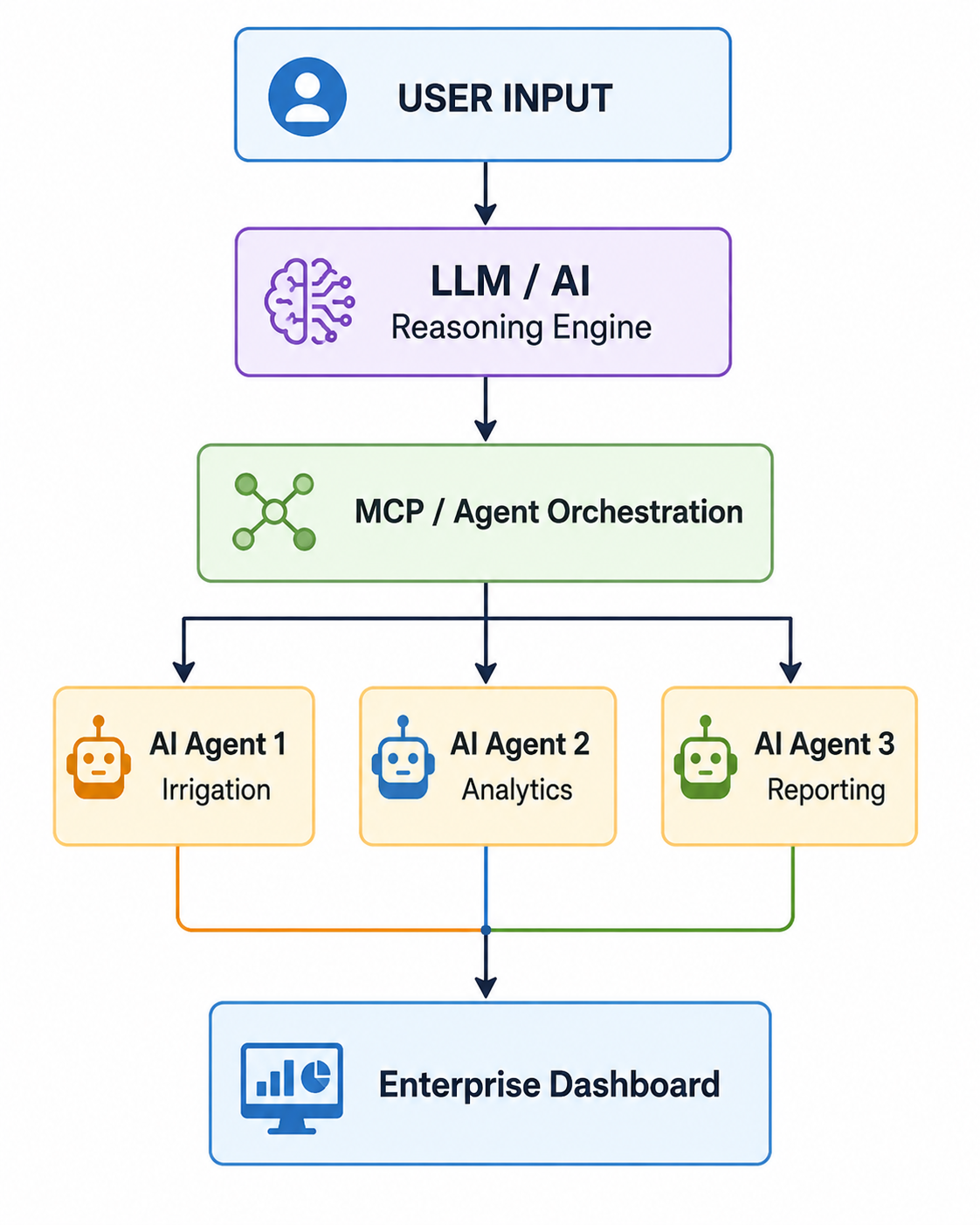
This architecture represents the future direction of enterprise AI systems.
Organizations are moving toward:
- intelligent orchestration
- autonomous workflows
- AI-driven operations
instead of isolated AI tools.
Why Experienced IT Professionals Have an Advantage
Many professionals fear AI because they assume:
“AI will replace experienced engineers.”
In reality, experienced professionals often have major advantages.
Why?
Because enterprise AI implementation requires:
- architecture thinking
- system integration
- workflow understanding
- governance
- scalability
- operational experience
These are areas where experienced professionals are extremely valuable.
AI Is Not Replacing All Jobs — It Is Reshaping Them
AI will certainly automate repetitive work.
But simultaneously, it is creating demand for:
- AI governance
- AI operations
- AI transformation
- AI integration
- AI architecture
- AI product management
The future workforce will likely consist of:
Humans working alongside intelligent AI systems.
The Rise of Domain-Specific AI
One of the biggest future opportunities lies in combining:
AI + Industry Expertise
Examples include:
- AI in Agriculture
- AI in Healthcare
- AI in Manufacturing
- AI in Finance
- AI in Education
Professionals who combine domain knowledge with AI capabilities will become highly valuable.
Final Thoughts
The AI revolution is still in its early stages.
We are moving from:
- standalone AI tools
to - AI-native enterprises.
This transformation is creating an entirely new generation of careers across:
- management
- business operations
- technical engineering
- governance
- strategy
The future will not belong only to people who build AI models.
It will belong to people who can:
- integrate AI into real systems
- solve business problems
- design scalable AI workflows
- lead AI transformation
Artificial Intelligence is no longer just a technology trend.
It is becoming the operating layer of the future enterprise.