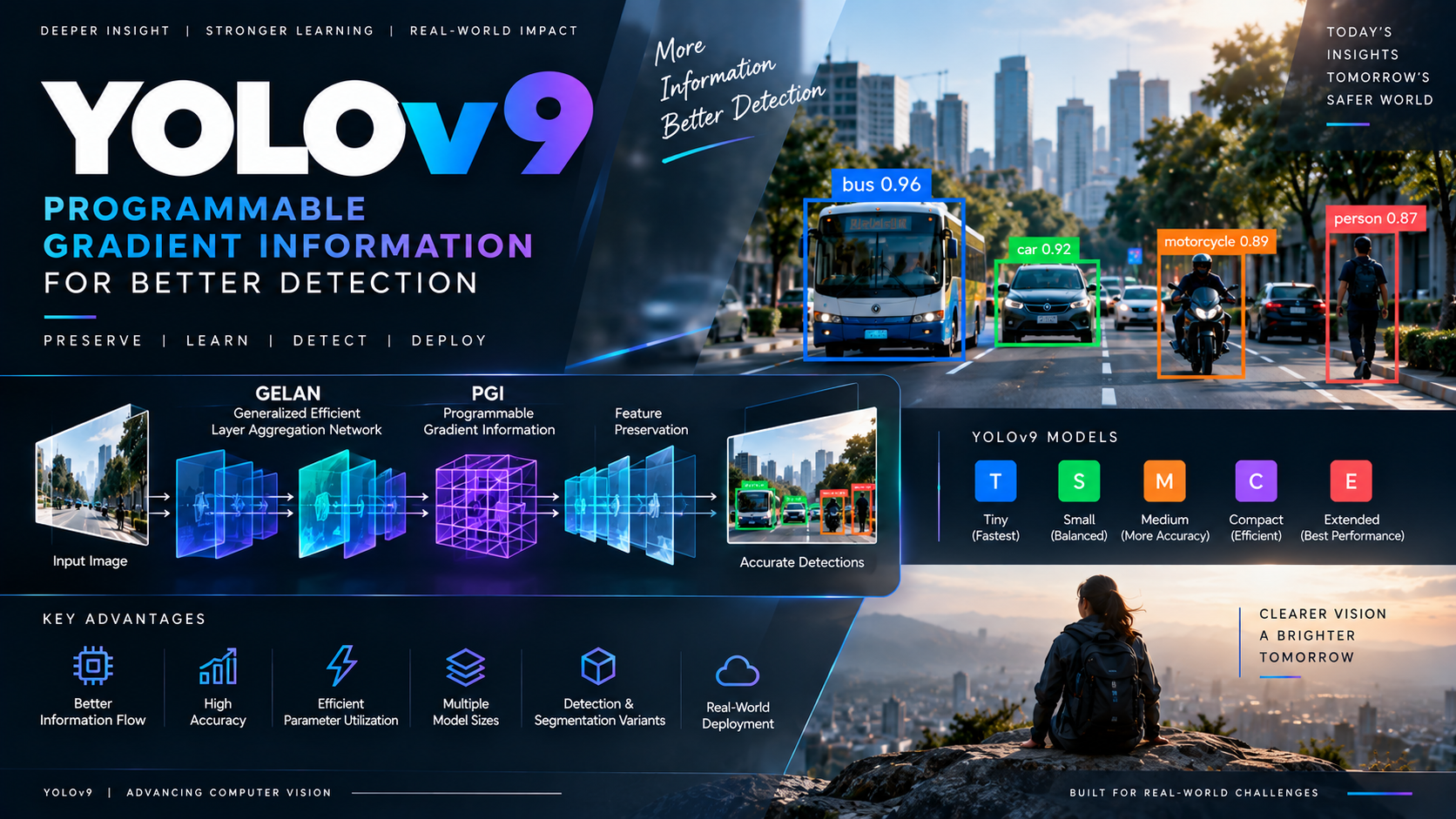
YOLOv9: Programmable Gradient Information for Better Detection
Introduction
YOLOv9 was introduced in February 2024 by Chien-Yao Wang, I-Hau Yeh, and Hong-Yuan Mark Liao. The model focused on an important challenge in deep neural networks: information loss as data passes through multiple layers.
To address this problem, YOLOv9 introduced two major concepts: Programmable Gradient Information (PGI) and the Generalized Efficient Layer Aggregation Network (GELAN).
What is YOLOv9?
YOLOv9 is a real-time object detection architecture designed to improve the relationship between accuracy, computational efficiency, and information preservation.
Instead of simply increasing the number of parameters, YOLOv9 focuses on helping the network retain important information during feature extraction and training.
The original YOLOv9 project was developed by the research team behind the YOLOv9 paper and released as an open-source project.
The Information Bottleneck Problem
As an image moves through deeper layers of a neural network, it is repeatedly transformed and compressed. During this process, some information from the original input can be lost.
This becomes particularly important for lightweight models because they have fewer parameters and computational resources available for representing complex visual information.
YOLOv9 addresses this challenge using Programmable Gradient Information.
Programmable Gradient Information (PGI)
PGI is one of the central innovations of YOLOv9.
It provides additional information during training so that the network can generate more reliable gradients and learn the target task more effectively.
The main idea is to preserve useful information throughout the learning process instead of allowing important details to disappear as the data passes through deeper layers.
PGI is particularly useful for improving the training of models with different sizes and computational requirements.
Generalized Efficient Layer Aggregation Network (GELAN)
GELAN is the main architectural innovation associated with YOLOv9.
It was designed using gradient-path planning to improve parameter utilization and computational efficiency. GELAN combines ideas from efficient layer aggregation approaches while remaining flexible enough to work with different computational blocks.
This allows YOLOv9 to extract useful features without relying simply on a large increase in model size.
YOLOv9 Architecture
The YOLOv9 design can be understood through several important components:
GELAN-Based Feature Extraction
The network uses GELAN to efficiently extract and combine visual features from the input image.
PGI Training Mechanism
PGI provides additional gradient information during training to help preserve important information and improve learning.
Multi-Scale Detection
YOLOv9 processes features at different scales, allowing it to identify objects of different sizes.
Detection Head
The detection component converts the extracted features into predictions such as bounding boxes, confidence values, and object classes.
YOLOv9 Model Variants
YOLOv9 provides several model configurations:
- YOLOv9-T – Tiny
- YOLOv9-S – Small
- YOLOv9-M – Medium
- YOLOv9-C – Compact
- YOLOv9-E – Extended
These variants allow developers to select a model according to their available computational resources and application requirements.
YOLOv9 also includes segmentation variants such as YOLOv9-C-Seg and YOLOv9-E-Seg.
Key Features of YOLOv9
- Programmable Gradient Information
- GELAN architecture
- Improved information preservation
- Efficient parameter utilization
- Multiple model sizes
- Multi-scale object detection
- Object detection and segmentation variants
- Training and deployment support
Advantages of YOLOv9
YOLOv9 provides several important advantages:
- Addresses information loss during deep feature extraction
- Improves parameter utilization
- Provides different model sizes
- Supports efficient real-time detection
- Can work with lightweight as well as larger models
- Provides segmentation variants
- Suitable for edge and high-performance computer vision systems
The original research reported strong results on the MS COCO dataset, demonstrating the efficiency of PGI and GELAN across different model scales.
Limitations
YOLOv9's larger variants require more computational resources and can take longer to train than smaller models.
As with other object detection models, real-world performance also depends on factors such as dataset quality, image resolution, object size, lighting, and the target hardware.
YOLOv8 vs YOLOv9
| Feature | YOLOv8 | YOLOv9 |
|---|---|---|
| Main focus | Multi-task computer vision | Information preservation and efficiency |
| Major architecture | C2f | GELAN |
| Major innovation | Anchor-free detection | PGI |
| Information flow | Efficient feature extraction | Focus on reducing information loss |
| Model variants | N/S/M/L/X | T/S/M/C/E |
| Tasks | Detection, segmentation, classification, pose, OBB | Detection and segmentation variants |
YOLOv9 therefore represents a different architectural direction, concentrating heavily on information flow and gradient quality during training.
Applications
YOLOv9 can be used for:
- Vehicle detection
- Traffic monitoring
- Industrial inspection
- Surveillance
- Smart-city systems
- Robotics
- Autonomous systems
- Retail analytics
- Medical image analysis
- Real-time video analytics
- Edge AI applications
Conclusion
YOLOv9 introduced a different way of improving real-time object detection by focusing on how information is preserved and learned inside the network.
Its two major innovations, Programmable Gradient Information (PGI) and GELAN, aim to improve gradient quality, parameter utilization, and computational efficiency. These ideas make YOLOv9 an important step in the evolution of modern YOLO-based object detection.
Comments (0)
No comments yet. Be the first to share your thoughts!
Join the Conversation
Please log in to your Teltam account to post a comment on this article.
Log In to Comment