YOLO11: Efficient and Versatile Vision AI
Introduction
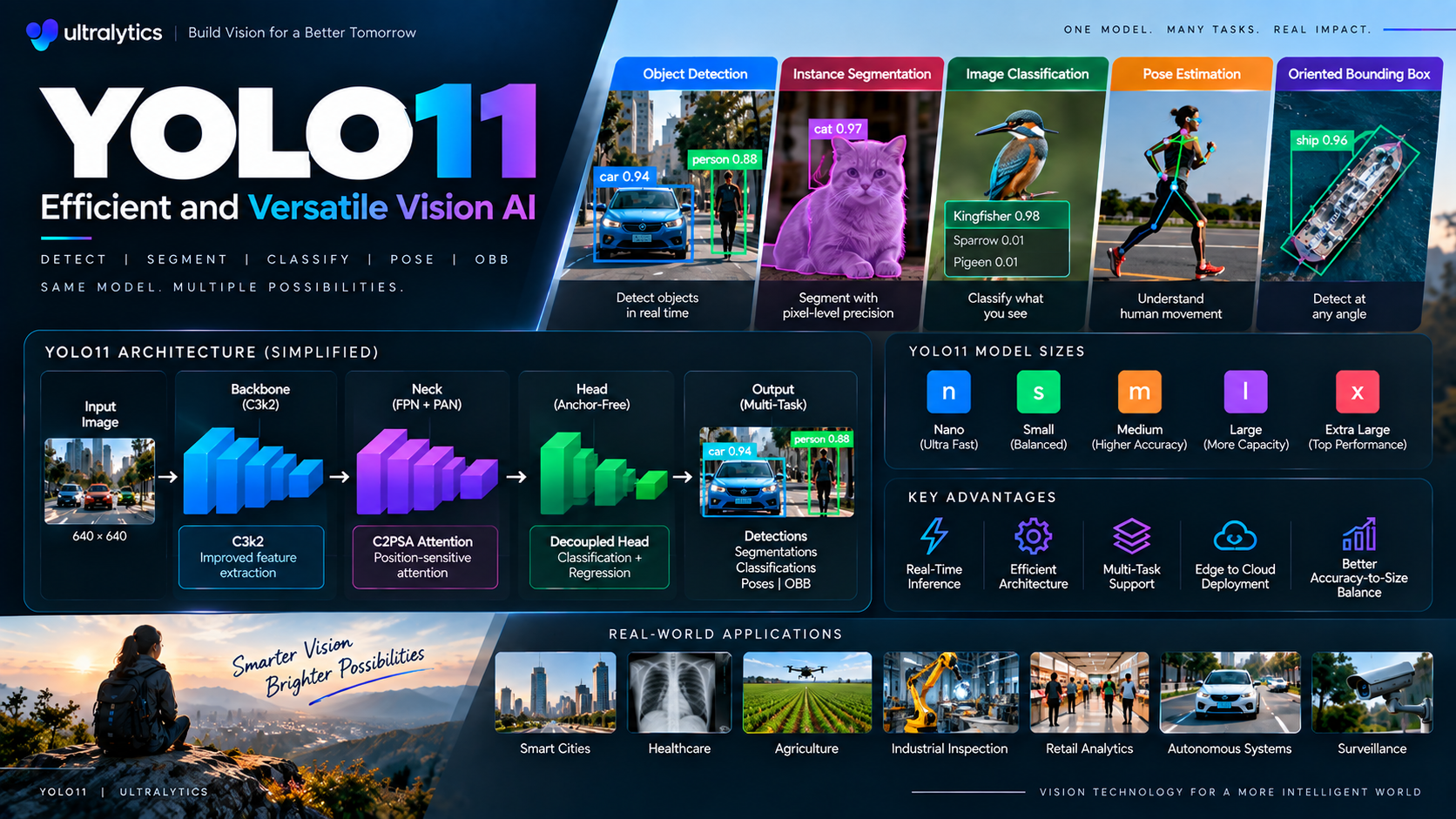
YOLO11 is an Ultralytics computer vision model released in September 2024. It builds on earlier YOLO generations with improvements aimed at achieving a strong balance between accuracy, speed, efficiency, and versatility across computer vision tasks.
Rather than focusing only on object detection, YOLO11 is designed as a broader vision framework supporting multiple tasks and deployment environments, from edge devices to cloud systems.
What is YOLO11?
YOLO11 is a modern vision model from Ultralytics designed for efficient real-time computer vision.
It supports tasks including:
- Object detection
- Instance segmentation
- Image classification
- Pose estimation
- Oriented bounding-box detection
This makes YOLO11 suitable for applications where different types of visual analysis need to be performed using a common framework.
YOLO11 Architecture
YOLO11 retains the familiar backbone → neck → head structure used throughout the YOLO family while introducing important changes to feature extraction and attention.
C3k2
YOLO11 replaces the C2f block used by YOLOv8 with the C3k2 block. C3k2 is based on the C2f design but uses more flexible internal blocks to improve feature processing and efficiency.
C2PSA Attention
YOLO11 adds C2PSA, which incorporates position-sensitive attention into the feature extraction process. This helps the network focus on useful spatial information within the feature maps.
SPPF
YOLO11 continues to use Spatial Pyramid Pooling – Fast (SPPF) to increase the receptive field and efficiently process contextual information at different spatial scales.
FPN and PAN
The neck combines information from different feature-map resolutions using feature pyramid and path aggregation approaches, helping the model detect objects of different sizes.
Anchor-Free Detection
Like YOLOv8, YOLO11 uses an anchor-free, decoupled detection head, separating classification and bounding-box regression.
Key Features of YOLO11
- C3k2-based architecture
- C2PSA attention
- Anchor-free detection
- Efficient feature extraction
- Multi-scale feature fusion
- Multiple model sizes
- Detection, segmentation, classification, pose, and OBB support
- Edge and cloud deployment support
- Improved accuracy-to-computation balance
YOLO11 Model Sizes
YOLO11 is available in several sizes, including:
- YOLO11n – Nano
- YOLO11s – Small
- YOLO11m – Medium
- YOLO11l – Large
- YOLO11x – Extra Large
These variants allow developers to select an appropriate model according to computational resources and application requirements.
Advantages of YOLO11
YOLO11 provides several practical benefits:
- Efficient real-time inference
- Improved feature extraction
- Strong accuracy-to-computation balance
- Multiple model sizes
- Support for multiple computer vision tasks
- Suitable for edge and cloud environments
- Familiar Ultralytics workflow and tooling
- Useful for both development and production applications
Ultralytics reported that YOLO11m achieves better COCO performance than YOLOv8m while using 22% fewer parameters, according to its 2024 recap.
YOLO10 vs YOLO11
| Feature | YOLOv10 | YOLO11 |
|---|---|---|
| Main focus | End-to-end detection efficiency | Versatile vision and efficiency |
| Major concept | NMS-free inference | Improved architecture and training |
| Backbone/blocks | Efficiency-focused YOLO design | C3k2 |
| Attention | — | C2PSA |
| Detection | End-to-end approach | Anchor-free detection |
| Tasks | Primarily detection | Detection, segmentation, classification, pose, OBB |
| Deployment | Real-time systems | Edge to cloud |
YOLOv10 and YOLO11 therefore emphasize different aspects of modern computer vision: YOLOv10 focused strongly on eliminating NMS-related inference overhead, while YOLO11 expanded architectural efficiency and multi-task capabilities.
Applications
YOLO11 can be used for:
- Vehicle detection
- License plate detection
- Traffic monitoring
- Industrial inspection
- Surveillance
- Medical imaging
- Retail analytics
- Agriculture
- Robotics
- Pose estimation
- Instance segmentation
- Satellite and aerial image analysis
- Smart-city systems
Its ability to support multiple vision tasks makes it suitable for applications where detection alone is not sufficient.
Limitations
Larger YOLO11 models require more computational resources than smaller variants. The choice of model size therefore depends on the available hardware, required latency, and desired accuracy.
As with other computer vision models, real-world performance also depends on the quality and diversity of the training dataset, image resolution, object size, lighting, and deployment environment.
Conclusion
YOLO11 represents another step in the evolution of the YOLO family toward efficient, flexible, multi-task computer vision.
With architectural improvements such as C3k2 and C2PSA, combined with an anchor-free detection head and support for multiple vision tasks, YOLO11 provides a unified approach for building modern computer vision applications across different hardware environments.
Comments (0)
No comments yet. Be the first to share your thoughts!
Join the Conversation
Please log in to your Teltam account to post a comment on this article.
Log In to Comment