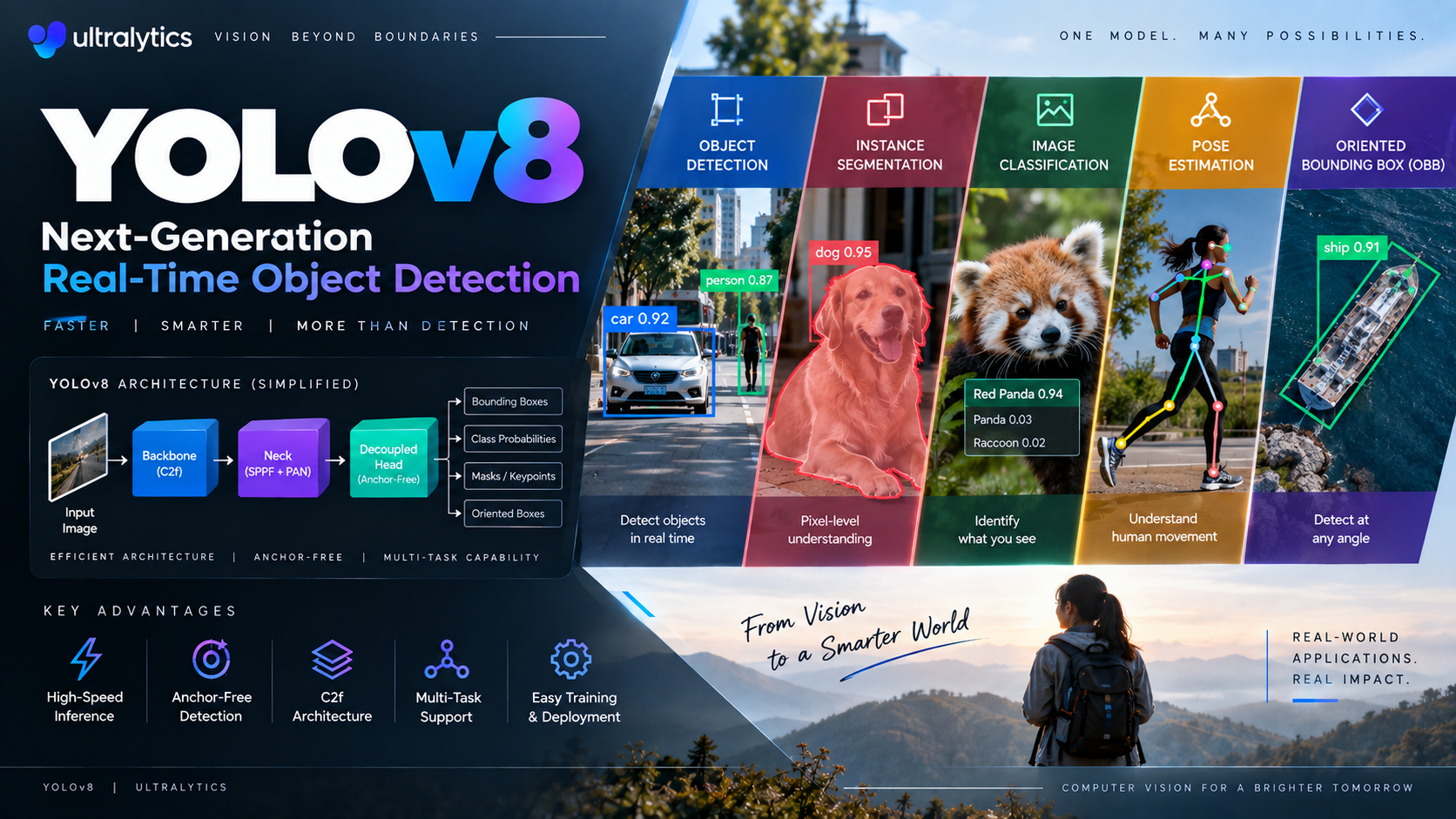
YOLOv8: Next-Generation Real-Time Object Detection
Introduction
YOLOv8 was released by Ultralytics on January 10, 2023, introducing a new architecture and a more versatile computer vision framework. It continued the YOLO focus on real-time performance while expanding support beyond traditional object detection.
YOLOv8 introduced important architectural changes such as the C2f module, an anchor-free detection head, and a decoupled head, making it a significant evolution from earlier YOLO versions.
What is YOLOv8?
YOLOv8 is a real-time computer vision model from Ultralytics designed for fast and efficient visual recognition. Unlike earlier YOLO versions that focused mainly on object detection, YOLOv8 provides a unified framework supporting object detection, image classification, instance segmentation, pose estimation, and oriented bounding boxes (OBB).
This makes YOLOv8 useful for both academic projects and production-oriented computer vision applications.
YOLOv8 Architecture
YOLOv8 introduced several changes to its network architecture.
C2f Module
The C2f module replaces the C3 block used in YOLOv5. It combines feature information from multiple internal bottleneck layers, improving feature reuse and gradient flow while maintaining computational efficiency.
Anchor-Free Detection
One of the major changes in YOLOv8 is its anchor-free detection approach. Instead of depending on predefined anchor boxes, the model predicts object locations directly from feature-map points.
Decoupled Detection Head
YOLOv8 uses a decoupled head, separating classification and bounding-box regression tasks. This design helps the model optimize these different prediction objectives more independently.
SPPF and Feature Pyramid Processing
YOLOv8 retains efficient spatial-pyramid processing and multi-scale feature extraction to help detect objects appearing at different sizes.
Key Features of YOLOv8
- Anchor-free object detection
- C2f-based architecture
- Decoupled detection head
- Distribution Focal Loss (DFL) for box regression
- Multiple model sizes
- Object detection support
- Instance segmentation
- Image classification
- Pose estimation
- Oriented bounding box detection
- Unified Python API and CLI
YOLOv8 Model Sizes
YOLOv8 is available in different sizes, allowing users to choose a model according to their available computational resources and accuracy requirements.
Common variants include:
- YOLOv8n – Nano
- YOLOv8s – Small
- YOLOv8m – Medium
- YOLOv8l – Large
- YOLOv8x – Extra Large
Smaller models are generally suitable when lower computational requirements and faster inference are priorities, while larger models provide greater capacity for more demanding tasks.
Advantages of YOLOv8
YOLOv8 provides several practical benefits:
- Fast real-time inference
- Anchor-free detection
- Improved feature representation
- Flexible model sizes
- Easy custom dataset training
- Support for multiple computer vision tasks
- Unified development workflow
- Deployment support across different environments
Its multi-task capabilities make it useful when a project requires more than conventional bounding-box detection.
Limitations
YOLOv8 still requires appropriate computational resources for training larger models. Performance can also vary depending on dataset quality, image resolution, object size, and environmental conditions.
Although smaller variants can run efficiently on limited hardware, more complex applications may require GPU acceleration for practical training and inference speeds.
YOLOv7 vs YOLOv8
| Feature | YOLOv7 | YOLOv8 |
|---|---|---|
| Main approach | Real-time detection optimization | Versatile computer vision framework |
| Detection head | Earlier YOLO design | Anchor-free, decoupled |
| Main feature block | E-ELAN | C2f |
| Anchor boxes | Used in traditional design | Not required |
| Tasks | Primarily detection | Detection, segmentation, classification, pose, OBB |
| Development | YOLOv7 repository | Unified Ultralytics framework |
Applications
YOLOv8 can be used for:
- Vehicle detection
- License plate detection
- Pedestrian detection
- Traffic monitoring
- Industrial inspection
- Medical image analysis
- Surveillance systems
- Retail analytics
- Robotics
- Pose estimation
- Instance segmentation
- Smart-city applications
Conclusion
YOLOv8 represents an important evolution of the YOLO family by combining real-time detection with a broader multi-task computer vision framework. Its C2f architecture, anchor-free detection head, decoupled prediction design, and support for multiple vision tasks make it suitable for a wide variety of modern computer vision applications.
Comments (0)
No comments yet. Be the first to share your thoughts!
Join the Conversation
Please log in to your Teltam account to post a comment on this article.
Log In to Comment