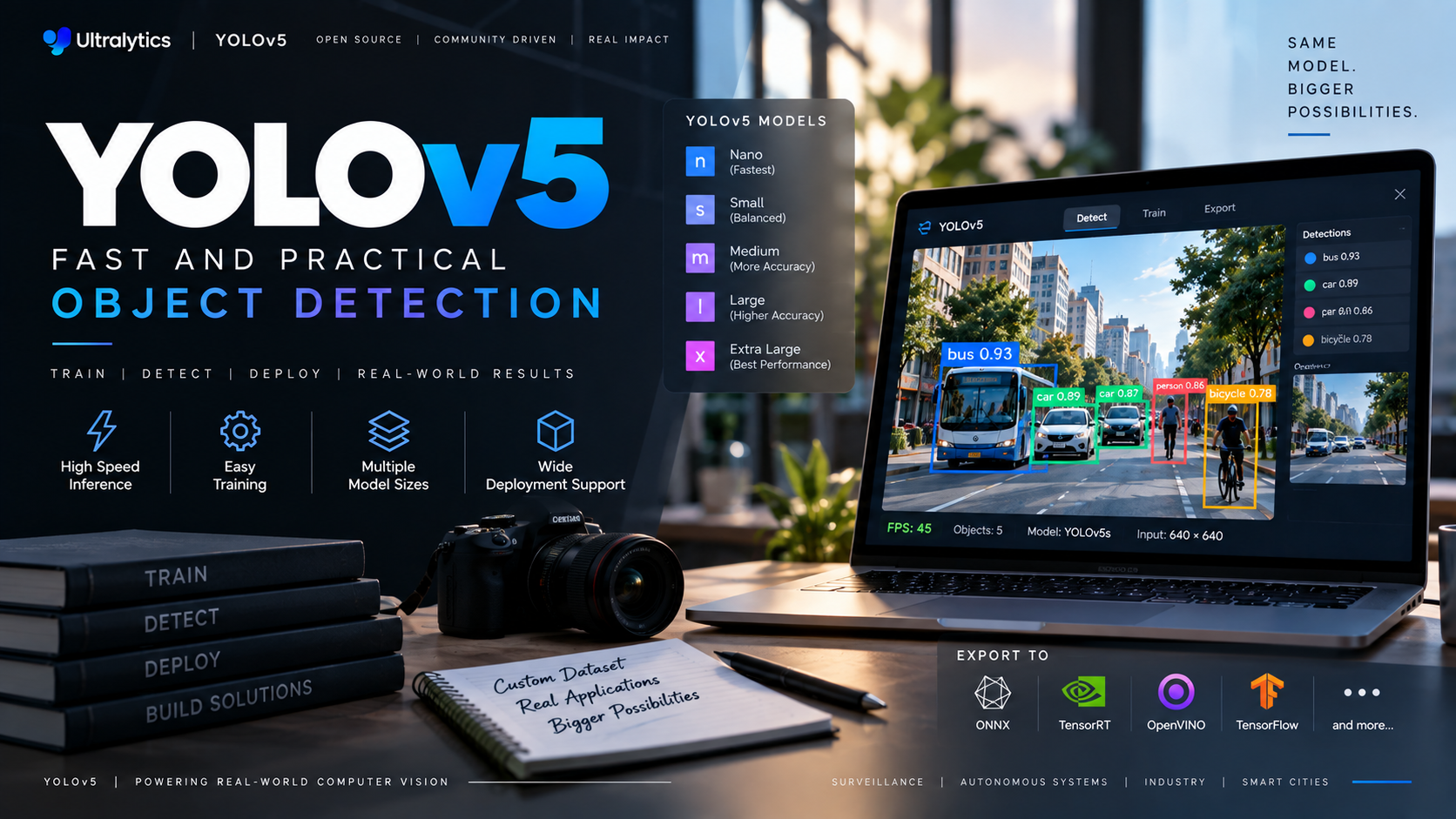
YOLOv5: Fast and Practical Object Detection
Introduction
The YOLO family continued to evolve with a strong focus on making object detection not only accurate and fast, but also easy to train, deploy, and use in practical applications.
YOLOv5 was publicly released by Ultralytics in May 2020 as a PyTorch-based implementation. Unlike earlier YOLO papers, there was no formal research paper specifically introducing YOLOv5; the model was developed and released through the Ultralytics GitHub project.
YOLOv5 became widely used because of its straightforward training workflow, pretrained models, deployment options, and strong real-time performance.
What is YOLOv5?
YOLOv5 is a real-time object detection model built using PyTorch.
It provides a practical pipeline for:
- Training custom object-detection datasets
- Detecting objects in images
- Processing videos
- Performing real-time inference
- Exporting models for different deployment environments
Its architecture follows the common backbone → neck → head structure.
YOLOv5 Architecture
YOLOv5 consists of three major components:
1. Backbone — CSPDarknet53
The backbone extracts important visual features from the input image using a CSPDarknet-based architecture.
2. Neck — SPPF + PANet
The neck combines features at different scales. YOLOv5 uses SPPF (Spatial Pyramid Pooling Fast) and PANet for efficient feature processing and aggregation.
3. Detection Head
The detection head generates the final predictions, including:
- Bounding boxes
- Objectness scores
- Class probabilities
Basic Workflow
Input Image → CSPDarknet → SPPF + PANet → Detection Head → Final Detections
Key Features of YOLOv5
1. PyTorch-Based Implementation
YOLOv5 was built around PyTorch, making it convenient for researchers and developers familiar with the Python deep-learning ecosystem.
2. Multiple Model Sizes
YOLOv5 provides different model sizes, including:
- YOLOv5n
- YOLOv5s
- YOLOv5m
- YOLOv5l
- YOLOv5x
These variants allow users to select a model according to their requirements for speed, memory, and accuracy.
3. SPPF
YOLOv5 introduced Spatial Pyramid Pooling Fast (SPPF) as an efficient alternative to the earlier SPP implementation. It provides similar output while improving processing speed.
4. Data Augmentation
YOLOv5 uses techniques such as Mosaic augmentation, MixUp, HSV augmentation, and random flipping to improve training and generalization.
5. Easy Model Export
YOLOv5 supports deployment through formats and frameworks such as ONNX, TensorRT, OpenVINO, TensorFlow, and others, making it practical for different environments.
Advantages of YOLOv5
YOLOv5 offers:
- Fast inference
- Easy custom-dataset training
- Multiple model sizes
- Strong real-time performance
- PyTorch compatibility
- Extensive deployment options
- Practical training and inference tools
Its combination of performance and usability contributed to its widespread adoption in computer vision projects.
Limitations of YOLOv5
Some limitations include:
- Larger models require more memory and computational power.
- Small or heavily overlapping objects can still be challenging.
- Choosing the appropriate model size requires balancing speed and accuracy.
- Performance can vary depending on dataset quality and training configuration.
YOLOv4 vs YOLOv5
| Feature | YOLOv4 | YOLOv5 |
|---|---|---|
| Release | 2020 | 2020 |
| Framework | Darknet | PyTorch |
| Backbone | CSPDarknet53 | CSPDarknet-based |
| Neck | SPP + PANet | SPPF + PANet |
| Model Variants | Different configurations | n, s, m, l, x |
| Custom Training | Supported | Highly accessible |
| Deployment | Multiple options | Extensive export support |
Applications of YOLOv5
YOLOv5 is commonly used for:
- Vehicle detection
- License-plate detection
- Pedestrian detection
- Surveillance
- Industrial inspection
- Traffic monitoring
- Retail analytics
- Robotics
- Real-time video analysis
It is particularly convenient for projects that require training a detector on a custom dataset.
Conclusion
YOLOv5 brought a strong focus on practical object detection and developer accessibility. Its PyTorch implementation, multiple model sizes, efficient architecture, augmentation techniques, and deployment options made it highly useful for real-world computer vision projects.
YOLOv5 also helped make custom object detection more accessible to developers, researchers, and students, continuing the evolution of the YOLO family toward increasingly practical AI solutions.
Comments (0)
No comments yet. Be the first to share your thoughts!
Join the Conversation
Please log in to your Teltam account to post a comment on this article.
Log In to Comment