YOLOv3: Improved Multi-Scale Object Detection
Introduction
As object detection continued to evolve, the YOLO family focused on improving the balance between speed and accuracy. YOLOv2 introduced important improvements such as anchor boxes and multi-scale training, but detecting small objects and objects at different sizes remained challenging.
YOLOv3 was introduced in 2018 by Joseph Redmon and Ali Farhadi in the paper “YOLOv3: An Incremental Improvement.” It introduced a stronger feature-extraction network and improved multi-scale detection while maintaining the real-time philosophy of YOLO.
What is YOLOv3?
YOLOv3 is the third major version of the YOLO object detection algorithm.
Its main improvements include:
- Darknet-53 backbone
- Multi-scale object detection
- Improved detection of small objects
- Feature pyramid-style predictions
- Logistic classifiers for class prediction
- Better bounding-box prediction
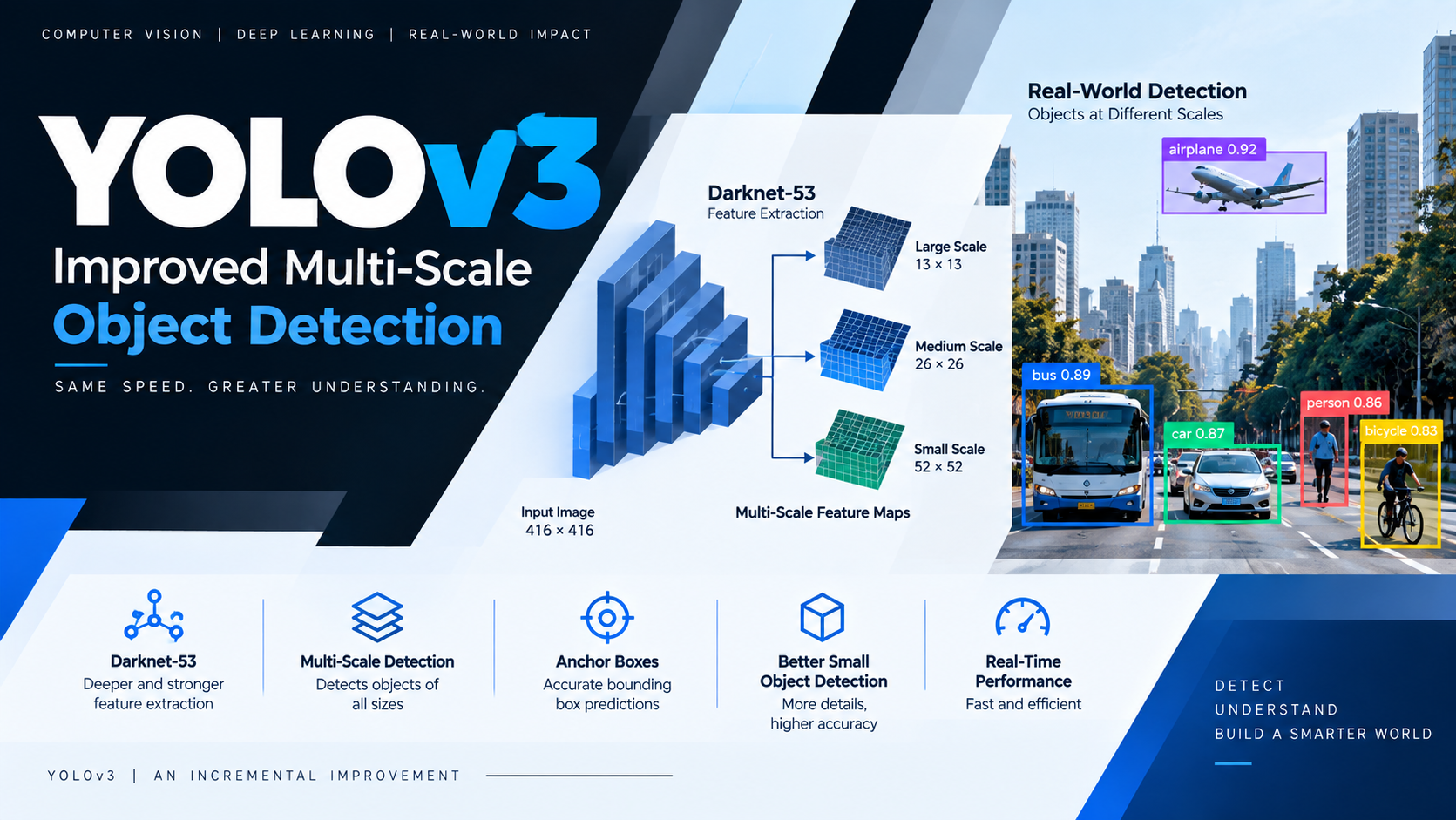
The model predicts objects at three different scales, allowing it to handle objects of different sizes more effectively.
YOLOv3 Architecture
YOLOv3 uses Darknet-53 as its backbone.
Darknet-53 is a 53-layer convolutional neural network that uses residual connections to improve feature learning.
The general workflow is:
Input Image
↓
Darknet-53
↓
Feature Extraction at Multiple Scales
↓
Three Detection Layers
↓
Bounding Boxes + Objectness + Class Predictions
↓
Non-Maximum Suppression
↓
Final Detections
Multi-Scale Detection
One of the most important features of YOLOv3 is its ability to perform detection at three different scales.
This helps the model detect:
- Large objects
- Medium-sized objects
- Small objects
The network combines features from different stages of the backbone so that fine-grained information can be used for smaller objects while deeper features provide stronger semantic information.
This was a significant improvement over earlier YOLO versions.
Darknet-53
YOLOv3 introduced Darknet-53, replacing the Darknet-19 backbone used in YOLOv2.
Darknet-53 uses residual blocks inspired by the residual-learning approach used in ResNet.
It provides deeper feature extraction while maintaining relatively efficient computation.
The architecture contains:
- 53 convolutional layers
- Residual connections
- 3 × 3 convolutions
- 1 × 1 convolutions
This improved the model's ability to learn complex visual features.
Anchor Boxes
YOLOv3 continues to use anchor boxes, which were introduced in YOLOv2.
Anchor boxes provide predefined reference shapes for predicting object bounding boxes.
YOLOv3 uses nine anchor boxes, distributed across its three detection scales.
Different anchor sizes are assigned to different detection layers, helping the model handle objects with different dimensions.
Class Prediction
YOLOv3 changed the way class predictions were handled compared with earlier YOLO versions.
Instead of using a softmax classifier for mutually exclusive classes, YOLOv3 uses independent logistic classifiers with binary cross-entropy loss.
This approach is useful when categories may not always be mutually exclusive.
Key Features of YOLOv3
1. Darknet-53 Backbone
Provides deeper and stronger feature extraction compared with Darknet-19.
2. Three Detection Scales
Predictions at three different scales improve detection across different object sizes.
3. Better Small-Object Detection
The use of higher-resolution feature maps helps improve detection of smaller objects.
4. Residual Connections
Residual blocks help information flow through the deeper network.
5. Anchor-Based Detection
Multiple anchor boxes allow the model to predict different object shapes and sizes.
6. Real-Time Performance
YOLOv3 maintains the high-speed detection philosophy of the YOLO family.
Advantages of YOLOv3
YOLOv3 provides several advantages:
- Better detection accuracy than earlier YOLO versions
- Improved small-object detection
- Multi-scale predictions
- Strong feature extraction
- Fast inference
- Suitable for real-time applications
- Efficient end-to-end detection pipeline
Limitations of YOLOv3
Despite its improvements, YOLOv3 still has some limitations:
- Accuracy can decrease in highly crowded scenes.
- Small objects can still be difficult to detect.
- Larger models require more computational resources.
- There is still a trade-off between detection speed and accuracy.
These challenges encouraged further improvements in later YOLO versions.
YOLOv2 vs YOLOv3
| Feature | YOLOv2 | YOLOv3 |
|---|---|---|
| Backbone | Darknet-19 | Darknet-53 |
| Residual Connections | No | Yes |
| Detection Scales | Mainly single detection scale | 3 scales |
| Small Object Detection | Improved | Further improved |
| Anchor Boxes | Yes | Yes |
| Multi-Scale Training | Yes | Yes |
| Real-Time Detection | Yes | Yes |
Applications of YOLOv3
YOLOv3 can be used in many computer vision applications, including:
- Vehicle detection
- Pedestrian detection
- Traffic monitoring
- Surveillance
- Industrial inspection
- Robotics
- Autonomous systems
- Real-time video analytics
- Object tracking systems
Conclusion
YOLOv3 represented an important step forward in real-time object detection. Its Darknet-53 backbone, residual connections, and three-scale detection strategy improved the model's ability to recognize objects of different sizes, particularly smaller objects.
By continuing to balance speed, accuracy, and efficient inference, YOLOv3 became a widely used object detection model and provided an important foundation for subsequent YOLO architectures.
Comments (0)
No comments yet. Be the first to share your thoughts!
Join the Conversation
Please log in to your Teltam account to post a comment on this article.
Log In to Comment