Why Senior Engineers Should Learn AI Differently (Not Like Freshers)
Senior engineers should not learn AI the same way freshers do. Their experience is their biggest advantage.
If you have 10, 15, or even 20+ years of experience in software, data, or IT systems, AI may give you mixed feelings.
On one hand, everyone is talking about AI — tools, prompts, agents, copilots, and models.
On the other hand, you may be wondering:
- Do I really need to learn all this now?
- Am I already late?
- Why does AI learning feel disconnected from real projects?
- Do I need to become a data scientist to stay relevant?
Let’s start with a simple truth:
Senior engineers should NOT learn AI the same way freshers do.
This is not a limitation.
It is actually your biggest advantage.
The Real Problem: AI Learning Is Built for Beginners
Most AI courses, tutorials, and videos are designed for freshers and early-career engineers.
They often focus heavily on:
- Algorithms
- Model training
- Accuracy scores
- Mathematics
- Tool-by-tool tutorials
- Building models from scratch
For a fresher, this approach can make sense because they are still developing their technical foundations.
But for senior engineers, following the same path can create:
- Confusion
- Frustration
- Self-doubt
- Information overload
- A false feeling of being behind
You are not struggling with AI because you are incapable.
You may simply be learning it from the wrong angle.
The learning path should match your experience level.
Fresher vs Senior: A Different AI Learning Approach
| Freshers | Senior Engineers |
|---|---|
| Learn algorithms | Apply engineering judgment |
| Learn how models work | Understand where models fit |
| Focus on model accuracy | Focus on business impact |
| Learn individual tools | Think about complete systems |
| Build individual projects | Design end-to-end workflows |
| Focus on implementation | Focus on architecture and decisions |
Freshers often need to understand how AI works.
Senior engineers need to understand where AI fits.
That single difference can completely change the learning experience.
What Senior Engineers Already Have That AI Cannot Replace
Before learning something new, it is important to recognize what you already bring to the table.
Experienced engineers understand:
- How real systems behave in production
- Why data is rarely perfect
- How requirements change during projects
- How failures actually happen
- How stakeholders think
- How technical decisions affect business
- Why perfect accuracy is rarely the only objective
- How systems need to be maintained over time
These are not outdated skills.
They are valuable AI-era skills.
AI can generate code, explain concepts, and suggest solutions.
But experience helps you determine whether those solutions actually make sense.
AI does not replace experience. AI can amplify experience.
Where AI Really Fits in Real Projects
A common mistake is to think that AI should be the center of every new system.
In real projects, the complete flow is much broader:
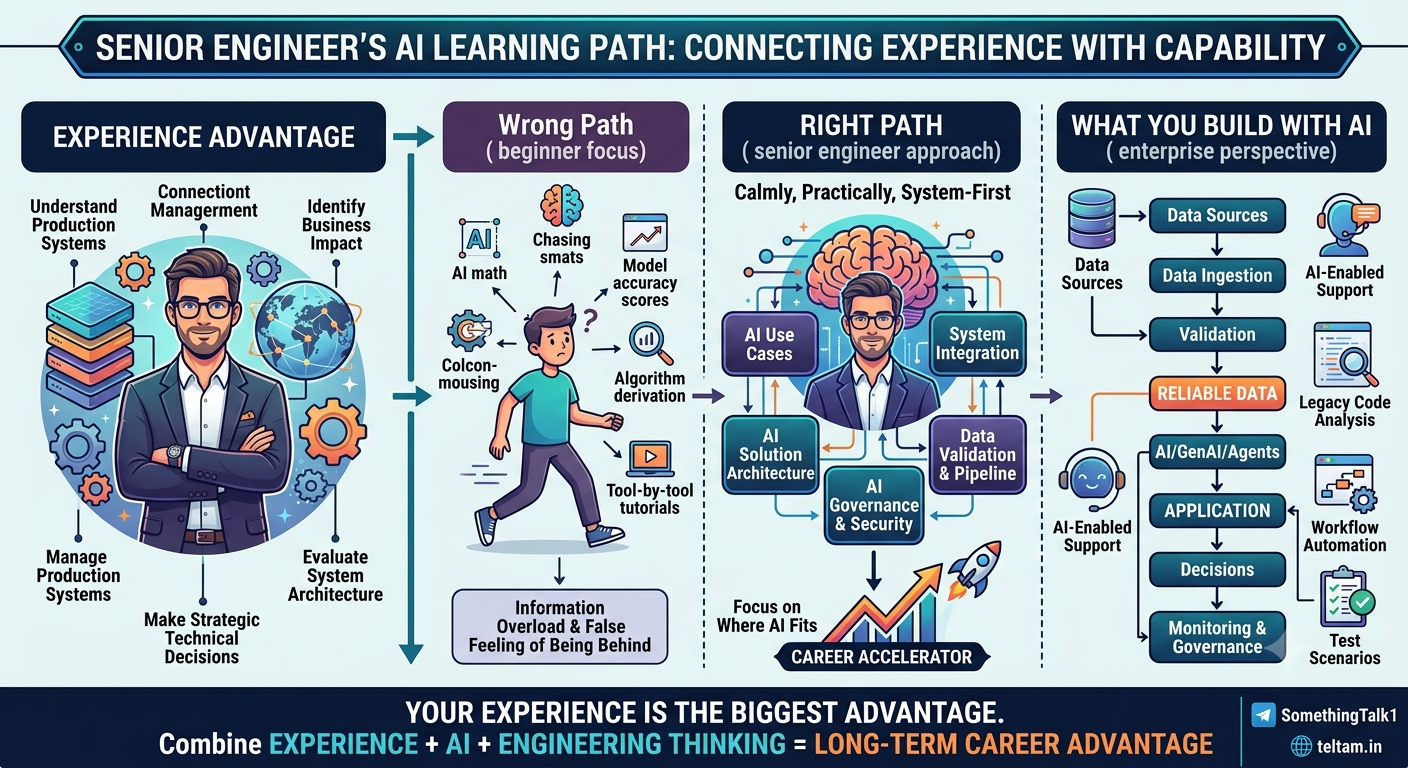
Data Sources → Data Ingestion → Validation → Reliable Data → AI/ML/GenAI → Application → Decisions → Monitoring & Governance
AI is only one component.
Before an AI system can provide useful results, organizations still need:
- Reliable data
- Data validation
- Stable pipelines
- Security
- Monitoring
- Governance
- Cost control
- Clear ownership
This is where senior engineering experience becomes extremely valuable.
The challenge is not simply:
“Which AI model should we use?”
The better question is:
“How should AI fit into the existing system safely and effectively?”
Step-by-Step: How Senior Engineers Should Learn AI
Let’s make this practical.
Here is a learning approach designed around the strengths of experienced professionals.
Step 1: Learn AI Concepts, Not AI Mathematics
You do not necessarily need to begin by:
- Deriving algorithms
- Training complex models from scratch
- Studying advanced mathematical proofs
- Competing with machine learning researchers
Instead, first understand:
- What AI can do
- What AI cannot do
- How AI systems are used
- Why models can fail
- Why hallucinations occur
- What AI risks look like
- Where AI can create business value
The goal is to understand AI well enough to make good engineering decisions.
Think like an architect, not a researcher.
Step 2: Connect AI to Systems You Already Know
Instead of asking:
“How does this AI model work?”
Start asking:
“Where can this capability fit into the systems I already understand?”
For example:
- Can Generative AI assist analysts?
- Can AI improve data validation?
- Can AI reduce repetitive support work?
- Can AI help developers understand legacy code?
- Can AI improve documentation?
- Can AI assist with testing?
- Can AI automate part of an existing workflow?
This approach makes AI practical.
You are not starting your career again.
You are adding a new capability to your existing engineering experience.
Step 3: Learn Prompt Thinking, Not Prompt Tricks
Prompting is often presented as a collection of secret techniques.
For senior engineers, it is better understood as structured thinking expressed through natural language.
Experienced engineers already know how to:
- Write requirements
- Define constraints
- Explain edge cases
- Describe expected behavior
- Ask precise questions
- Break complex problems into smaller tasks
These skills transfer directly into effective prompting.
Instead of:
“Write code for this.”
Try:
“Design a scalable solution for this requirement. Consider large data volumes, error handling, security, performance, and explain the assumptions.”
The second approach encourages better reasoning and produces a more useful starting point.
Prompting is an interface. Engineering judgment remains yours.
Step 4: Focus on AI Readiness, Not Just AI Models
Many organizations focus heavily on choosing an AI model.
But successful AI adoption requires much more.
Common challenges include:
- Poor data quality
- Unclear ownership
- Lack of monitoring
- No cost controls
- Weak security
- Missing governance
- Inadequate testing
Senior engineers can create significant value by focusing on:
- Data contracts
- Validation rules
- Auditability
- Monitoring
- Access controls
- Failure handling
- Cost management
- Governance
This is where AI becomes an enterprise engineering problem, not just a model problem.
The Wrong vs Right AI Learning Path
Wrong Path
Chasing tools → Copying demos → Learning models randomly → Following trends → Fear of falling behind
Right Path
Understand use cases → Design workflows → Connect AI with existing systems → Evaluate risks → Apply AI where it creates value
AI rewards clarity more than panic.
You do not need to learn every AI tool.
You need to understand how to evaluate and apply the right capability.
A Real Enterprise Perspective
In large enterprise programs, AI is rarely the first step.
Organizations often need to establish:
- Data standardization
- Reliable data pipelines
- Data validation
- Governance
- Security
- Monitoring
- Business ownership
Only then does it make sense to introduce AI into the workflow.
This is why senior engineers should not think:
“I need to learn every AI model.”
Instead, think:
“I need to understand how AI can become a reliable part of the systems I already build and manage.”
That mindset changes everything.
Why Senior Engineers Have an Advantage in the AI Era
Consider two engineers.
Engineer A
Knows many AI tools but has limited experience with production systems.
Engineer B
Has years of experience with:
- System architecture
- Production failures
- Data pipelines
- Security
- Performance
- Business requirements
- Stakeholder communication
If Engineer B learns how to use AI effectively, the combination can be extremely powerful.
Why?
Because AI provides speed, while experience provides judgment.
AI + Engineering Experience = Stronger Decision-Making
The goal is not to compete with AI.
The goal is to become better at using it.
How Senior Engineers Should Think About AI Roles
Senior engineers do not necessarily need to transition completely into machine learning research.
There are many ways to contribute to AI-enabled systems.
For example:
- AI solution architecture
- AI integration
- Data engineering
- AI-enabled application development
- Enterprise automation
- AI governance
- AI security
- AI platform engineering
- AI-assisted software development
The important skill is understanding how AI connects with the broader technology ecosystem.
What Senior Engineers Should Avoid
AI learning becomes inefficient when it turns into endless tool collection.
Avoid:
- Learning tools without understanding their purpose
- Copying tutorials without understanding the architecture
- Chasing every new AI platform
- Comparing yourself with beginners learning different concepts
- Assuming AI knowledge means knowing every model
- Focusing only on prompts
- Ignoring security, privacy, and governance
Technology will continue changing.
Your ability to evaluate technology and make sound decisions will remain valuable.
A Practical AI Learning Framework for Senior Engineers
A simple progression can be:
Stage 1 — AI Awareness
Understand:
- AI
- Machine Learning
- Generative AI
- LLMs
- AI agents
- Common AI use cases
Stage 2 — AI Application
Learn how to use AI for:
- Coding
- Documentation
- Analysis
- Research
- Automation
- Testing
- Productivity
Stage 3 — AI Integration
Understand:
- APIs
- Databases
- Applications
- Authentication
- Data pipelines
- Tool integration
Stage 4 — AI Architecture
Learn about:
- System design
- Reliability
- Scalability
- Security
- Monitoring
- Cost
- Governance
Stage 5 — Real-World AI Projects
Finally, apply the knowledge to real business problems.
This is where your existing engineering experience becomes a major advantage.
Why Calm Learning Beats AI Panic
The AI industry moves quickly.
Every week there are:
- New models
- New tools
- New frameworks
- New agents
- New announcements
Trying to learn everything is impossible.
Instead, build a stable foundation.
Ask:
What problem does this technology solve?
Where does it fit into a system?
What are its limitations?
What happens if it fails?
How do we measure whether it actually creates value?
These questions will remain useful even when today's tools are replaced.
Why This Is the Philosophy Behind teltam.in
teltam.in is built around a simple belief:
Experienced engineers don't need more AI hype. They need clarity.
The goal is not to turn every experienced professional into a data scientist.
The goal is to help professionals:
- Understand AI foundations
- Apply AI practically
- Connect AI with existing systems
- Communicate confidently about AI
- Make better technical decisions
- Build long-term career relevance
AI should feel like a natural extension of your experience, not a threat to it.
Final Thoughts
If you are a senior engineer feeling uncertain about AI, remember this:
You are not behind.
You may simply be approaching AI from the wrong angle.
You don't need to restart your career.
You don't need to learn every AI tool.
You don't need to become a machine learning researcher.
Instead:
- Learn AI concepts
- Connect AI to your existing systems
- Understand practical use cases
- Strengthen your engineering judgment
- Learn how to evaluate AI-generated solutions
- Focus on architecture, data, security, and reliability
Learn AI the way a senior engineer should:
Calmly.
Practically.
System-first.
That is how AI becomes a career accelerator, not a career risk.
Your experience is not becoming less valuable because of AI.
The opportunity is to combine that experience with AI.
Experience + AI + Engineering Thinking = Long-Term Advantage.
This blog is part of the learning journey through SomethingTalk1 and teltam.in, focused on AI foundations, engineering thinking, and practical technology understanding.
Explore more practical AI learning at teltam.in.
Comments (0)
No comments yet. Be the first to share your thoughts!
Join the Conversation
Please log in to your Teltam account to post a comment on this article.
Log In to Comment