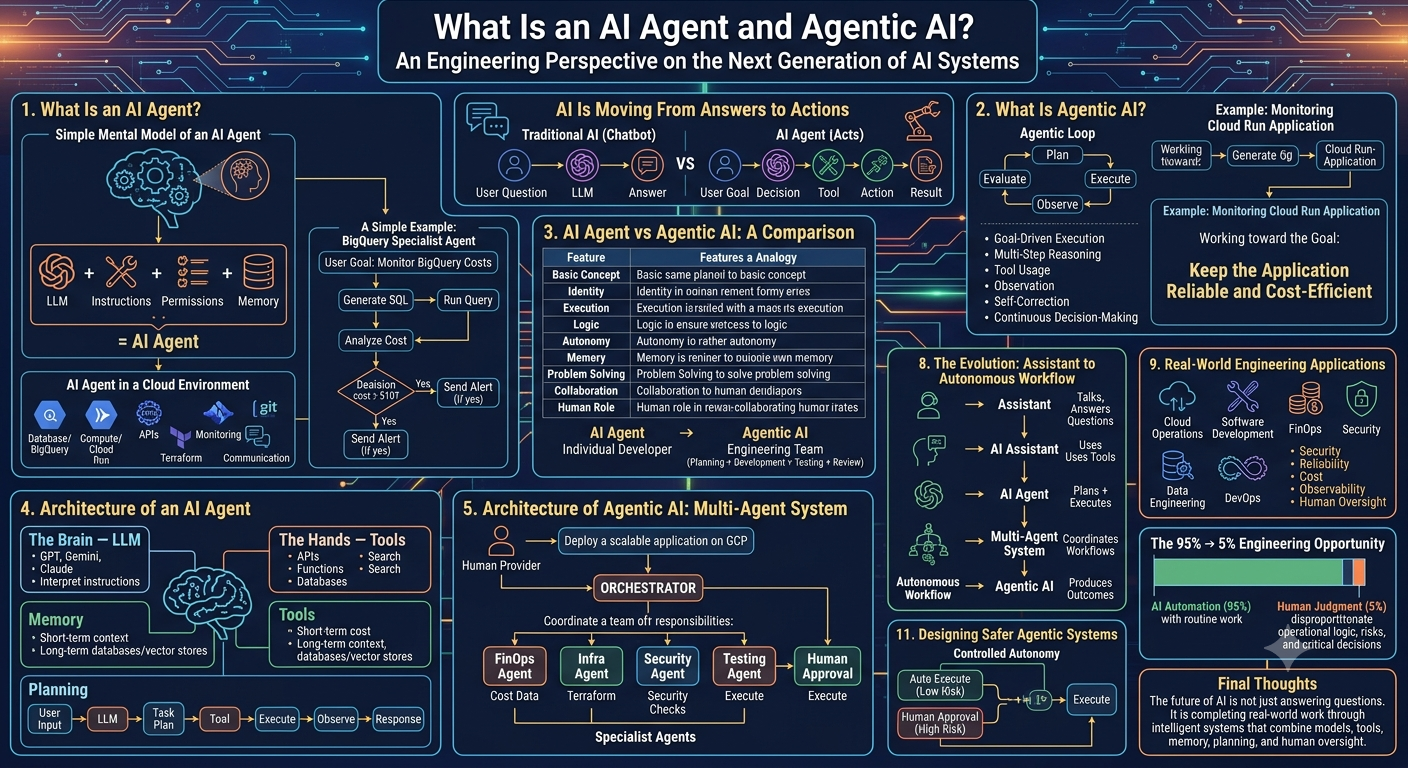
What Is an AI Agent and Agentic AI?
An Engineering Perspective on the Next Generation of AI Systems
Artificial Intelligence is evolving rapidly.
We are moving beyond simple chatbots toward systems that can reason, use tools, make decisions, and complete real-world tasks.
Two concepts are at the center of this transformation:
AI Agents
Agentic AI
Although these terms are often used interchangeably, they describe different levels of capability.
In this article, we will understand the difference from an engineering perspective, explore their architectures, and look at practical examples using cloud and enterprise systems.
AI Is Moving From Answers to Actions
Traditional AI systems are primarily designed to answer questions.
You ask something.
The model processes your prompt.
Then it generates a response.
An AI Agent goes one step further.
It can take that response and perform an action using external tools and systems.
This creates a simple distinction:
Traditional AI

User
  ↓
Question
  ↓
LLM
  ↓
Answer


AI Agent

User
  ↓
Goal
  ↓
LLM
  ↓
Decision
  ↓
Tool
  ↓
Action
  ↓
Result
The fundamental shift is:
Chatbot → Talks
AI Agent → Acts
1. What Is an AI Agent?
An AI Agent is a software system that combines a Large Language Model (LLM) with the ability to interact with external tools and systems.
A typical AI Agent may contain:
-
An LLM
-
Tools
-
Permissions
-
Memory
-
Instructions
-
A defined role or persona
-
A mechanism for executing actions
The LLM provides the reasoning capability, while the tools allow the agent to interact with the real world.
Simple Mental Model
AI Agent

LLM
 +
Tools
 +
Instructions
 +
Permissions
 +
Memory
 =
AI Agent
This is what makes an agent different from a basic chatbot.
A Simple Example
Imagine an AI system designed as a BigQuery Specialist Agent.
Instead of simply answering:
“How much did our database cost this month?”
the agent could:
-
Connect to the appropriate dataset.
-
Generate a SQL query.
-
Execute the query.
-
Analyze the results.
-
Calculate the cost.
-
Compare it with a predefined threshold.
-
Alert the engineering team if the cost exceeds the limit.
For example:
User Goal
    ↓
"Monitor BigQuery costs"
    ↓
BigQuery Agent
    ↓
Generate SQL
    ↓
Run Query
    ↓
Analyze Cost
    ↓
Is cost > $10?
    ↓
   YES
    ↓
Send Alert
This is action-oriented AI.
The system is not merely producing text.
It is interacting with infrastructure.
AI Agent in a Cloud Environment
Consider a cloud engineering environment.
An AI Agent could have access to:
| Capability | Example |
|---|---|
| Database | BigQuery |
| Compute | Cloud Run |
| APIs | Cloud APIs |
| Monitoring | Cloud Monitoring |
| Code | Git repositories |
| Infrastructure | Terraform |
| Communication | Email or messaging APIs |
With appropriate permissions and safeguards, the agent can use these tools to perform specific tasks.
This is where AI starts becoming an engineering collaborator rather than just an assistant.
The 95% → 5% Engineering Opportunity
A useful perspective discussed in AI engineering is the movement from broad automation toward precision in the final stage of a task.
AI can automate a large portion of repetitive work.
But the final part often involves:
-
Edge cases
-
Business rules
-
Security
-
Architecture
-
Production constraints
-
Cost optimization
-
Human judgment
This creates an important engineering principle:
AI Automation
██████████████████████████████████████████████████ 95%

Human Judgment
██                                                 5%

The final 5% can determine
whether the system succeeds in production.
AI Agents become particularly valuable when they can help engineers handle both the repetitive work and the complex operational steps surrounding it.
2. What Is Agentic AI?
Agentic AI represents a broader concept.
An AI Agent may perform a task.
Agentic AI is designed to work toward a goal through an ongoing decision-making process.
Instead of simply:
Prompt → Tool → Result
an agentic system may operate through a continuous loop:
Plan
  ↓
Execute
  ↓
Observe
  ↓
Evaluate
  ↓
Re-plan
  ↓
Execute Again
  ↓
Final Result
This is the Agentic Loop.
Core Characteristics of Agentic AI
Agentic AI systems commonly involve several characteristics.
Goal-Driven Execution
The system works toward an objective rather than responding only to individual prompts.
Multi-Step Reasoning
The system can break a complex objective into smaller tasks.
Tool Usage
The system can interact with APIs, databases, search systems, code environments, and other tools.
Observation
The system examines the result of an action before deciding what to do next.
Self-Correction
If an approach fails, the system can modify its plan and try another approach.
Continuous Decision-Making
The system can repeatedly evaluate its progress toward the goal.
Example: Monitoring Cloud Run
Imagine an agentic system responsible for monitoring a Cloud Run application.
The objective is:
Keep the application reliable and cost-efficient.
The system could operate like this:
                Goal
                 ↓
        Monitor Cloud Run
                 ↓
          Collect Metrics
                 ↓
        Detect Traffic Spike
                 ↓
        Identify Bottleneck
                 ↓
       Analyze Infrastructure
                 ↓
      Recommend Configuration
                 ↓
          Calculate Cost
                 ↓
       Human Approval
                 ↓
          Apply Change
                 ↓
            Monitor
                 ↓
          Evaluate Result
                 ↓
        Re-plan if Required
This is significantly more sophisticated than a simple chatbot.
3. AI Agent vs Agentic AI
The difference becomes clearer when we compare them directly.
| Feature | AI Agent | Agentic AI |
|---|---|---|
| Basic concept | Individual intelligent worker | Goal-oriented intelligent system |
| Identity | Single agent | Agent or multiple cooperating agents |
| Execution | Performs assigned tasks | Continuously works toward a goal |
| Logic | Task → Tool → Result | Plan → Execute → Observe → Re-plan |
| Autonomy | Usually bounded | Greater goal-directed autonomy |
| Memory | May use short- or long-term memory | Often maintains state across workflows |
| Problem solving | Task-level | End-to-end |
| Collaboration | May work independently | Can coordinate multiple agents |
| Human role | Provides instructions or approval | Supervises critical decisions |
Simple Analogy
AI Agent
    ↓
Individual Developer

Agentic AI
    ↓
Engineering Team
    ↓
Planning + Development + Testing + Review
An AI Agent can be thought of as an intelligent worker.
Agentic AI is closer to an intelligent workflow or team of workers.
4. Architecture of an AI Agent
A useful way to understand an AI Agent is to compare it with a human worker.
An agent typically contains several important components.
The Brain — LLM
The LLM acts as the reasoning engine.
Examples include models from providers such as:
-
GPT
-
Gemini
-
Claude
The LLM interprets instructions, reasons about the task, and determines which action may be appropriate.
User Request
     ↓
    LLM
     ↓
Reasoning
     ↓
Decision
The Hands — Tools
Tools allow the agent to interact with external systems.
Examples include:
-
APIs
-
Python functions
-
Databases
-
Search tools
-
Cloud services
-
File systems
-
Code execution environments
Without tools, an agent may only be able to generate recommendations.
With tools, it can potentially execute actions.
Memory
Memory allows the system to maintain useful information.
Short-Term Memory
Usually includes information from the current interaction.
Examples:
-
Conversation history
-
Current task state
-
Recent tool results
Long-Term Memory
Can provide persistent knowledge across interactions.
Examples:
-
Knowledge bases
-
Documents
-
Databases
-
Vector stores
-
Retrieval-Augmented Generation (RAG)
A simplified model is:
                AI Agent
                   │
       ┌───────────┼───────────┐
       ↓           ↓           ↓
      LLM        Tools       Memory
    Reasoning   Actions      Context
Planning
An agent also needs instructions that define:
-
What it should do
-
What it should not do
-
Which tools it can use
-
How it should behave
-
When it should request human approval
These rules can be defined through system instructions, tool policies, workflows, and application logic.
A simplified flow is:
User Input
    ↓
LLM Reasoning
    ↓
Task Planning
    ↓
Tool Selection
    ↓
Execution
    ↓
Observation
    ↓
Response
5. Architecture of Agentic AI
Agentic AI becomes even more powerful when multiple specialized agents collaborate.
Instead of asking one agent to handle everything, responsibilities can be divided among several agents.
For example:
                     HUMAN
                       │
                       ▼
                 ORCHESTRATOR
                       │
          ┌────────────┼────────────┐
          ▼            ▼            ▼
      FinOps Agent  Infra Agent  Security Agent
          │            │            │
          ▼            ▼            ▼
       Cost Data    Terraform    Security Checks
          │            │            │
          └────────────┼────────────┘
                       ▼
                 Testing Agent
                       │
                       ▼
                 Human Approval
                       │
                       ▼
                    Execute
This is a Multi-Agent System.
The Orchestrator
The orchestrator acts as the coordinator.
Suppose the user gives the system this goal:
Deploy a scalable application on GCP.
The orchestrator can divide the goal into different responsibilities.
Goal:
Deploy scalable application on GCP

             ↓

       Orchestrator

       ┌─────┼─────┐
       ↓     ↓     ↓
     Infra  FinOps Security
     Agent   Agent   Agent
       ↓     ↓     ↓
       └─────┼─────┘
             ↓
          Testing
             ↓
       Human Approval
             ↓
          Deployment
Each specialist focuses on its own area.
Specialist Agents
FinOps Agent
Responsible for financial optimization.
It may:
-
Check cloud pricing
-
Estimate infrastructure cost
-
Compare alternatives
-
Identify expensive resources
-
Recommend cost optimizations
Infrastructure Agent
Responsible for infrastructure design.
It may:
-
Design cloud architecture
-
Generate Terraform
-
Configure services
-
Analyze scalability
-
Prepare deployment configurations
Security Agent
Responsible for security analysis.
It may:
-
Review permissions
-
Identify vulnerabilities
-
Check exposed resources
-
Validate security policies
-
Flag risky configurations
6. Human-in-the-Loop
Even highly autonomous AI systems should not automatically perform every action.
For high-impact operations, a Human-in-the-Loop (HITL) mechanism can provide an important safety layer.
For example:
AI Agent
   ↓
Analyze Situation
   ↓
Generate Recommendation
   ↓
Prepare Action
   ↓
───────────────
Human Approval
───────────────
   ↓
Execute Action
   ↓
Monitor Result
This is especially important for operations involving:
-
Production systems
-
Financial transactions
-
Security changes
-
Database modifications
-
Infrastructure deletion
-
Sensitive information
The guiding principle is:
AI can be the teammate. Human beings remain responsible for critical decisions.
7. Why Agentic AI Matters From an ROI Perspective
The business value of AI is increasingly shifting from simply generating text toward completing useful outcomes.
Traditional AI usage can look like:
Prompt
  ↓
Response
  ↓
Prompt
  ↓
Response
  ↓
Prompt
  ↓
Response
The user is still responsible for connecting all the steps.
Agentic AI aims to automate more of that workflow.
                    Goal
                     ↓
              Agentic System
                     ↓
        ┌────────────┼────────────┐
        ↓            ↓            ↓
     Planning     Execution    Analysis
        │            │            │
        └────────────┼────────────┘
                     ↓
                  Result
The value therefore moves closer to:
Input → Outcome
rather than simply:
Input → Text
A Practical Example
Imagine a company wants to deploy a new application.
A traditional workflow may require engineers to:
-
Research cloud services.
-
Design architecture.
-
Estimate costs.
-
Write infrastructure code.
-
Configure security.
-
Deploy the application.
-
Monitor performance.
-
Optimize the infrastructure.
An agentic workflow could coordinate specialized agents across these steps.
Business Goal
      ↓
Planning Agent
      ↓
Architecture Agent
      ↓
FinOps Agent
      ↓
Security Agent
      ↓
Infrastructure Agent
      ↓
Testing Agent
      ↓
Human Approval
      ↓
Deployment
      ↓
Monitoring
      ↓
Optimization
The goal is not simply to generate more AI output.
The goal is to reduce the amount of manual coordination required to achieve a meaningful result.
8. AI Agent → Agentic System → Autonomous Workflow
The evolution can be visualized as three stages.
        ASSISTANT
            │
            ▼
      Answers Questions
            │
            ▼
         AI AGENT
            │
            ▼
       Uses Tools
       Performs Tasks
            │
            ▼
       AGENTIC AI
            │
            ▼
   Plans + Executes + Observes
            │
            ▼
    Coordinates Workflows
            │
            ▼
     Produces Outcomes
This represents a broader shift from conversation to execution.
9. Real-World Engineering Applications
Agentic systems can potentially be applied across many engineering domains.
Cloud Operations
Agents can monitor infrastructure, analyze metrics, identify anomalies, and recommend changes.
Software Development
Agents can assist with:
-
Coding
-
Testing
-
Debugging
-
Code review
-
Documentation
-
Deployment
FinOps
Agents can analyze cloud consumption and identify opportunities for cost optimization.
Security
Security agents can inspect configurations, analyze vulnerabilities, and flag suspicious activity.
Data Engineering
Agents can generate queries, analyze datasets, validate pipelines, and monitor data quality.
DevOps
Agents can assist with deployment workflows, monitoring, incident analysis, and operational automation.
10. The Engineering Challenges
Agentic AI is powerful, but it is not without challenges.
Security
Agents may have access to sensitive tools and systems.
Poorly configured permissions can create significant security risks.
Reliability
An autonomous system can make incorrect decisions.
The more authority an agent has, the more important validation becomes.
Cost
Agents may perform multiple model calls and tool operations for a single task.
This can increase infrastructure and API costs.
Observability
Engineering teams need to understand:
-
What the agent decided
-
Which tools it used
-
Why it made a decision
-
What failed
-
What changed
Human Oversight
Critical operations should have appropriate approval mechanisms.
11. Designing Safer Agentic Systems
A robust agentic architecture should follow the principle of controlled autonomy.
Instead of giving an agent unrestricted access, organizations can define boundaries.
                 AGENT
                   │
                   ▼
              Decision
                   │
            ┌──────┴──────┐
            ▼             ▼
       Low Risk        High Risk
            │             │
            ▼             ▼
       Auto Execute   Human Approval
            │             │
            └──────┬──────┘
                   ▼
                Execute
                   │
                   ▼
                Monitor
This allows organizations to benefit from automation without giving AI unlimited authority.
Key Takeaways
The difference between AI Agents and Agentic AI can be summarized simply.
AI Agents:
-
Perform tasks
-
Use external tools
-
Interact with systems
-
Operate within defined responsibilities
Agentic AI:
-
Works toward goals
-
Plans multiple steps
-
Observes results
-
Re-plans when necessary
-
Coordinates complex workflows
-
Can involve multiple specialized agents
The progression looks like this:
Chatbot
   ↓
AI Assistant
   ↓
AI Agent
   ↓
Multi-Agent System
   ↓
Agentic AI
   ↓
Autonomous Workflow
Final Thoughts
AI is moving beyond the era of simply answering questions.
The next phase is about taking action, coordinating tools, completing tasks, and achieving outcomes.
An AI Agent provides the ability to act.
Agentic AI provides the broader ability to plan, execute, observe, adapt, and continue working toward a goal.
For engineers, this creates an important shift in mindset.
The question is no longer only:
“What can this AI model generate?”
The more important question becomes:
“What real-world work can this AI system safely complete?”
The future of AI will not simply be about larger models.
It will be about intelligent systems that combine models, tools, memory, planning, workflows, and human oversight.
And the most effective engineering teams will learn how to design these systems responsibly.
The future of AI is not just answering questions.
It is completing real-world work.
Comments (0)
No comments yet. Be the first to share your thoughts!
Join the Conversation
Please log in to your Teltam account to post a comment on this article.
Log In to Comment