Introduction
Artificial Intelligence is evolving rapidly.
Earlier, we used chatbots that simply responded to our questions. Today, we are moving toward something more capable and autonomous: AI Agents.
But what exactly is Agentic AI?
In this blog, let's understand the journey from LLMs to Chatbots to AI Agents in a simple, step-by-step way—without the hype.
Video Explanation:
https://youtu.be/Emc5nzfQuh0?si=YG0h3ue5_SF-KKC4
Step 1: LLM – The Brain
LLM stands for Large Language Model.
Think of an LLM as the brain of an AI system.
An LLM can:
-
Take input, such as text
-
Understand patterns in language
-
Generate responses by predicting the next likely words
However, an LLM by itself has limitations.
It does not automatically:
-
Remember information across every interaction
-
Access external tools unless connected to them
-
Perform real-world actions independently
In simple terms:
An LLM can think and respond, but it cannot do much beyond its available capabilities.
Step 2: Chatbot – Adding Conversation Context
A chatbot builds on top of an LLM by adding conversation history and context.
Now the system can:
-
Remember previous messages within a conversation
-
Understand follow-up questions
-
Provide more contextual responses
For example:
User: What is Python?
User: Where is it commonly used?
The chatbot understands that "it" refers to Python.
However, a traditional chatbot still has limitations:
-
It usually waits for user input
-
It primarily responds to requests
-
It does not independently complete multi-step tasks
Step 3: AI Agent – The Real Change
This is where things become more interesting.
An AI Agent combines intelligence with the ability to use tools and perform actions.
AI Agent = Brain + Tools + Decision-Making + Actions
An AI Agent can:
-
Think about a problem
-
Decide what needs to be done
-
Use tools when necessary
-
Take actions
-
Check the results
-
Continue until the task is completed
Example
A chatbot might receive this instruction:
"Write a summary."
An AI Agent could handle a broader task:
Search → Analyze → Write → Review → Deliver
Instead of only generating text, the agent can potentially perform multiple steps to achieve a goal.
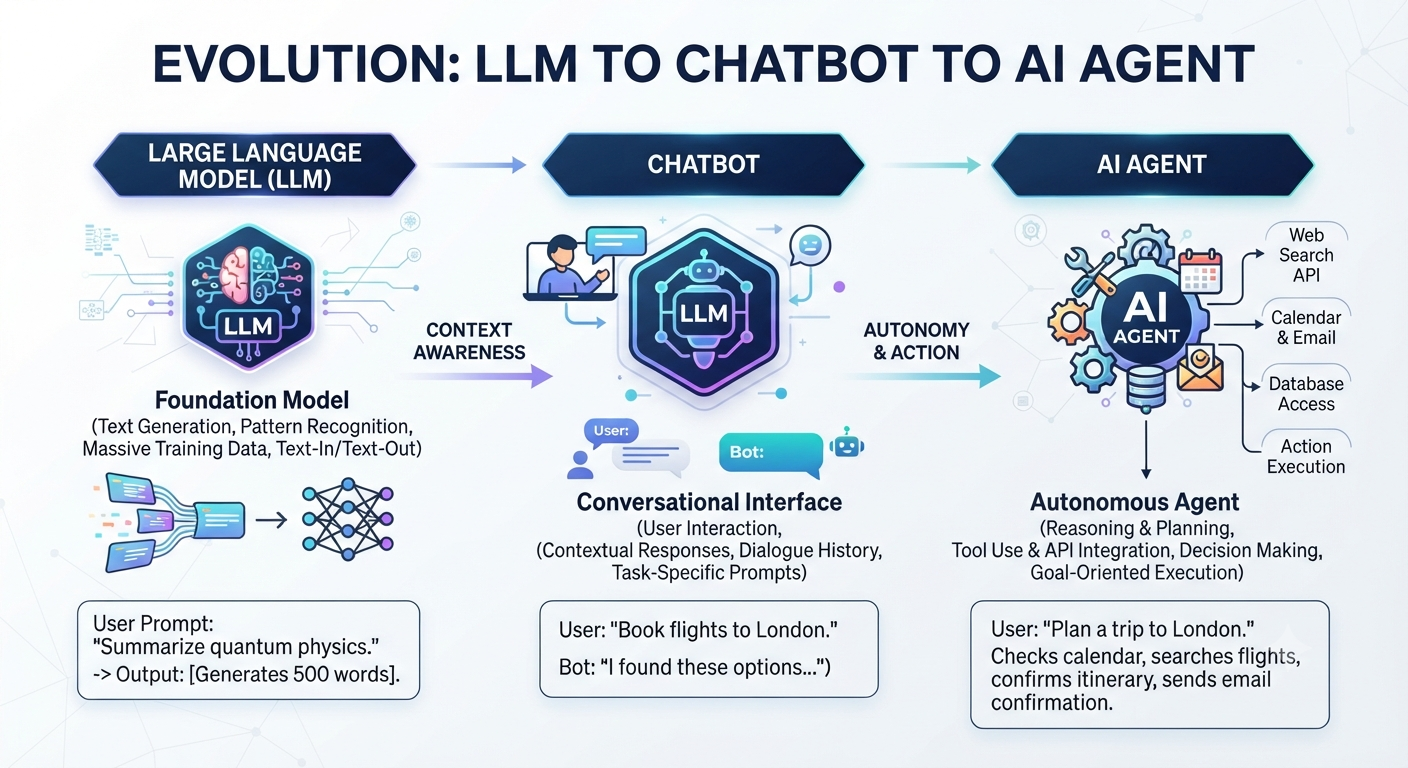
Diagram 1: Evolution of AI Systems
LLM
(Brain Only)
    ↓
Chatbot
(Brain + Conversation Context)
    ↓
AI Agent
(Brain + Memory + Tools + Actions)
Step 4: The Agentic Loop
The Agentic Loop is one of the most important concepts in Agentic AI.
An AI Agent often works through a repeated cycle:
-
Think – What should I do?
-
Act – Use a tool or perform an action.
-
Observe – Check the result.
-
Repeat – Continue if more work is required.
Simple Diagram
Thought
   ↓
Action
   ↓
Observation
   ↓
Repeat
   ↺
This general pattern is often associated with the ReAct approach:
Reason + Act
The important idea is simple:
The AI does not always generate one final answer immediately. It can perform a sequence of steps, observe what happens, and continue working toward the goal.
Step 5: Core Components of an AI Agent
An AI Agent typically includes several important components.
1. LLM – The Brain
The LLM helps the agent understand information, reason about tasks, and generate responses.
2. Prompt – Instructions
The prompt defines:
-
What the agent should do
-
How it should behave
-
What rules it should follow
3. Tools – Actions
Tools allow an AI Agent to interact with external systems.
Examples include:
-
Web search
-
Databases
-
APIs
-
Calculators
-
Code execution
-
Email systems
4. Memory – Context
Memory helps the agent maintain relevant information.
For example:
-
Previous conversations
-
User preferences
-
Results from earlier steps
5. Planning – Task Breakdown
Complex tasks often require multiple steps.
An AI Agent may break a task into smaller actions.
For example:
User Request
     ↓
Understand the Goal
     ↓
Create a Plan
     ↓
Use Required Tools
     ↓
Check Results
     ↓
Complete the Task
Step 6: Why is Agentic AI Important?
Traditionally, software developers explicitly define the flow of a program.
For example:
IF this happens
    → Do this
ELSE
    → Do that
With Agentic AI, some parts of the workflow can become more flexible.
The system may be able to:
-
Understand a goal
-
Determine the next step
-
Select an appropriate tool
-
Execute an action
-
Evaluate the result
This represents an important shift:
From:
Programming fixed workflows
Toward:
Building systems that can reason through tasks and execute actions within defined boundaries
However, this does not mean AI completely replaces programming.
Developers still need to:
-
Build the systems
-
Define permissions
-
Connect tools
-
Set safety rules
-
Monitor AI behavior
-
Validate results
LLM vs Chatbot vs AI Agent
| Feature | LLM | Chatbot | AI Agent |
|---|---|---|---|
| Generate responses | Yes | Yes | Yes |
| Conversation context | Limited | Yes | Yes |
| Use tools | Usually No | Sometimes | Yes |
| Multi-step tasks | Limited | Limited | Yes |
| Make decisions | Limited | Limited | Yes |
| Perform actions | No | Limited | Yes |
A Simple Real-World Example
Imagine you ask:
"Find the best laptops under my budget and create a comparison report."
A Traditional Chatbot
The chatbot may simply provide a general answer based on available information.
An AI Agent
An AI Agent could potentially:
-
Search for laptops
-
Collect specifications
-
Compare prices
-
Analyze the options
-
Create a comparison table
-
Provide recommendations
This ability to combine reasoning, tools, and actions is what makes AI agents powerful.
Agentic AI: The Key Idea
Agentic AI is not simply about making AI "more intelligent."
The key concept is giving an AI system the ability to work toward a goal by combining:
-
Intelligence
-
Memory
-
Tools
-
Planning
-
Decision-making
-
Actions
The AI system can move beyond simply responding to prompts and instead participate in completing tasks.
Important Reality Check: No Hype
AI Agents are powerful, but they are not magic.
AI Agents can still:
-
Make incorrect decisions
-
Use the wrong tool
-
Misinterpret instructions
-
Produce inaccurate information
-
Fail during complex tasks
That is why good Agentic AI systems need:
-
Clear instructions
-
Tool permissions
-
Guardrails
-
Human oversight
-
Validation
The goal is not to create an AI that operates without limits.
The goal is to create an AI system that can perform useful tasks reliably and safely.
Conclusion
Agentic AI represents the evolution from simple AI responses toward AI systems capable of working through tasks.
The journey looks like this:
LLM
   ↓
Chatbot
   ↓
AI Agent
   ↓
Agentic Systems
Understanding Agentic AI is becoming increasingly important for developers and AI professionals.
It opens the path toward building systems that combine:
Intelligence + Tools + Memory + Planning + Actions
If you understand these concepts early, you can begin exploring the journey from:
Developer → AI Engineer → AI Architect
Final Takeaway
Chatbots primarily respond.
AI Agents can reason through tasks, use tools, and take actions toward a goal.
Closing
Want to learn more about:
-
Artificial Intelligence
-
Generative AI
-
Large Language Models
-
AI Agents
-
Prompt Engineering
-
FastAPI
-
Machine Learning
Follow for more educational content.
YouTube: somethingtalk1
Website: https://teltam.in
Comments (0)
No comments yet. Be the first to share your thoughts!
Join the Conversation
Please log in to your Teltam account to post a comment on this article.
Log In to Comment