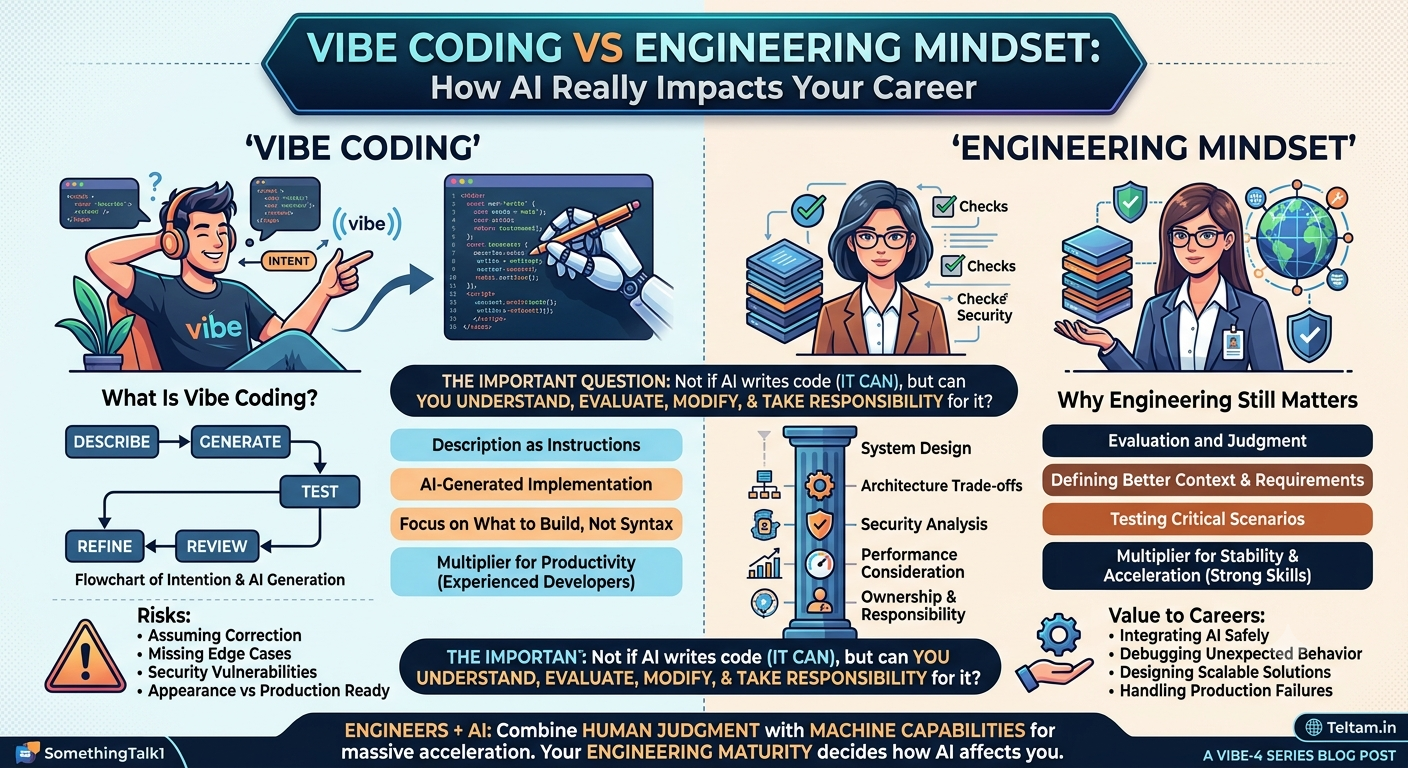
Vibe Coding vs Engineering Mindset: How AI Really Impacts Your Career
AI does not decide your future. Your engineering maturity decides how AI affects you.
Why This Topic Matters Now
Over the last few months, Vibe Coding has become a popular term in the software development world. Developers are increasingly using AI to generate code, design features, debug problems, and accelerate development.
At the same time, we hear statements such as:
- “You don’t need deep coding anymore.”
- “AI will write everything for you.”
- “Prompting is the new programming.”
These statements can create confusion, anxiety, and sometimes dangerous overconfidence.
The important question is not whether AI can write code.
It can.
The more important question is:
Can you understand, evaluate, modify, and take responsibility for the code AI produces?
This blog explores what vibe coding really means, where it works well, where it can fail, and why an engineering mindset continues to matter.
What Is Vibe Coding?
In simple terms, vibe coding means describing your intent to an AI system and allowing it to generate code or logic based on your instructions.
The workflow is often:
Describe → Generate → Test → Review → Refine
Instead of manually writing every line of syntax, developers can spend more time thinking about what they actually want to build.
For example, instead of manually creating an entire API, a developer might ask an AI assistant:
“Create a REST API for managing employee records using Python and a relational database.”
The AI can generate an initial implementation that the developer can then inspect, test, and modify.
An Important Clarification
Vibe coding is not no-thinking coding.
It shifts some of the effort from manually writing syntax toward:
- Defining requirements
- Giving context
- Reviewing generated code
- Testing behavior
- Identifying problems
- Making engineering decisions
AI may handle part of the implementation.
You still handle the responsibility.
Traditional Coding vs Vibe Coding
Traditional Development Flow
Requirement → Design → Manual Coding → Debugging → Testing → Deployment
Vibe Coding Flow
Requirement → AI Prompt → Generated Code → Human Review → Testing → Fix / Refactor → Deployment
So what actually changed?
- Development can become faster.
- Boilerplate work can be reduced.
- Syntax-related effort can decrease.
- Prototyping can become easier.
But several things did not change:
- Responsibility
- Accountability
- Testing
- Security
- Architecture
- Performance considerations
- Engineering judgment
In fact, when AI generates more code, the review process becomes even more important.
Where Vibe Coding Works Very Well
Vibe coding can be extremely useful when the developer already understands the problem and wants to reduce repetitive implementation work.
Common examples include:
- Boilerplate code
- CRUD APIs
- SQL queries
- Data transformations
- Unit-test generation
- Proofs of concept
- Documentation
- Small utility functions
- Integration or “glue” code
Imagine knowing exactly what needs to be built but not wanting to manually type hundreds of repetitive lines.
That is where AI can provide a significant productivity boost.
If you know what should be built, AI can help you build it faster.
Where Vibe Coding Can Fail
The biggest problem begins when developers assume that generated code is automatically correct.
Vibe coding becomes risky when projects involve:
- Large data volumes
- Complex business rules
- Performance requirements
- Security-sensitive operations
- Legacy systems
- Backward compatibility
- Financial transactions
- Production-critical workflows
AI-generated code can sometimes:
- Produce inefficient database queries
- Ignore unusual edge cases
- Handle null values incorrectly
- Introduce security vulnerabilities
- Make incorrect assumptions
- Create unnecessary complexity
- Appear correct while failing under real-world conditions
A piece of code can compile successfully and still be a poor engineering solution.
AI can be confident. It cannot be accountable for your production system.
AI as a Multiplier, Not a Replacement
Think about AI as a multiplier.
Weak engineering skills + AI → Unstable systems
Average engineering skills + AI → Mixed results
Strong engineering skills + AI → Massive acceleration
The same AI tool can produce completely different outcomes depending on the person using it.
Why?
Because experienced engineers can:
- Define better requirements
- Provide better context
- Identify incorrect assumptions
- Evaluate architecture
- Detect performance problems
- Test edge cases
- Understand trade-offs
AI does not eliminate the need for engineering knowledge.
It can increase the value of good engineering knowledge.
Who Benefits Most From Vibe Coding?
Not every developer benefits from AI in the same way.
Beginners
Beginners can use AI to learn and experiment, but blindly accepting generated code can prevent them from developing fundamental skills.
The risk is:
Copy → Run → It works → Never understand why
This creates short-term productivity but weak long-term capability.
Intermediate Engineers
Intermediate developers can gain significant productivity from AI.
However, they need to carefully review generated solutions and understand the reasoning behind them.
Senior Engineers
Experienced engineers can potentially gain the greatest advantage because they can combine AI-generated implementation with strong system-level thinking.
They can ask:
- Is this architecture appropriate?
- Will this scale?
- What are the failure scenarios?
- What security risks exist?
- What happens when the system receives unexpected data?
This creates a powerful combination:
Engineering experience + AI acceleration
Why Engineering Mindset Still Wins
AI is very good at:
- Pattern generation
- Syntax generation
- Repetitive implementation
- Fast experimentation
- Producing alternative solutions
Engineers still need to handle:
- Context
- Requirements
- Trade-offs
- System design
- Risk assessment
- Business understanding
- Ownership
A production system rarely fails simply because someone forgot a semicolon.
It often fails because of a bad decision.
For example:
Should the system prioritize:
- Speed or accuracy?
- Cost or performance?
- Simplicity or flexibility?
- Consistency or availability?
- Security or convenience?
These are engineering decisions.
Why Companies Still Value Experience
When companies ask for experienced AI or software engineers, they are not necessarily asking for years of manually writing code.
They often need people who can:
- Integrate AI into existing systems
- Debug unexpected behavior
- Understand data flows
- Work with APIs and databases
- Design scalable solutions
- Evaluate AI-generated implementations
- Handle production failures
- Make responsible technical decisions
This is why engineering maturity matters more than AI buzzwords.
Knowing the names of dozens of AI tools is not the same as knowing how to build a reliable system.
How Engineers Should Use Vibe Coding
Step 1: Fix the Mindset
Instead of thinking:
“AI will replace me.”
Think:
“AI can accelerate me if I know how to use it correctly.”
The goal is not to compete with AI at typing code.
The goal is to become better at solving problems with AI as a tool.
Step 2: Prompt Like a Designer
A weak prompt might be:
“Write code for this application.”
A stronger prompt provides context:
“Design a scalable solution for this application assuming a large dataset. Explain your assumptions, architecture, potential bottlenecks, and error-handling strategy before generating the code.”
The second approach encourages the AI to consider the problem more carefully.
Better context → Better output → Better review
Step 3: Review Every AI-Generated Solution
After AI generates code, ask yourself:
- What are the edge cases?
- What happens when the data becomes large?
- What assumptions has the AI made?
- What is the time and space complexity?
- Where should validation and logging be added?
Do not evaluate code only by asking:
“Does it run?”
Also ask:
“Is this the right solution?”
Step 4: Treat AI Like a Junior Engineer
A useful mental model is:
AI writes the first draft. You own the final solution.
AI can generate an implementation quickly.
You are responsible for:
- Reviewing it
- Testing it
- Securing it
- Refactoring it
- Integrating it
- Maintaining it
Never assume that generated code is production-ready simply because it works in a small test.
Step 5: Position Yourself Correctly
Instead of focusing only on how many AI tools you have used, demonstrate what you can build with them.
For example, rather than saying:
“I have experience using AI tools.”
A stronger statement is:
“I design and integrate AI capabilities into real software systems.”
The second statement communicates engineering value rather than tool familiarity.
The Biggest Career Mistake to Avoid
The biggest mistake is not using AI.
The bigger mistake is depending on AI without understanding what it produces.
If you stop learning because AI can write code, your technical foundation may become weaker.
If you use AI while continuously improving your fundamentals, your productivity can increase significantly.
Keep learning:
- Programming fundamentals
- Data structures
- Databases
- APIs
- System design
- Testing
- Security
- Cloud concepts
- AI fundamentals
Then use AI to accelerate your work.
The Future Is Not AI vs Engineers
The future is unlikely to be simply:
AI vs Humans
A more useful way to think about it is:
Engineers + AI
The strongest professionals will know how to combine human judgment with machine capabilities.
AI can help generate possibilities.
Engineers decide which possibility is appropriate.
AI can generate code.
Engineers decide whether that code belongs in the system.
AI can identify patterns.
Engineers determine whether those patterns actually matter.
Final Thoughts
Vibe coding is real.
It is powerful.
And it can significantly change how software is developed.
But engineering mindset remains the foundation.
The future belongs to engineers who can:
- Think clearly
- Understand systems
- Define problems
- Evaluate AI output
- Make responsible decisions
- Use AI as leverage rather than a crutch
The goal should not be to become someone who can generate the most code with AI.
The goal should be to become someone who can solve the right problem with the right technology.
AI does not decide your future. Your engineering maturity decides how AI affects you.
Master both — AI tools and engineering thinking — and you become more adaptable, not less relevant.
This blog is part of the VIBE-4 series on SomethingTalk1 and Teltam.in, focused on AI, engineering mindset, practical learning, and the future of software careers.
Comments (0)
No comments yet. Be the first to share your thoughts!
Join the Conversation
Please log in to your Teltam account to post a comment on this article.
Log In to Comment