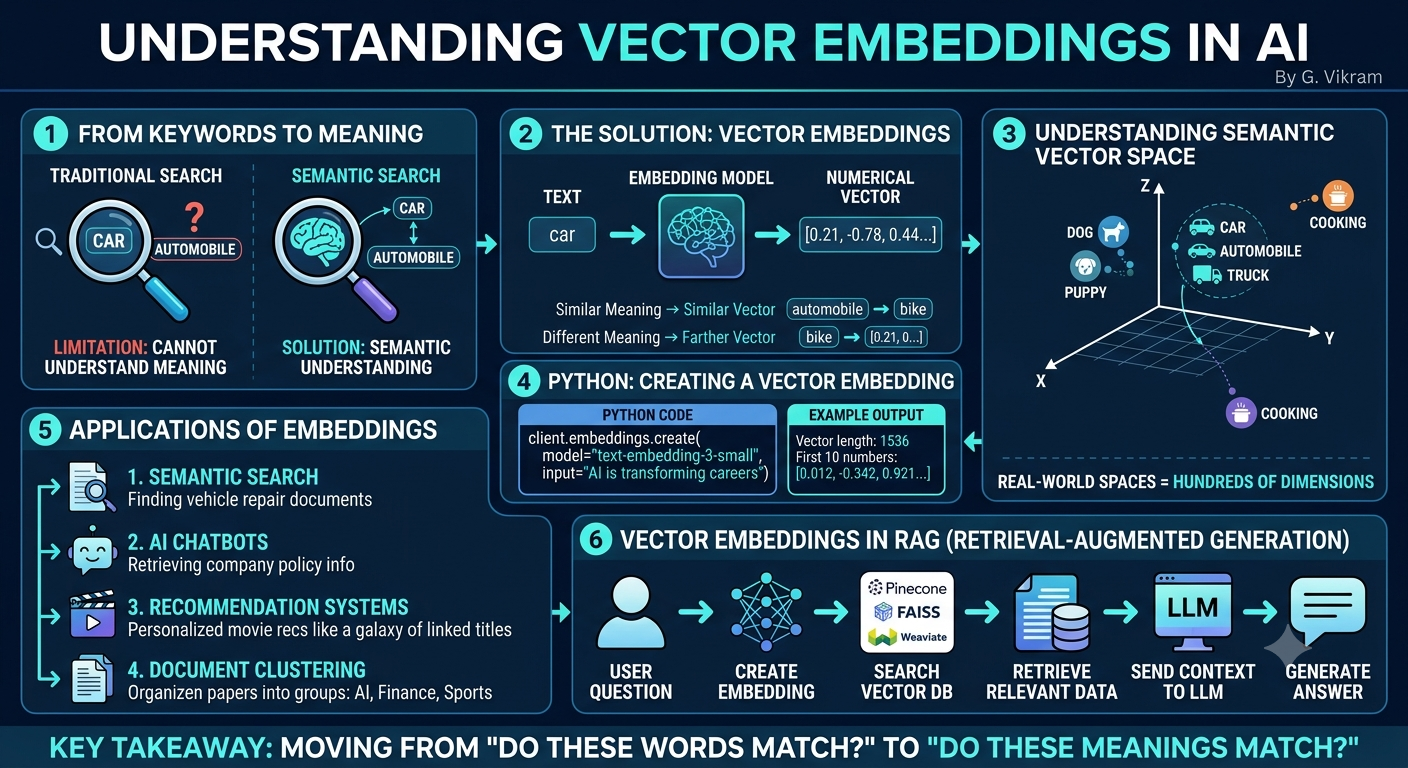
Understanding Vector Embeddings in AI
From Keywords to Meaning: How AI Understands Text
Artificial Intelligence • Machine Learning • Generative AI
By G. Vikram
Digital Consultant | Architect | AI Advisor
March 13, 2026 · 8 min read
Introduction
Modern AI applications such as semantic search, recommendation systems, and intelligent chatbots need to understand the meaning of text, not simply match individual words.
Traditional search systems usually depend on keyword matching. This creates a problem when two different words have similar meanings.
For example:
car and automobile
A human immediately understands that these two words are closely related.
A traditional keyword search system, however, may treat them as completely different words.
This is where Vector Embeddings come into the picture.
In this article, we will understand:
-
Why keyword search has limitations
-
What vector embeddings are
-
How semantic similarity works
-
How to generate embeddings using Python
-
How embeddings power AI search
-
How embeddings are used in RAG
-
Real-world applications of embeddings
1. The Problem: Keyword Search Cannot Understand Meaning
Let's consider a simple search system.
User Query
car repair
Documents in the System
1. automobile maintenance guide
2. how to fix a bike
3. cooking recipes
A traditional keyword search system looks for the exact words:
car
repair
But Document 1 contains:
automobile
maintenance
So the system may fail to return the most relevant document.
The Problem
Humans understand:
car ≈ automobile
repair ≈ maintenance
But keyword matching does not naturally understand these relationships.
The core problem is not simply finding words. It is understanding meaning.
This is called the semantic understanding problem.
2. The Solution: Vector Embeddings
A vector embedding converts text into a numerical representation that captures its semantic meaning.
For example:
car
    ↓
[0.21, -0.78, 0.44, ...]

automobile
    ↓
[0.19, -0.80, 0.40, ...]

bike
    ↓
[-0.55, 0.33, -0.91, ...]
These numbers are generated by an embedding model.
The important idea is:
Similar Meaning
       ↓
Similar Vector Representation
Therefore:
Vector(car) ≈ Vector(automobile)
while an unrelated concept may have a very different representation.
Simple Concept
             TEXT
               ↓
        Embedding Model
               ↓
       Numerical Vector
               ↓
      Semantic Similarity
This allows AI systems to compare information based on meaning rather than exact words.
3. Understanding Semantic Vector Space
Imagine that every word or sentence is represented as a point in a large mathematical space.
Related concepts tend to appear closer together.
Simplified Visualization
                 Dog
                  |
                Puppy


       Car ─── Automobile
                  |
                Truck
This is only a simplified visualization.
Real embedding spaces contain hundreds or thousands of dimensions, depending on the embedding model.
The Key Idea
Similar concepts → closer vectors
Different concepts → farther vectors
This is what allows AI systems to identify semantic relationships.
4. Semantic Similarity Example
Consider these three sentences.
Sentence A
I love programming.
Sentence B
Coding is my passion.
Sentence C
The weather is hot today.
A semantic search system can understand that Sentence A and Sentence B express a similar idea.
| Sentence Pair | Similarity |
|---|---|
| A ↔ B | High |
| A ↔ C | Low |
The important relationship is:
programming ≈ coding
Even though the exact words are different, their meaning is related.
A keyword search might look for the exact word "programming".
An embedding-based system can recognize that "coding" represents a closely related concept.
That is the power of semantic similarity.
5. How Embeddings Power AI Search
One of the most important applications of embeddings is AI-powered semantic search.
A simplified architecture looks like this:
┌─────────────────────┐
│     User Query      │
└──────────┬──────────┘
           ↓
┌─────────────────────┐
│   Embedding Model   │
└──────────┬──────────┘
           ↓
┌─────────────────────┐
│   Vector Database   │
└──────────┬──────────┘
           ↓
┌─────────────────────┐
│ Relevant Documents  │
└──────────┬──────────┘
           ↓
┌─────────────────────┐
│        LLM          │
└──────────┬──────────┘
           ↓
┌─────────────────────┐
│ Intelligent Answer  │
└─────────────────────┘
How the Process Works
Step 1 — User Query
The user asks a question.
Step 2 — Create Embedding
The query is converted into a numerical vector.
Step 3 — Search
The vector database searches for similar vectors.
Step 4 — Retrieve
The most relevant documents are retrieved.
Step 5 — Generate
The retrieved information is provided to an LLM as context.
Step 6 — Answer
The LLM generates the final response.
This architecture is widely used in AI assistants, semantic search systems, and RAG applications.
6. Python: Creating a Vector Embedding
Let's generate an embedding using the OpenAI API.
Python Code
from openai import OpenAI

client = OpenAI()

text = "AI is transforming careers"

response = client.embeddings.create(
    model="text-embedding-3-small",
    input=text
)

embedding = response.data[0].embedding

print("Vector length:", len(embedding))
print("First 10 numbers:", embedding[:10])
Example Output
Vector length: 1536

First 10 numbers:
[0.012, -0.342, 0.921, ...]
The resulting list of numbers represents the input text in the embedding space.
Instead of storing only:
AI is transforming careers
an AI system can also work with its numerical semantic representation.
The exact values of an embedding depend on the model and the input text.
7. Where Are Vector Embeddings Used?
Vector embeddings are not limited to search.
They are used across many modern AI applications.
1. Semantic Search
Semantic search retrieves information based on meaning.
For example, the user searches:
How can I fix my car?
The system may find:
Automobile maintenance
Vehicle repair
Car servicing
Engine troubleshooting
The exact words do not need to match.
The meaning is what matters.
Traditional Search
"car repair"
      ↓
Find exact keywords
      ↓
Return matching documents
Semantic Search
"How can I fix my car?"
      ↓
Create embedding
      ↓
Understand semantic meaning
      ↓
Find related information
2. AI Chatbots
AI chatbots can use embeddings to retrieve relevant information from a knowledge base.
This is useful for:
-
Customer support
-
Educational assistants
-
Enterprise assistants
-
Technical support
-
Knowledge-base chatbots
For example, a company chatbot can search its internal documentation using semantic similarity before generating an answer.
3. Recommendation Systems
Products, movies, songs, and articles can be represented as vectors.
The system can then find items with similar representations.
For example:
User watches
      ↓
Science-fiction movie
      ↓
Compare vectors
      ↓
Find similar content
      ↓
Recommend related movies
This helps create personalized recommendations.
4. Document Clustering
Large collections of documents can be converted into vectors.
Similar documents can then be grouped together.
For example:
        Documents
             ↓
        Embeddings
             ↓
     Similarity Analysis
             ↓
    ┌────────┼────────┐
    ↓        ↓        ↓
 AI Docs   Finance   Sports
This is useful for organizing:
-
Research papers
-
Articles
-
Reports
-
Support tickets
-
Business documents
8. Vector Embeddings in RAG
Retrieval-Augmented Generation (RAG) is one of the most important applications of embeddings.
RAG combines information retrieval with a Large Language Model.
Typical RAG Workflow
             User Question
                   ↓
          Create Embedding
                   ↓
          Search Vector DB
                   ↓
        Retrieve Relevant Data
                   ↓
          Send Context to LLM
                   ↓
             Generate Answer
Why Do Embeddings Matter in RAG?
Imagine that a company has thousands of documents.
A user asks:
What is our work-from-home policy?
The system needs to find the most relevant document before asking the LLM to generate the answer.
Embeddings help identify documents that are semantically related to the question.
Therefore:
User Question
      ↓
Semantic Search
      ↓
Relevant Documents
      ↓
LLM
      ↓
Answer
This makes embeddings a fundamental part of many RAG architectures.
9. Popular Vector Search Technologies
Several technologies can be used to store and search vector embeddings.
| Technology | Purpose |
|---|---|
| Pinecone | Managed vector database |
| FAISS | High-performance similarity search library |
| Weaviate | Vector database and AI search platform |
These technologies help applications efficiently search through large collections of high-dimensional vectors.
10. Keyword Search vs Semantic Search
The difference can be summarized very simply.
Traditional Keyword Search
        Query
          ↓
   Find Matching Words
          ↓
    Return Results
Semantic Search
        Query
          ↓
   Create Embedding
          ↓
   Understand Meaning
          ↓
 Find Similar Vectors
          ↓
 Return Relevant Results
The Transformation
Keyword Matching
       ↓
Semantic Representation
       ↓
Meaning-Based Search
Traditional search mainly focuses on words.
Embedding-based search focuses more on the meaning represented by those words.
This is one of the major shifts that enabled modern AI-powered search systems.
Key Takeaway
Vector embeddings are one of the foundational technologies behind modern AI applications.
They allow machines to represent information numerically and compare different pieces of content based on their semantic relationships.
The complete concept can be remembered as:
       TEXT
        ↓
 EMBEDDING MODEL
        ↓
 NUMERICAL VECTOR
        ↓
SIMILARITY SEARCH
        ↓
RELEVANT INFORMATION
        ↓
   AI RESPONSE
Remember: Embeddings help AI move from:
"Do these words match?"
to:
"Do these meanings match?"
Conclusion
Vector embeddings provide a powerful way for machines to represent and compare the meaning of words, sentences, and documents.
They are used in:
-
AI search engines
-
Intelligent chatbots
-
Recommendation systems
-
Document clustering
-
Retrieval-Augmented Generation (RAG)
Understanding embeddings is an important foundation for anyone building modern AI applications.
Once you understand how text is converted into vectors and compared using similarity, you can move on to more advanced topics such as:
Vector Embeddings
       ↓
Vector Databases
       ↓
Semantic Search
       ↓
RAG
       ↓
Advanced AI Applications
Final Thought
Vector embeddings are the bridge between human language and the numerical representations that AI systems use to understand, compare, and retrieve information.
The better we can represent meaning mathematically, the more effectively AI systems can search, recommend, retrieve, and work with information.
Comments (0)
No comments yet. Be the first to share your thoughts!
Join the Conversation
Please log in to your Teltam account to post a comment on this article.
Log In to Comment