The Future of AI in Product Development
Multi-Agent Systems and the Agentic SDLC
Artificial Intelligence • Product Development • Multi-Agent Systems • Agentic AI
By G. Vikram
Digital Consultant | Architect | AI Advisor
March 15, 2026 · 10 min read
What You'll Learn
Artificial Intelligence is entering a new phase.
For the past few years, most people have interacted with AI through a simple model:
Ask a Question
      ↓
AI Generates an Answer
Tools such as ChatGPT and Perplexity AI made this interaction model accessible to millions of people.
But inside modern product organizations, AI is evolving beyond simple question-and-answer interactions.
The emerging direction is more powerful:
AI systems are becoming teams of specialized agents that collaborate with each other and with humans.
This shift is also transforming how software products are planned, developed, tested, deployed, and monitored.
In this article, we will explore:
-
Multi-Agent Systems
-
AI agent collaboration
-
Human-AI hybrid teams
-
Agentic SDLC
-
AI as a raw material
-
AI as the final product
-
Enterprise AI use cases
-
Internal AI tooling
-
The future of AI-driven product development
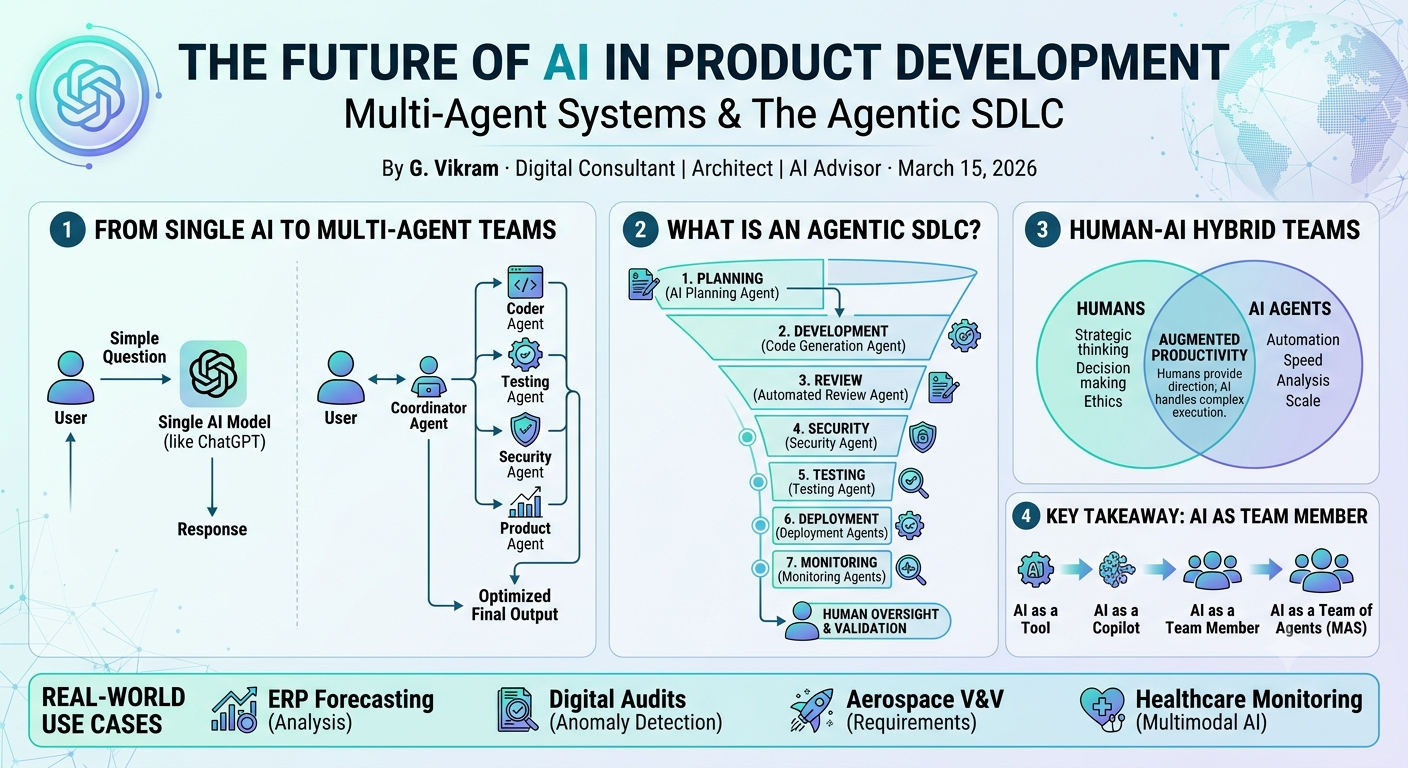
1. From a Single AI Assistant to a Team of AI Agents
Most people today interact with AI like this:
User
  ↓
Ask Question
  ↓
AI Model
  ↓
Response
This works well for many simple tasks.
However, complex work rarely happens in isolation.
In a real organization, multiple people with different responsibilities collaborate to produce a final result.
For example, a software development team may include:
-
Developers
-
Test engineers
-
Security reviewers
-
Product managers
-
Architects
-
DevOps engineers
Each role focuses on a different part of the problem.
The same concept is now being applied to AI systems.
Instead of asking one AI system to perform every task, organizations can create multiple specialized AI agents.
Each agent has a specific responsibility.
Example AI Agents
Coder Agent
Generates or modifies code.
Security Agent
Reviews code for potential vulnerabilities.
Testing Agent
Validates functionality and generates or executes tests.
Product Agent
Checks whether the implementation satisfies business requirements.
Documentation Agent
Creates and maintains technical documentation.
These agents can work together like a small digital engineering team.
2. Single AI vs Multi-Agent Architecture
The difference between the traditional approach and a multi-agent approach can be represented as follows.
Traditional AI System
              User
                │
                ▼
        ┌──────────────┐
        │  Single AI   │
        │    Model     │
        └──────┬───────┘
               │
               ▼
          Final Output
Multi-Agent System
                 User
                   │
                   ▼
        ┌──────────────────┐
        │ Coordinator Agent│
        └────────┬─────────┘
                 │
       ┌─────────┼─────────┐
       │         │         │
       ▼         ▼         ▼
    Coder    Security   Testing
    Agent      Agent      Agent
       │         │         │
       └─────────┼─────────┘
                 │
                 ▼
        ┌──────────────────┐
        │  Product Agent   │
        └────────┬─────────┘
                 │
                 ▼
            Final Output
In this architecture, a Coordinator Agent manages the workflow between specialized agents.
This approach is commonly referred to as a Multi-Agent System (MAS).
3. Why Multi-Agent Systems Matter
The biggest advantage of specialization is that each agent can focus on a particular responsibility.
Consider a simple development task:
Build a user registration system.
Instead of one AI agent doing everything, a multi-agent architecture could divide the work.
User Requirement
       │
       ▼
Coordinator Agent
       │
       ├──────────────► Product Agent
       │                     │
       │                     ▼
       │              Check Requirements
       │
       ├──────────────► Coder Agent
       │                     │
       │                     ▼
       │                 Generate Code
       │
       ├──────────────► Security Agent
       │                     │
       │                     ▼
       │              Security Review
       │
       └──────────────► Testing Agent
                             │
                             ▼
                         Run Tests
The final result can then be reviewed and refined before being presented to the human team.
This creates a workflow that is closer to how real engineering teams operate.
4. AI Agents Can Debate and Refine Solutions
One interesting concept in multi-agent architectures is agent debate.
Instead of blindly accepting the first generated answer, one agent can challenge the work produced by another.
Consider this workflow:
                Requirement
                     │
                     ▼
               Coder Agent
                     │
                     ▼
              Proposed Solution
                     │
                     ▼
              Security Agent
                     │
              ┌──────┴──────┐
              │             │
           Safe?          Risk?
              │             │
              ▼             ▼
          Continue       Revise Code
                            │
                            ▼
                       Coder Agent
Another agent can then validate the business requirements.
Finally, the testing agent can verify whether the implementation actually works.
Example Workflow
Step 1
Coder Agent proposes an implementation.
Step 2
Security Agent checks for vulnerabilities.
Step 3
Product Agent verifies whether business requirements are satisfied.
Step 4
Testing Agent validates the implementation.
Step 5
If problems are detected, the workflow iterates.
Generate
   ↓
Review
   ↓
Test
   ↓
Problems?
   ↓
Yes ───────► Revise
   │            │
   └────────────┘
        ↓
      Test
        ↓
     Approve
This iterative process can produce higher-quality results by introducing multiple perspectives.
5. Humans Are Still Part of the System
One of the most important ideas in agentic AI is that humans do not necessarily disappear from the workflow.
Instead, organizations can move toward Human-AI Hybrid Teams.
Humans and AI agents have different strengths.
Humans Provide
-
Strategic thinking
-
Decision making
-
Product direction
-
Business context
-
Ethical judgment
-
Accountability
AI Agents Provide
-
Automation
-
Analysis
-
Speed
-
Scale
-
Repetitive task execution
-
Continuous processing
The result is a human-in-the-loop architecture.
                Human
                  │
          Strategy & Decisions
                  │
                  ▼
           AI Agent Team
                  │
       ┌──────────┼──────────┐
       ▼          ▼          ▼
     Build      Test       Analyze
       │          │          │
       └──────────┼──────────┘
                  │
                  ▼
              Human Review
                  │
                  ▼
             Final Decision
The human remains responsible for important decisions while AI handles increasingly complex execution tasks.
6. The Evolution of the Software Development Life Cycle
Another major transformation is happening in the Software Development Life Cycle (SDLC).
Traditionally, software development involves stages such as:
Requirements
     ↓
Planning
     ↓
Development
     ↓
Testing
     ↓
Deployment
     ↓
Maintenance
Historically, AI was used mainly for small development tasks such as:
-
Code suggestions
-
Autocomplete
-
Documentation
-
Simple debugging
But AI is now moving into multiple stages of the development lifecycle.
This leads to the concept of the Agentic SDLC.
7. Traditional SDLC vs Agentic SDLC
Traditional SDLC
Planning
   ↓
Development
   ↓
Testing
   ↓
Deployment
   ↓
Maintenance
Agentic SDLC
             Human Product Manager
                     │
                     ▼
             AI Planning Agent
                     │
                     ▼
          Code Generation Agent
                     │
                     ▼
          Automated Review Agent
                     │
                     ▼
              Testing Agent
                     │
                     ▼
        Deployment & Monitoring
              Agents
                     │
                     ▼
              Human Review
In an Agentic SDLC, AI participates in multiple stages of product development.
The developer's role can shift from manually writing every line of code toward:
Designing → Guiding → Reviewing → Validating
This does not eliminate engineering expertise.
Instead, it changes where that expertise is applied.
8. What Is an Agentic SDLC?
An Agentic SDLC is a software development lifecycle in which autonomous or semi-autonomous AI agents participate in development activities across multiple stages.
For example:
Requirements
An AI agent can analyze product requirements and identify missing information.
Planning
A planning agent can break a feature into technical tasks.
Development
A coding agent can generate implementation code.
Code Review
A review agent can inspect the generated code.
Security
A security agent can identify potential vulnerabilities.
Testing
A testing agent can generate and execute test cases.
Deployment
Deployment agents can assist with release workflows.
Monitoring
Monitoring agents can analyze application behavior after deployment.
The overall concept is:
Requirements
     ↓
Planning Agent
     ↓
Coding Agent
     ↓
Review Agent
     ↓
Security Agent
     ↓
Testing Agent
     ↓
Deployment Agent
     ↓
Monitoring Agent
     ↓
Human Oversight
9. AI as Raw Material vs AI as the Final Product
Another useful way to think about enterprise AI is to distinguish between two roles.
AI can be used as:
Raw Material
or
The Final Product
AI as Raw Material
Here, AI works behind the scenes.
The end user may not even realize that AI is being used.
Examples include:
-
Processing enterprise data
-
Sales forecasting
-
Supply-chain planning
-
Inventory prediction
-
Business analytics
-
Fraud detection
-
Internal process automation
For example:
Enterprise Data
      ↓
AI Processing
      ↓
Prediction / Analysis
      ↓
Business Decision
In this case, AI improves the underlying business process.
AI as the Final Product
In other applications, AI becomes the primary user experience.
Examples include:
-
AI assistants
-
AI copilots
-
Intelligent customer-support systems
-
Healthcare monitoring applications
-
AI-powered productivity tools
The architecture may look like:
User
  ↓
AI Interface
  ↓
AI System
  ↓
Response / Action
Here, AI is not simply supporting the product.
AI becomes a core part of the product itself.
10. Real-World Enterprise AI Use Cases
The transition toward agentic systems is not limited to software development.
AI agents and intelligent systems can support many industries.
ERP Forecasting
Organizations can use AI to analyze historical business data and predict future demand.
For example:
Historical Sales
       ↓
AI Analysis
       ↓
Demand Forecast
       ↓
Production Planning
       ↓
Inventory Optimization
This can help businesses make better decisions about production and inventory.
Global Digital Audits
Large organizations may operate across dozens of locations.
Traditional audits can require significant manual effort.
AI systems can assist by analyzing large amounts of enterprise information and identifying:
-
Anomalies
-
Process inefficiencies
-
Unusual patterns
-
Compliance issues
A simplified workflow is:
Enterprise Data
       ↓
AI Analysis
       ↓
Pattern Detection
       ↓
Anomaly Identification
       ↓
Human Audit Review
AI can therefore act as an additional layer of analysis while human experts remain responsible for final decisions.
11. Aerospace Verification and Validation
Aerospace software operates under strict safety and reliability requirements.
Verification and Validation (V&V) are critical parts of the engineering process.
AI can assist engineers by helping with tasks such as:
-
Reviewing requirements
-
Analyzing test results
-
Identifying inconsistencies
-
Supporting documentation
-
Assisting verification workflows
However, safety-critical systems require appropriate human oversight, validation, and compliance processes.
AI assistance does not remove the need for qualified engineers and formal verification procedures.
12. Healthcare Monitoring
Another important application is AI-based health monitoring.
Modern systems can combine information from multiple sources such as:
-
Wearable sensors
-
Cameras
-
Audio signals
-
Health devices
-
Other physiological data
This is an example of multimodal AI processing.
A simplified architecture is:
Wearable Sensors ───┐
                    │
Cameras ────────────┤
                    │
Audio ──────────────┤
                    ▼
             Multimodal AI
                    │
                    ▼
              Risk Analysis
                    │
                    ▼
             Alert / Review
Such systems can help identify patterns that may require attention.
However, healthcare applications require careful validation, privacy protection, regulatory compliance, and human oversight.
13. The Shift Toward Internal AI Tooling
Another important trend is the move toward internal AI platforms and tools.
Instead of depending entirely on external software products, organizations may build AI systems tailored to their own workflows.
This approach can provide several advantages.
Data Privacy
Sensitive enterprise information can be processed within controlled environments.
Customization
Internal systems can be designed around specific organizational requirements.
Integration
AI tools can connect directly with existing enterprise systems.
Cost Control
Organizations can optimize systems according to their own usage patterns and requirements.
A simplified architecture looks like:
Enterprise Systems
       │
       ▼
Internal AI Platform
       │
 ┌─────┼─────┐
 ▼     ▼     ▼
Agent  Agent  Agent
 │     │     │
 └─────┼─────┘
       ▼
Business Applications
The idea is not necessarily to replace external AI models.
Instead, organizations can use external models as components within a larger internal AI architecture.
Tools such as Claude and Perplexity AI can also serve as examples of AI capabilities that organizations may integrate into broader workflows.
14. Why Multi-Agent Systems Are Different
A single AI model can be powerful.
But a multi-agent architecture introduces specialization and collaboration.
Consider:
Single Agent
     ↓
One General-Purpose Workflow
versus:
                  Coordinator
                      │
       ┌──────────────┼──────────────┐
       ▼              ▼              ▼
     Coder         Security        Testing
       │              │              │
       └──────────────┼──────────────┘
                      ▼
                 Final Review
Each agent can have:
-
A specific role
-
Specific instructions
-
Specific tools
-
Specific responsibilities
-
Access to specific information
This makes it possible to design more structured AI workflows.
15. The Future Product Team
The traditional product team might look like:
Product Manager
      +
Developers
      +
Designers
      +
Test Engineers
      +
Security Engineers
The emerging model could become:
Human Product Manager
          │
          ▼
     AI Coordinator
          │
 ┌────────┼────────┬────────┐
 ▼        ▼        ▼        ▼
Coding  Testing  Security  Analysis
Agent    Agent     Agent      Agent
          │
          ▼
      Human Team
This does not mean every organization will immediately replace human roles with agents.
Instead, AI can become a force multiplier for human teams.
The product manager may spend less time on repetitive analysis and more time on strategy.
Developers may spend less time writing boilerplate code and more time on architecture and complex problem solving.
Test engineers may spend less time creating repetitive test cases and more time designing robust validation strategies.
16. The Emerging Agentic Product Development Loop
The future development process may become increasingly continuous.
      Human Idea
          ↓
    Product Planning
          ↓
       AI Agents
          ↓
    Build & Validate
          ↓
       Deployment
          ↓
      Monitoring
          ↓
      User Feedback
          ↓
    Product Analysis
          ↓
    Improved Planning
          │
          └──────────────► Repeat
Instead of thinking of development as a one-way pipeline, organizations can think of it as a continuous AI-assisted product loop.
This could significantly accelerate experimentation and iteration.
17. What Product Leaders Need to Understand
As AI becomes more deeply integrated into product development, product leaders will need to think beyond simply selecting an AI model.
They will need to understand:
Agent Architecture
How multiple AI agents interact.
Human Oversight
Where human approval should be required.
Data Governance
What information agents can access.
Security
How AI-generated actions and outputs should be controlled.
Evaluation
How to measure whether an AI agent is actually performing well.
Cost
How model usage and agent workflows affect operational expenses.
Reliability
What happens when an agent produces an incorrect result.
The challenge is therefore not simply:
"How do we use AI?"
It becomes:
"How do we design reliable systems in which humans and AI agents work together?"
18. Final Thoughts
The biggest insight from the evolution of AI is that the future is unlikely to be defined by a single intelligent model alone.
Instead, we are moving toward ecosystems of intelligent agents collaborating with humans.
The progression can be viewed as:
Single AI Assistant
        ↓
AI Copilot
        ↓
Specialized AI Agents
        ↓
Multi-Agent Systems
        ↓
Human-AI Hybrid Teams
        ↓
Agentic Organizations
At the same time, software development is evolving:
Traditional SDLC
        ↓
AI-Assisted SDLC
        ↓
Agentic SDLC
        ↓
Continuous AI Product Development
This transformation will influence how organizations build products, manage teams, automate workflows, and make decisions.
Key Takeaway
The future of AI in product development is not simply about having a more intelligent chatbot.
It is about creating systems of specialized agents that can plan, build, review, test, analyze, and improve products while humans provide direction, judgment, and accountability.
The most important shift is:
AI as a Tool
     ↓
AI as a Copilot
     ↓
AI as a Team Member
     ↓
AI as a Team of Agents
And the role of humans evolves alongside it:
Manual Execution
       ↓
AI-Assisted Execution
       ↓
Supervision
       ↓
Strategy & Decision Making
Organizations that learn how to design these human-AI systems effectively will be better positioned to build the next generation of digital products.
Conclusion
Artificial Intelligence is moving beyond the traditional question-and-answer model.
The next phase is about collaboration, specialization, autonomy, and continuous interaction between humans and AI agents.
Multi-Agent Systems can divide complex tasks among specialized agents.
Agentic SDLC can bring AI into multiple stages of software development.
Human-AI hybrid teams can combine machine speed and scale with human judgment and strategic thinking.
At the same time, AI can become either an invisible engine operating behind a product or the central experience that users interact with directly.
The future product organization may therefore look very different from today's organization:
                  HUMAN
                    │
             Strategy & Vision
                    │
                    ▼
             AI Coordinator
                    │
        ┌───────────┼───────────┐
        ▼           ▼           ▼
      Build       Test       Analyze
       Agent       Agent       Agent
        │           │           │
        └───────────┼───────────┘
                    ▼
             Deploy & Monitor
                    │
                    ▼
              Human Review
                    │
                    ▼
             Better Product
The future is not necessarily AI replacing humans.
It is increasingly about humans designing, directing, and working alongside intelligent AI systems.
The next generation of products may not be built by humans alone — they may be built by human teams working alongside teams of AI agents.
Comments (0)
No comments yet. Be the first to share your thoughts!
Join the Conversation
Please log in to your Teltam account to post a comment on this article.
Log In to Comment