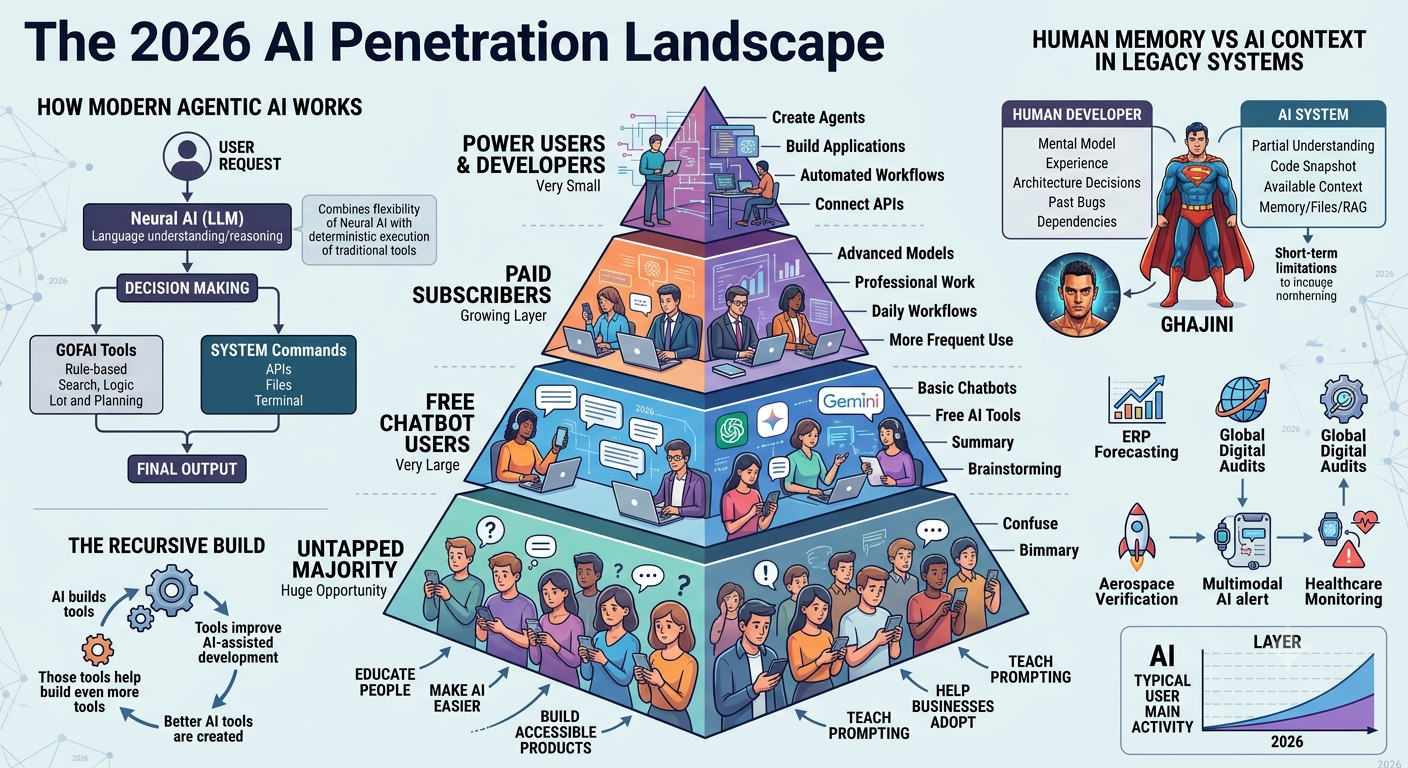
The 2026 AI Penetration Landscape
Who Is Really Using AI — and Who Is Not?
When we talk about AI, it often feels like everyone is using it.
But the reality is very different.
AI adoption is happening at different levels. Some people use AI occasionally for simple questions, while others rely on it for professional work, software development, automation, and building complete AI systems.
A useful way to understand this landscape is to look at different layers of AI users.
Let’s break it down step by step.
Step 1: Understanding the AI User Layers
Instead of looking at AI as simply "used" or "not used," it is more useful to look at levels of adoption and usage.
There are three major groups of AI users.
1. Free Chatbot Users
This is the largest active group of AI users.
These users typically interact with:
- Basic chatbots
- Free AI tools
- Simple question-and-answer systems
- Writing and email assistants
- Everyday productivity tools
Popular examples include:
- ChatGPT
- Gemini
Typical use cases include asking questions, generating emails, summarizing information, brainstorming ideas, and learning new topics.
This represents the entry-level layer of AI adoption.
2. Paid Subscribers
The next layer consists of users who actively pay for premium AI services.
These users generally:
- Use advanced AI models
- Access additional features
- Depend on AI for professional work
- Use AI more frequently
- Integrate AI into their daily workflows
This group is smaller than free users but generally demonstrates deeper AI adoption.
For these users, AI is becoming less of an experiment and more of a productivity tool.
3. Power Users and Developers
This is the smallest group, but potentially the most influential.
These users go beyond simply chatting with AI.
They:
- Build AI applications
- Create AI agents
- Design automated workflows
- Connect AI with APIs
- Build internal AI tools
- Experiment with new AI architectures
This group is small compared with the overall population, but it is responsible for much of the innovation happening around AI systems.
AI Adoption Landscape
              POWER USERS & DEVELOPERS
                    Very Small
                         │
                         ▼
                PAID SUBSCRIBERS
                  Growing Layer
                         │
                         ▼
               FREE CHATBOT USERS
                  Very Large
                         │
                         ▼
              ───────────────────
                UNTAPPED MAJORITY
                 Huge Opportunity
The important point is that AI adoption is still far from universal.
Step 2: The Untapped Majority
Here is one of the most important insights:
A huge portion of the world's population has still not meaningfully used AI.
This means the AI revolution is still in its relatively early stages.
The opportunity is not limited to building better AI models.
There is also a massive opportunity to:
- Educate people about AI
- Make AI easier to use
- Build accessible AI products
- Help businesses adopt AI
- Create AI-powered workflows
- Teach people how to communicate effectively with AI
This is where AI education and content creation become increasingly important.
Step 3: The Return of GOFAI
Most people associate modern AI with neural networks and large language models.
But there is another important part of the story.
It is called GOFAI.
What Is GOFAI?
GOFAI stands for:
Good Old-Fashioned Artificial Intelligence
It refers to traditional AI approaches such as:
- Rule-based systems
- Search algorithms
- Symbolic logic
- Expert systems
- Planning systems
These approaches have existed for decades.
So why are they becoming relevant again?
Because modern AI systems are increasingly combining:
Neural AI + Traditional AI
How Modern Agentic AI Works
                   USER REQUEST
                        │
                        ▼
                ┌───────────────┐
                │   Neural AI   │
                │     (LLM)     │
                └───────┬───────┘
                        │
                        ▼
                 DECISION MAKING
                        │
             ┌──────────┴──────────┐
             │                     │
             ▼                     ▼
      ┌─────────────┐       ┌──────────────┐
      │   GOFAI     │       │    SYSTEM    │
      │ Tools       │       │   Commands   │
      │             │       │              │
      │ Search      │       │ APIs         │
      │ Logic       │       │ Files        │
      │ Planning    │       │ Terminal     │
      └──────┬──────┘       └───────┬──────┘
             │                      │
             └──────────┬───────────┘
                        │
                        ▼
                  FINAL OUTPUT
The LLM provides language understanding and reasoning capabilities, while traditional tools and deterministic systems can provide structured operations, search, rules, and execution.
This combination is particularly important for agentic AI systems.
Key Insight
The future of AI is not necessarily about choosing between neural networks and traditional AI.
Instead, powerful systems can combine both approaches.
Neural networks provide intelligence and flexibility.
Traditional systems provide structure, rules, tools, and deterministic execution.
Together, they can create more capable AI agents.
Step 4: New Tools Changing Everything
The AI tooling landscape is also evolving rapidly.
Modern AI development tools are moving beyond simple chat interfaces.
They increasingly allow AI systems to interact with:
- Files
- Codebases
- Terminals
- APIs
- Applications
- Development environments
Two examples frequently discussed in this space are Claude Code and Claude Cowork.
Claude Code
Claude Code represents a more developer-focused approach.
It can work directly with development environments and help with tasks such as:
- Searching code
- Writing code
- Modifying files
- Reviewing implementations
- Running commands
- Working across a project
This makes AI behave more like an active development assistant rather than a simple chatbot.
Claude Cowork
Claude Cowork focuses more on knowledge workers and non-technical users.
It can help with tasks involving:
- Documents
- Spreadsheets
- Presentations
- Research
- File-based workflows
The broader trend is important:
AI is moving from answering questions to performing tasks.
The Recursive Build
One of the most interesting ideas in modern AI development is the concept of a recursive build.
The basic idea is:
AI builds tools
       │
       ▼
Tools improve AI-assisted development
       │
       ▼
Better AI tools are created
       │
       ▼
Those tools help build even more tools
In other words, AI is increasingly becoming both:
The technology being built
and
A tool used to build that technology.
This creates a potentially powerful feedback loop in software development.
Step 5: The "Ghajini" Memory Problem
Another interesting challenge with AI systems is memory.
A humorous comparison is the movie Ghajini, where the main character experiences severe short-term memory limitations.
AI systems are obviously not experiencing memory loss in the human sense, but the comparison highlights an important technical limitation.
AI models work within a limited context.
This creates a major difference between how humans and AI understand large software systems.
Why AI Works Well for New Projects
AI is particularly effective when working on greenfield projects.
A greenfield project is a project created from scratch.
In such projects, AI can help:
- Design initial architecture
- Generate boilerplate code
- Create prototypes
- Build APIs
- Generate documentation
- Create tests
- Develop a first version quickly
As a result, teams can sometimes reach a working Version 1 much faster.
Why AI Struggles With Existing Systems
The situation becomes more complicated with large legacy systems.
Human developers gradually develop a mental model of a system.
They remember:
- Why architectural decisions were made
- Which modules depend on one another
- Why certain workarounds exist
- Which bugs occurred previously
- What trade-offs were accepted
- Which components are fragile
AI does not automatically possess this long-term organizational memory.
Instead, it typically works with the information available in its current context.
Human Memory vs AI Context
              HUMAN DEVELOPER
                     │
                     ▼
                 Experience
                     │
                     ▼
           Architecture Decisions
                     │
                     ▼
                Past Bugs
                     │
                     ▼
            System Dependencies
                     │
                     ▼
             Deep Mental Model
                   AI SYSTEM
                      │
                      ▼
                 Code Snapshot
                      │
                      ▼
                Available Context
                      │
                      ▼
              Memory / Files / RAG
                      │
                      ▼
             Partial Understanding
This limitation can sometimes result in AI suggesting changes that appear correct locally but cause problems elsewhere in the system.
That is why human review remains essential, especially when working with production and legacy systems.
Step 6: The Changing Role of Developers
As AI becomes more capable, the role of software developers is also changing.
Traditionally:
Developer → Writes Code
Increasingly:
Developer → Designs, Guides, Reviews, and Orchestrates AI
Developers are spending more time on:
- Architecture
- System design
- AI orchestration
- Code review
- Security validation
- Testing
- Production safety
- Business requirements
The developer is gradually becoming an AI supervisor and system designer.
Step 7: A New Operating Model for Engineering Teams
AI is also changing how organizations think about engineering productivity.
Traditional software teams commonly use metrics such as:
- Story points
- Sprint velocity
- Hours worked
- Number of completed tickets
But these measurements become less meaningful when AI agents can complete large portions of implementation work.
New measurements may include:
| Metric | What It Measures |
|---|---|
| Token Consumption | AI resources used |
| Agent Success Rate | Percentage of tasks successfully completed |
| Deployment Time | Speed from idea to production |
| Review Effort | Human effort required to validate AI output |
| Task Completion Time | Overall development speed |
Some teams may also experiment with much shorter development cycles.
Instead of:
Two-week sprint → delivery
the workflow could become:
Idea → AI execution → human review → deployment
within a few hours for suitable tasks.
Step 8: Humans as "Pre-Flight Checkers"
Despite the rapid growth of AI capabilities, humans remain critical.
A useful way to think about the developer's role is as a pre-flight checker.
Before AI-generated work reaches production, humans need to verify that it does not:
- Break authentication
- Introduce security vulnerabilities
- Corrupt production data
- Violate compliance requirements
- Break existing functionality
- Create unexpected system dependencies
AI can move quickly.
Humans provide judgment, responsibility, and safety.
Step 9: Real-World AI Applications
The changing AI landscape is not limited to software development.
AI is increasingly being applied across industries.
ERP Forecasting
AI can analyze historical business data and help predict future demand.
For example:
Historical Sales Data
         │
         ▼
       AI Model
         │
         ▼
 Demand Forecast
         │
         ▼
Production Planning
         │
         ▼
Inventory Optimization
This can help organizations reduce waste and improve planning.
Global Digital Audits
AI systems can analyze enterprise processes across multiple locations.
Instead of relying entirely on manual audits, AI can help identify:
- Anomalies
- Process inefficiencies
- Missing information
- Operational patterns
- Potential risks
Human auditors can then investigate and validate the findings.
Aerospace Verification and Validation
Aerospace software operates under strict safety requirements.
AI can assist engineers with:
- Verification
- Validation
- Test analysis
- Documentation
- Requirements checking
However, because failures can have serious consequences, human oversight remains essential.
Healthcare Monitoring
AI can also process information from multiple sources.
For example:
- Wearable sensors
- Cameras
- Audio
- Medical devices
- Patient information
This is an example of multimodal AI.
A simplified architecture looks like this:
Wearable Sensors ───┐
                    │
Cameras ────────────┤
                    │
Audio ──────────────┤
                    ▼
             Multimodal AI
                    │
                    ▼
             Risk Analysis
                    │
                    ▼
             Real-Time Alert
                    │
                    ▼
             Human Caregiver
Such systems demonstrate how AI can combine multiple information sources to support real-time decision-making.
Step 10: The Shift Toward Internal AI Tooling
Another major trend is the development of internal AI platforms.
Instead of relying entirely on external tools, organizations may build customized AI systems around their own:
- Data
- Processes
- Applications
- Security requirements
- Business workflows
This approach can provide several advantages.
Better Data Privacy
Sensitive enterprise information can remain within controlled environments.
Deeper Customization
AI workflows can be designed specifically for the organization's requirements.
Internal Integration
AI can connect directly with internal databases, applications, APIs, and business processes.
Long-Term Efficiency
Organizations can create reusable AI infrastructure instead of repeatedly purchasing separate solutions.
This trend is sometimes described as micro-engineering — creating focused internal tools that solve specific organizational problems.
The AI Adoption Challenge
Despite rapid innovation, organizations still face significant challenges.
Challenge 1: The Speed of Change
AI technology is changing extremely quickly.
A company may spend significant time:
Evaluate → Approve → Purchase → Deploy
By the time the process is complete, a newer and more capable tool may already be available.
This creates a difficult question:
How can organizations experiment with AI without creating uncontrolled technology risk?
AI-First Sandbox Approach
One possible solution is an AI-first sandbox environment.
Organizations can provide employees with controlled environments where they can:
- Experiment with AI
- Test new tools
- Build prototypes
- Run internal hackathons
- Explore automation ideas
Instead of blocking experimentation through lengthy approval processes, organizations can create safe environments for rapid learning.
Challenge 2: Security
Agentic AI introduces another important concern.
Some AI tools may require access to:
- Files
- Code repositories
- Terminals
- APIs
- Databases
- Internal systems
This creates potential risks such as:
- Data leakage
- Unauthorized access
- Accidental file modification
- Security vulnerabilities
- Exposure of confidential information
Therefore, the more autonomous an AI system becomes, the more important permissions, monitoring, isolation, and human oversight become.
The Bigger Picture
The AI landscape in 2026 is not simply about having better models.
It is about three major questions:
1. Who is using AI?
From casual chatbot users to professional power users.
2. How deeply are they using AI?
From simple questions to automated workflows and autonomous agents.
3. How are AI systems being built?
Increasingly through combinations of:
LLMs + Tools + GOFAI + Agents + Human Oversight
Simple AI Landscape Summary
| AI Layer | Typical User | Main Activity |
|---|---|---|
| Untapped Majority | Non-users | Little or no AI usage |
| Free Users | General users | Questions and basic tasks |
| Paid Users | Professionals | Advanced AI workflows |
| Power Users | AI enthusiasts | Automation and experimentation |
| Developers | Engineers | Building AI applications |
| AI Builders | Advanced teams | Agents and AI platforms |
The most important observation is that the majority of potential AI users are still at the beginning of their journey.
The Technical Future of AI
The next generation of AI systems is likely to combine multiple technologies.
                  MODERN AI SYSTEM
                         │
        ┌────────────────┼────────────────┐
        │                │                │
        ▼                ▼                ▼
   Neural Networks     GOFAI           Tools
        │                │                │
        └────────────────┼────────────────┘
                         │
                         ▼
                  AI AGENT SYSTEM
                         │
                         ▼
                  Human Oversight
                         │
                         ▼
                  Real-World Action
This is a very different model from the traditional chatbot.
The AI is no longer simply:
Question → Answer
Instead, the workflow becomes:
Request → Reason → Plan → Use Tools → Execute → Verify → Respond
That is the foundation of agentic AI.
Final Thoughts
The AI world in 2026 is much bigger than chatbots and large language models.
We are seeing a transition from:
Simple Chatbots → Intelligent Agents
From:
AI Answers → AI Actions
From:
Developers Writing Code → Developers Orchestrating AI
And from:
Traditional Software Workflows → AI-Assisted Workflows
At the same time, traditional AI techniques are finding new relevance.
The future may not belong exclusively to neural networks.
Instead, it may be built around the combination of:
Neural Networks + GOFAI + Tools + Agentic Systems + Human Intelligence
Closing Thought
We are still in the early phase of AI adoption.
The biggest opportunity is not simply building increasingly powerful AI models.
It is helping people and organizations understand how to use those models effectively.
The next major wave of AI may therefore be less about creating another chatbot and more about building intelligent systems that can reason, use tools, collaborate with humans, and take meaningful action.
The future of AI is not just about smarter models.
It is about smarter collaboration between humans and intelligent systems.
Comments (0)
No comments yet. Be the first to share your thoughts!
Join the Conversation
Please log in to your Teltam account to post a comment on this article.
Log In to Comment