Introduction: Why Prompt Engineering Matters
Artificial Intelligence tools like ChatGPT, Gemini, and Claude are becoming powerful assistants for learning, coding, writing, and problem solving.
However, the quality of an AI response depends heavily on how clearly we ask the question.
This skill is known as Prompt Engineering.
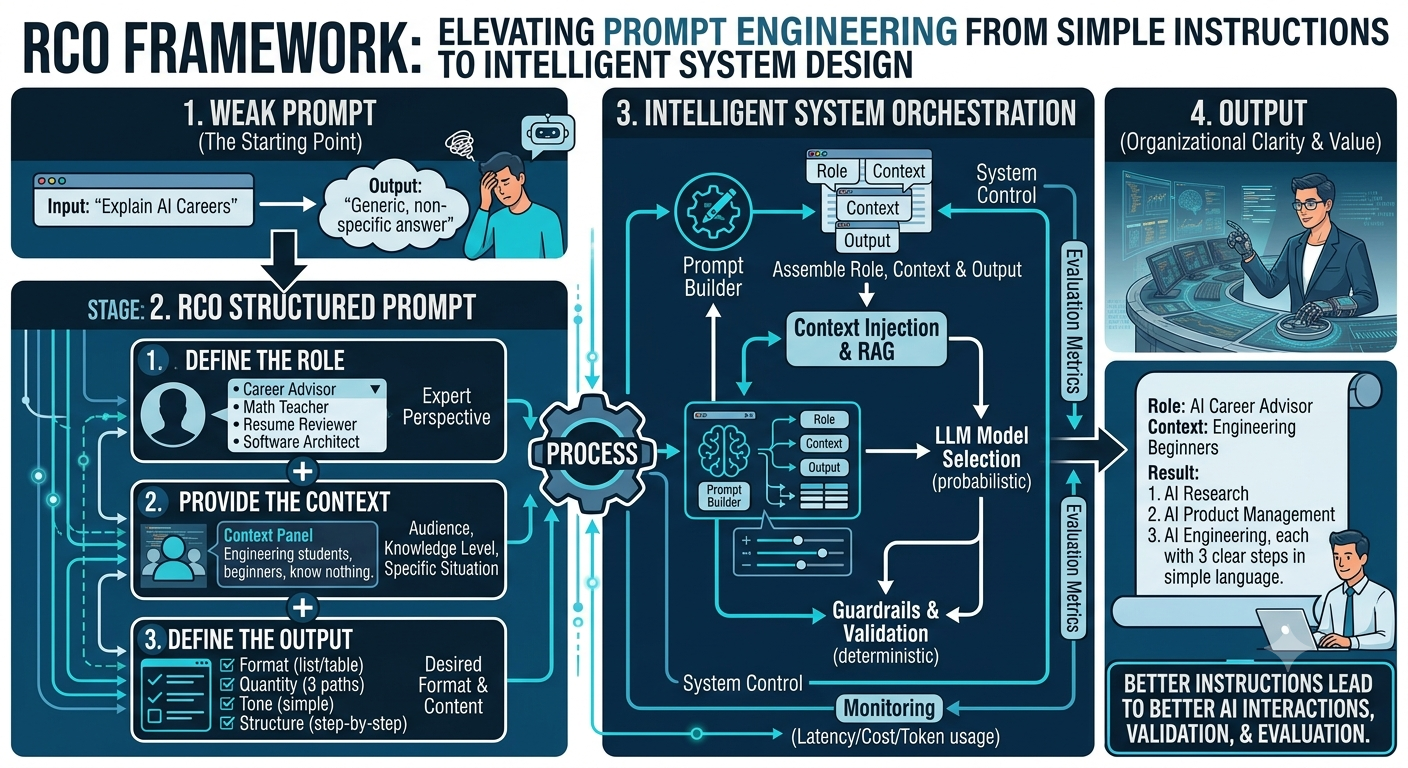
One simple and effective way to structure a prompt is the Role – Context – Output framework.
Prompt Engineering Framework
The Role – Context – Output framework helps structure prompts so that AI can produce clear, relevant, and useful responses.
- Role – Tell the AI who it should act as.
- Context – Provide the background and necessary information.
- Output – Explain what kind of response you want.
Step-by-Step Explanation
Step 1: Define the Role
The Role tells the AI what type of expert or assistant it should act as.
Examples include:
- Career advisor
- Math teacher
- Resume reviewer
- Software architect
- Marketing expert
For example:
Act as an AI career advisor.
When a role is clearly defined, the AI can better adjust its knowledge, tone, and style to the task.
Step 2: Provide the Context
The Context provides the background information needed to understand the problem.
Without enough context, AI tools may produce generic answers that do not fully match your situation.
For example:
Engineering students are beginners and do not know where to start in AI.
This tells the AI:
- Who the audience is
- Their knowledge level
- The purpose of the question
Providing context helps the AI generate a more relevant response.
Step 3: Define the Output
The Output section tells the AI exactly how you want the response to be presented.
Examples include:
- Give 3 career options.
- Provide a step-by-step explanation.
- Explain in simple language.
- Include practical examples.
For example:
Provide 3 AI career options and 3 steps to start each career. Explain in simple language.
Now the AI understands what type of answer is expected and how it should be structured.
How Prompt Quality Affects AI Output
A weak prompt may provide only a general instruction:
Explain AI careers.
This can result in a generic AI answer.
A structured prompt provides:
Role + Context + Output
This gives the AI more information about the expected response and can produce a clearer and more practical answer.
Example of a Complete Prompt
Here is a complete prompt using the Role – Context – Output framework:
Role: Act as an AI career advisor.
Context: Engineering students are beginners and do not know where to start in AI.
Output: Provide 3 AI career paths and 3 steps to start each career. Explain in simple language.
This structure helps AI generate a more organized and useful response.
Practice Exercise
Try creating a prompt using the same framework.
Role: Act as a math teacher.
Context: A 10th-grade student struggles with percentages.
Output: Explain percentages with one example and give one practice question.
Because the role, context, and output are clearly defined, the AI can provide an explanation that is appropriate for the student's level.
Why Prompt Engineering Is Important
Prompt engineering can help you:
- Get more relevant answers from AI tools
- Save time when working with AI
- Improve productivity
- Build AI applications and chatbots
- Communicate requirements more clearly to AI systems
Well-structured prompts are especially useful when working on tasks that require specific formats, audiences, constraints, or outcomes.
Final Thoughts
Prompt engineering is becoming an important skill in the AI era.
The Role – Context – Output framework provides a simple starting point for writing clearer prompts:
- Role defines who the AI should act as.
- Context explains the situation.
- Output defines what you want from the AI.
With practice, you can use structured prompting not only for learning and productivity, but also for building AI applications and solving real-world problems.
Better instructions lead to better AI interactions.
Comments (0)
No comments yet. Be the first to share your thoughts!
Join the Conversation
Please log in to your Teltam account to post a comment on this article.
Log In to Comment