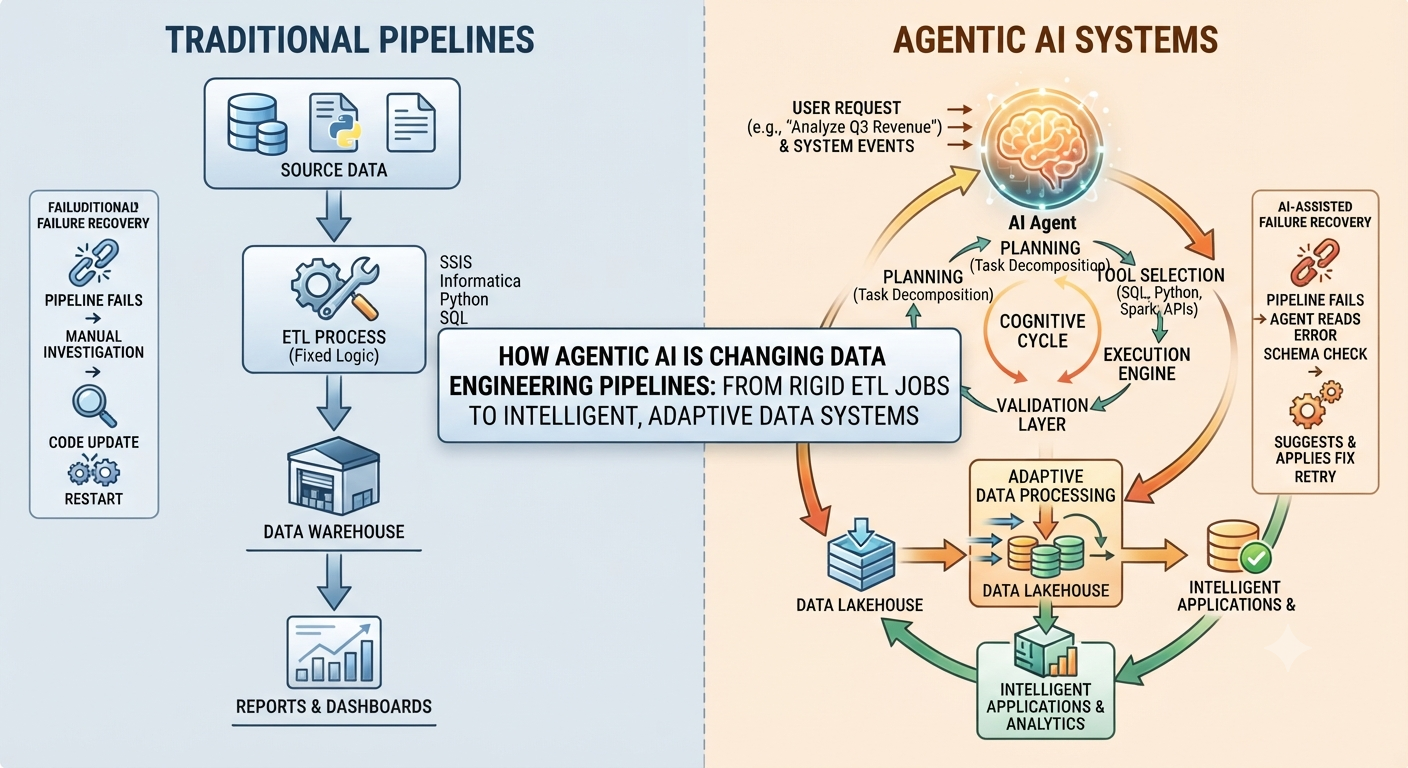
How Agentic AI Is Changing Data Engineering Pipelines
From Rigid ETL Jobs to Intelligent, Adaptive Data Systems
Introduction
Data engineering has traditionally been built around predefined workflows.
A typical pipeline follows a predictable pattern:
Source Data
    ↓
ETL Process
    ↓
Data Warehouse
    ↓
Reports and Dashboards
For many years, this approach has powered enterprise data systems successfully.
Data engineers have used technologies such as:
-
Informatica
-
IBM DataStage
-
SQL Server Integration Services (SSIS)
-
SQL
-
Python
-
Apache Spark
These pipelines are usually predefined, scheduled, and dependent on carefully designed logic.
However, traditional pipelines also have limitations.
If a pipeline fails:
-
Engineers investigate logs.
-
Errors are identified manually.
-
Code is updated.
-
The pipeline is restarted.
If a schema changes:
-
Existing transformations may fail.
-
Engineers need to update the pipeline.
-
Downstream systems may be affected.
As data systems become larger and more complex, maintaining pipelines can require significant engineering effort.
Today, a new approach is emerging.
Instead of building systems that only follow predefined instructions, we are beginning to build systems that can:
-
Understand requests
-
Analyze problems
-
Plan actions
-
Use tools
-
Validate results
-
Respond to failures
This shift is introducing a new concept into data engineering:
Agentic AI in Data Engineering
What Is Agentic AI in Data Engineering?
Agentic AI refers to AI systems that can use language models, tools, memory, and structured workflows to work toward a goal.
In a data engineering environment, an AI agent may help:
-
Understand data requests written in natural language
-
Plan data processing tasks
-
Generate SQL or Python code
-
Select appropriate tools
-
Monitor pipeline execution
-
Analyze failures
-
Suggest possible fixes
-
Validate outputs
The key difference is that the system can participate in the decision-making process.
Traditional pipelines follow predefined logic.
Agentic systems can introduce more adaptive decision-making around that logic.
Traditional Data Pipelines vs Agentic Data Pipelines
Let's understand the difference.
Traditional Data Pipeline
Source Data
    ↓
ETL Job
(Fixed Logic)
    ↓
Data Warehouse
    ↓
Dashboard / Reports
Characteristics:
-
Predefined workflows
-
Fixed execution paths
-
Manual configuration
-
Human intervention when failures occur
If something changes unexpectedly, the pipeline may require an engineer to investigate and fix the issue.
Agentic Data Pipeline
An agentic architecture can introduce an intelligent layer around the data workflow.
User Request / System Event
           ↓
      AI Agent
           ↓
       Planning
           ↓
    Tool Selection
(SQL / Python / Spark / APIs)
           ↓
    Execution Engine
           ↓
    Validation Layer
           ↓
 Memory and Context Store
           ↓
    Output or Next Action
Potential benefits include:
-
Adaptive decision-making
-
Intelligent monitoring
-
Automated troubleshooting
-
Dynamic tool selection
-
Improved pipeline maintenance
The goal is not necessarily to replace traditional pipelines.
Instead, Agentic AI can add intelligence around how pipelines are monitored, managed, and improved.
How an Agentic Data Pipeline Works
Let's understand the architecture step by step.
Step 1: Request Understanding
Imagine a user asks:
"Show me monthly revenue by region for the last six months."
An AI agent first needs to understand the request.
It identifies:
-
The required data
-
The time period
-
The aggregation
-
The grouping criteria
For example:
Request:
Monthly Revenue by Region
Last 6 Months

        ↓

Understand:
• Revenue data required
• Last 6 months
• Group by region
• Aggregate revenue
The system converts the business request into a structured task.
Step 2: Planning
Once the request is understood, the agent can create a plan.
For example:
Goal:
Generate Monthly Revenue Report

        ↓

Plan:

1. Find sales data
2. Filter the last 6 months
3. Group records by region
4. Calculate total revenue
5. Validate the results
6. Generate output
This process is known as task decomposition.
The agent breaks a larger task into smaller steps.
Step 3: Tool Selection
Different data tasks may require different technologies.
For example:
-
SQL for database queries
-
Python for transformations
-
Spark for large-scale processing
-
APIs for external data
-
Data quality tools for validation
The agent can determine which tool is appropriate for the task.
Task
  ↓
AI Agent
  ↓
Which Tool Is Required?
  ↓
SQL / Python / Spark / API
  ↓
Execute Task
This allows the system to connect decision-making with execution.
Step 4: Execution
Once the plan and tools are selected, the execution layer performs the required actions.
For example:
AI Agent
    ↓
Generate SQL Query
    ↓
Send Query to Database
    ↓
Retrieve Results
Or:
AI Agent
    ↓
Generate Transformation Logic
    ↓
Python or Spark
    ↓
Process Data
    ↓
Return Result
The execution layer performs the actual work.
Step 5: Validation
After processing the data, the results need to be validated.
The validation layer may check:
-
Schema consistency
-
Missing values
-
Duplicate records
-
Unexpected values
-
Data quality issues
Example:
Data Processing
      ↓
Validation
      ↓
Schema Check
      ↓
Null Check
      ↓
Duplicate Check
      ↓
Result Validation
If a problem is detected, the system may:
-
Alert an engineer
-
Retry the operation
-
Trigger a fallback workflow
-
Request additional review
Step 6: Memory and Context
An agentic system may maintain information about previous tasks and outcomes.
For example:
-
Common query patterns
-
Previous failures
-
Successful fixes
-
Performance information
-
Pipeline execution history
The purpose is to provide useful context for future decisions.
Pipeline Execution
       ↓
Result
       ↓
Store Relevant Context
       ↓
Future Task
       ↓
Retrieve Useful Information
This can help improve consistency and reduce repeated investigation.
Agentic Data Engineering Architecture
A simplified architecture looks like this:
                USER / SYSTEM EVENT
                        ↓
                   AI AGENT
                        ↓
                    PLANNER
                        ↓
                 TASK BREAKDOWN
                        ↓
                TOOL SELECTION
            ↙       ↓        ↘
          SQL     Python     Spark
            ↘       ↓        ↙
                 EXECUTOR
                        ↓
               DATA PROCESSING
                        ↓
               VALIDATION LAYER
                        ↓
             MEMORY + KNOWLEDGE
                        ↓
              OUTPUT / NEXT STEP
Each component has a specific responsibility.
Real-World Use Cases of Agentic AI in Data Engineering
Now let's explore practical applications.
1. Self-Healing ETL Pipelines
One of the most interesting applications of Agentic AI is intelligent failure handling.
Imagine a SQL query fails because a column name has changed.
Traditional Approach
Pipeline Fails
      ↓
Engineer Checks Logs
      ↓
Find Root Cause
      ↓
Update Code
      ↓
Restart Pipeline
Agent-Assisted Approach
Pipeline Fails
      ↓
Agent Reads Error
      ↓
Analyze Possible Cause
      ↓
Check Schema
      ↓
Suggest or Apply a Validated Fix
      ↓
Retry Execution
For example, an agent could help identify:
-
Missing columns
-
Schema changes
-
Invalid data types
-
Incorrect SQL syntax
Human approval and validation may still be required before production changes are applied.
The goal is to reduce repetitive troubleshooting work.
2. Natural Language Data Queries
Many business users understand what they want from data but may not know SQL.
For example:
"Show the top 10 customers by revenue."
An AI agent can potentially:
-
Understand the request.
-
Identify the relevant data source.
-
Generate a query.
-
Execute it with appropriate permissions.
-
Return the result.
The workflow might look like this:
Natural Language Request
        ↓
Understand Intent
        ↓
Generate Query
        ↓
Validate Query
        ↓
Execute
        ↓
Return Results
This creates a natural-language interface for working with data.
3. Automated Data Quality Monitoring
Data quality is one of the most important parts of data engineering.
AI agents can assist with continuous monitoring.
They may look for:
-
Sudden increases in null values
-
Duplicate records
-
Schema mismatches
-
Unexpected data patterns
-
Data distribution changes
Example:
Incoming Data
      ↓
Quality Monitoring
      ↓
Detect Anomaly
      ↓
Analyze Possible Cause
      ↓
Alert / Trigger Action
The system may then:
-
Notify engineers
-
Trigger validation workflows
-
Run additional checks
-
Route problematic data for review
This can help teams detect issues earlier.
4. Intelligent Pipeline Orchestration
Traditional pipeline orchestration usually follows predefined DAGs and schedules.
For example:
Task A
   ↓
Task B
   ↓
Task C
However, some workloads are more dynamic.
An intelligent orchestration layer may consider:
-
Data volume
-
Processing cost
-
Available compute resources
-
Pipeline priority
-
Previous execution performance
The system can then help determine the most suitable execution path.
For example:
Incoming Task
      ↓
Analyze Requirements
      ↓
Check Data Volume
      ↓
Select Compute Strategy
      ↓
Execute Workflow
This introduces more flexibility into pipeline orchestration.
5. AI Debugging Assistant for Data Pipelines
Debugging data pipelines can take significant time.
An AI-powered debugging assistant can help engineers by analyzing:
-
Pipeline logs
-
Error messages
-
Failed SQL queries
-
Configuration issues
-
Dependency problems
The workflow may look like this:
Pipeline Failure
      ↓
Collect Logs
      ↓
AI Analysis
      ↓
Identify Possible Cause
      ↓
Recommend Fix
      ↓
Engineer Review
In some controlled environments, automated remediation may be possible.
However, critical production systems should include appropriate validation and approval processes.
6. Automated SQL Generation
AI agents can help generate SQL based on business requirements.
Example:
"Show monthly sales by product category."
The agent may translate the request into a structured query workflow.
Business Request
       ↓
Understand Intent
       ↓
Identify Tables
       ↓
Generate SQL
       ↓
Validate SQL
       ↓
Execute Query
This can improve productivity, especially for exploratory analysis.
7. Intelligent Schema Change Detection
Schema changes are a common source of pipeline failures.
For example:
Old Schema

customer_id
customer_name
revenue
A source system changes to:
customer_id
name
total_revenue
Traditional pipelines may fail.
An intelligent monitoring system could:
-
Detect the schema change.
-
Compare the old and new schema.
-
Identify affected transformations.
-
Suggest possible mapping changes.
-
Flag the issue for review.
This can reduce the time required to identify the root cause.
8. Automated Pipeline Documentation
Documentation is often difficult to maintain.
AI agents can potentially help analyze:
-
SQL queries
-
Data transformations
-
Pipeline dependencies
-
Table relationships
They can then generate documentation describing:
-
Data sources
-
Transformations
-
Outputs
-
Dependencies
Example:
Pipeline Code
      ↓
AI Analysis
      ↓
Understand Transformations
      ↓
Generate Documentation
This can help keep documentation closer to the actual implementation.
Why This Shift Matters
The biggest change is not simply automation.
The bigger shift is the introduction of adaptive decision-making into data workflows.
Traditionally:
Humans define every step of the workflow.
With agentic systems, the approach can become:
Humans define the goal and boundaries, while AI helps determine and execute appropriate steps.
This changes how data systems may be designed.
From Automation to Intelligent Assistance
Traditional automation looks like this:
IF condition happens
THEN execute action
Agentic systems can add another layer:
Goal
 ↓
Analyze Situation
 ↓
Determine Possible Actions
 ↓
Select Appropriate Action
 ↓
Execute
 ↓
Observe Result
This makes the workflow more adaptive.
The Role of Data Engineers
Agentic AI does not eliminate the need for data engineers.
Instead, it can change where engineers spend their time.
A significant amount of engineering effort can involve:
-
Monitoring failures
-
Debugging pipelines
-
Handling schema changes
-
Maintaining dependencies
-
Investigating data issues
AI systems may help reduce some repetitive tasks.
This allows engineers to focus more on:
-
Architecture
-
Data platform design
-
Optimization
-
Governance
-
Security
-
Business requirements
The role can evolve from:
Building and maintaining pipelines
toward:
Designing intelligent data systems.
The Future of Data Engineering
In the coming years, we may see greater adoption of:
-
Natural-language data interfaces
-
AI-assisted SQL development
-
Intelligent data quality monitoring
-
Agent-assisted debugging
-
Adaptive orchestration
-
Automated documentation
-
AI-powered workflow management
However, traditional data engineering will remain important.
Databases, ETL processes, distributed computing, data governance, and reliable infrastructure will continue to be essential.
Agentic AI adds an intelligent layer to these systems.
The Future Data Engineering Workflow
A future workflow may look like this:
Business Goal
      ↓
AI Agent
      ↓
Planning
      ↓
Select Data Sources
      ↓
Choose Tools
      ↓
Execute Processing
      ↓
Validate Results
      ↓
Monitor Performance
      ↓
Human Review When Required
      ↓
Deliver Insight
The engineer defines the architecture, rules, permissions, and guardrails.
The AI agent assists with execution and decision-making.
Important Challenges to Consider
Agentic AI also introduces new challenges.
Organizations need to consider:
-
Data security
-
Access control
-
Incorrect AI-generated queries
-
Tool permissions
-
Data privacy
-
Validation
-
Monitoring
-
Human oversight
An AI agent should not automatically receive unrestricted access to production systems.
A well-designed system should include:
AI Agent
   ↓
Permission Check
   ↓
Validation
   ↓
Human Approval (When Required)
   ↓
Execution
Trust and safety are important parts of building production-ready agentic systems.
Final Thoughts
Agentic AI represents an important shift in how data systems can be designed and managed.
We are moving from:
Static Pipelines
      ↓
Intelligent and Adaptive Data Systems
Traditional pipelines execute predefined instructions.
Agentic systems can add the ability to:
-
Understand goals
-
Plan tasks
-
Select tools
-
Analyze failures
-
Validate results
-
Use context from previous operations
The goal is not to remove engineers from the process.
The opportunity is to reduce repetitive operational work and allow engineers to focus more on designing reliable, scalable, and intelligent data systems.
Conclusion
Agentic AI has the potential to transform data engineering pipelines from rigid workflows into more intelligent and adaptive systems.
By combining:
-
Large Language Models
-
Planning
-
Tool usage
-
Execution engines
-
Validation
-
Memory
-
Knowledge systems
organizations can build data platforms that are better equipped to handle complex and changing environments.
The future of data engineering may not be about choosing between traditional pipelines and AI.
Instead, it may be about combining reliable data engineering foundations with intelligent agent-based systems.
The question is no longer simply:
How do we automate the pipeline?
The next question is:
How do we design data systems that can understand, adapt, and assist in managing the pipeline?
That is where Agentic AI can play a major role.
Comments (0)
No comments yet. Be the first to share your thoughts!
Join the Conversation
Please log in to your Teltam account to post a comment on this article.
Log In to Comment