Enterprise AI Governance Stack Explained: From Infrastructure to Ethics
Introduction
Artificial Intelligence is no longer just an experimental technology.
Today, AI is deeply integrated into enterprise systems, helping organizations automate processes, make decisions, improve efficiency, and drive innovation.
However, as AI adoption grows, so do the risks.
Organizations are no longer asking only:
"How do we build AI?"
They are also asking:
"How do we control, monitor, and govern AI responsibly?"
This is where the Enterprise AI Governance Stack becomes important.
An AI Governance Stack provides a structured and layered approach to managing AI systems throughout an organization.
It helps ensure that AI systems are:
-
Reliable
-
Scalable
-
Transparent
-
Secure
-
Responsible
-
Compliant with regulations
In this blog, we will explore the Enterprise AI Governance Stack step by step, from technical infrastructure to risk management, ethics, compliance, and executive oversight.
Understanding the Enterprise AI Governance Stack
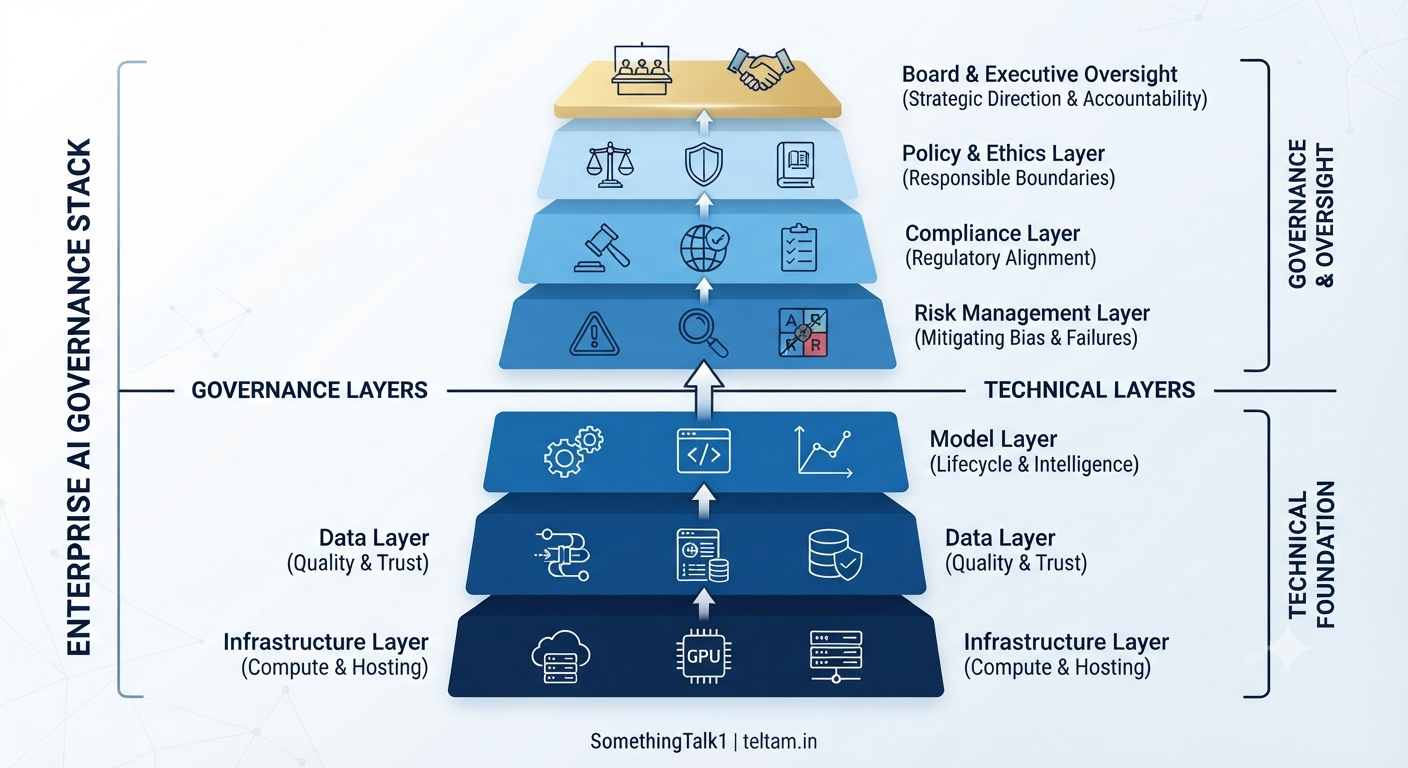
The Enterprise AI Governance Stack can be understood as a multi-layered system.
Each layer has a specific responsibility, and together they help organizations build and manage AI systems responsibly.
Think of the stack like this:
Board & Executive Oversight
            ↑
      Policy & Ethics
            ↑
       Compliance
            ↑
     Risk Management
            ↑
       Model Layer
            ↑
        Data Layer
            ↑
   Infrastructure Layer
The layers can be broadly divided into two categories:
Technical Foundation
-
Infrastructure
-
Data
-
Models
Governance and Oversight
-
Risk Management
-
Compliance
-
Policy and Ethics
-
Board and Executive Oversight
The bottom layers provide the technical foundation, while the upper layers provide control, accountability, and strategic direction.
Together, they help create AI systems that are both powerful and trustworthy.
Part 1: Technical Foundation Layers
Infrastructure → Data → Model
These are the core technical layers that power enterprise AI systems.
1. Infrastructure Layer
The Infrastructure Layer is the foundation of the entire AI ecosystem.
AI systems require computing power, hosting environments, APIs, and monitoring systems to operate effectively.
This layer typically includes:
-
Compute resources such as CPUs and GPUs
-
Cloud infrastructure
-
Model hosting platforms
-
API endpoints
-
Monitoring systems
-
Telemetry and logging
Why Does Infrastructure Matter?
Without reliable infrastructure:
-
AI models may not run efficiently
-
Real-time AI applications may fail
-
Scaling becomes difficult
-
Monitoring becomes challenging
-
System reliability can be affected
Example Technologies and Platforms
Some commonly used technologies include:
-
MLflow
-
AWS
-
Microsoft Azure
-
Google Cloud Platform (GCP)
The Infrastructure Layer helps ensure:
Performance + Scalability + Reliability
It provides the foundation on which the rest of the AI system operates.
2. Data Layer
Data is often described as the fuel of AI systems.
AI models depend on data to learn, make predictions, and generate insights.
However, enterprise data can come from many different sources.
This creates challenges related to:
-
Data quality
-
Data consistency
-
Security
-
Privacy
-
Access control
The Data Layer helps organizations manage these challenges.
Key Responsibilities
The Data Layer focuses on:
-
Data quality
-
Data consistency
-
Data lineage
-
Access control
-
Security
-
Privacy compliance
What is Data Lineage?
Data lineage helps organizations understand:
Where did this data come from?
It tracks the journey of data from its original source through different transformations and systems.
This is important for:
-
Auditing
-
Debugging
-
Compliance
-
Trust
Key Functions
The Data Layer may include:
-
Data cleaning
-
Data transformation
-
Data integration
-
Data storage
-
Data governance
Example Technologies
Some example tools include:
-
Databricks
-
Unity Catalog
-
dbt
The goal of the Data Layer is simple:
Build trust in the data pipeline.
Because if the data cannot be trusted, the AI system built on top of it cannot be trusted either.
3. Model Layer
The Model Layer is where the AI intelligence lives.
This layer focuses on managing AI and machine learning models throughout their lifecycle.
Key Areas Include:
-
Model training
-
Model deployment
-
Model versioning
-
Explainability
-
Performance monitoring
-
Drift detection
Why is Model Governance Important?
AI models are not static.
Over time, models can:
-
Lose accuracy
-
Experience performance degradation
-
Become biased
-
Produce unexpected results
-
Become less reliable as real-world data changes
This is why continuous monitoring is important.
Important Model Governance Activities
Organizations need to track:
-
Which model version is currently deployed
-
How the model performs
-
Whether the model is drifting
-
Whether the model can explain its predictions
-
Whether the model is producing unexpected results
Example Tools
Some commonly used tools include:
-
MLflow
-
Evidently AI
-
Weights & Biases
The Model Layer helps ensure that AI models remain:
Accurate + Explainable + Auditable
Part 2: Governance Layers
Risk → Compliance → Ethics → Leadership
Building AI systems is only one part of the challenge.
Organizations must also manage:
-
Risks
-
Regulations
-
Ethical concerns
-
Business accountability
This is where the governance layers become important.
4. Risk Management Layer
AI introduces new types of risks.
Unlike traditional software systems, AI systems can make predictions or decisions that may have unexpected consequences.
Common AI Risks Include:
-
Bias in predictions
-
Incorrect automated decisions
-
Unexpected model behavior
-
Ethical concerns
The Risk Management Layer helps organizations identify and manage these risks.
Key Responsibilities
This layer focuses on:
-
Risk classification
-
Impact assessment
-
Risk monitoring
-
Risk tracking
Example Framework
One example mentioned in AI governance is the:
NIST AI Risk Management Framework (RMF)
The main objective is to identify potential risks early and take appropriate actions to reduce them.
In simple terms:
Risk Management helps organizations understand what can go wrong before it becomes a serious problem.
5. Compliance Layer
Enterprises operate within legal, regulatory, and industry requirements.
As AI adoption increases, organizations need to demonstrate that their AI systems follow relevant regulations and standards.
The Compliance Layer helps organizations prepare for this.
Key Responsibilities
The Compliance Layer focuses on:
-
Audit readiness
-
Regulatory mapping
-
Documentation
-
Compliance monitoring
Examples of Standards and Regulations
Examples include:
-
EU AI Act
-
ISO 42001
-
SOC 2
The goal of this layer is to help organizations maintain proper documentation and governance processes.
It helps reduce:
Legal + Regulatory + Compliance Risks
6. Policy and Ethics Layer
AI systems should not only be technically powerful.
They should also be used responsibly.
The Policy and Ethics Layer focuses on defining boundaries for AI usage.
This Layer Defines:
-
Acceptable AI usage
-
Responsible AI practices
-
Bias mitigation rules
-
Human oversight mechanisms
-
Ethical guidelines
Why Does AI Ethics Matter?
Without proper ethical policies:
-
AI systems can cause harm
-
Bias can go unnoticed
-
Users may lose trust
-
Organizations may face reputational risks
The goal is to ensure that AI systems align with:
-
Human values
-
Fairness
-
Transparency
-
Accountability
In simple terms:
Ethics defines what AI should and should not do.
7. Board and Executive Oversight
AI governance is not only a technical responsibility.
It is also a business and strategic responsibility.
Senior leadership needs to understand:
-
Where AI is being used
-
What risks AI introduces
-
What value AI creates
-
Whether AI aligns with business goals
This Layer May Include:
-
Chief AI Officer (CAIO)
-
AI Governance Committees
-
Executive Leadership Teams
-
Board-Level Oversight
Key Responsibilities
Leadership may focus on:
-
Strategic direction
-
Monitoring AI impact
-
Business alignment
-
Governance accountability
This ensures that AI is not implemented simply because it is a new technology.
Instead, AI should support meaningful business goals.
The ultimate objective is:
Business Value + Accountability
How All the Layers Work Together
The real strength of the Enterprise AI Governance Stack comes from integration.
Each layer supports the others.
Let's look at the complete flow:
Infrastructure
     ↓
Provides the foundation for AI systems

Data
     ↓
Feeds information into AI models

Models
     ↓
Generate predictions and insights

Risk Management
     ↓
Identifies and manages potential risks

Compliance
     ↓
Ensures alignment with standards and regulations

Policy & Ethics
     ↓
Defines responsible boundaries for AI

Board & Executive Oversight
     ↓
Provides strategic direction and accountability
Together, these layers create a more:
-
Reliable
-
Scalable
-
Transparent
-
Governed
-
Responsible
AI ecosystem.
A Simple Way to Understand the Stack
Think about building an AI system like building a company.
Infrastructure
Provides the technical foundation.
Data
Provides the information.
Models
Provide the intelligence.
Risk Management
Identifies what could go wrong.
Compliance
Ensures rules and standards are followed.
Policy and Ethics
Defines responsible boundaries.
Leadership
Provides direction and accountability.
Every layer is important.
If one layer is weak, the overall AI system can become difficult to manage.
Why Does Enterprise AI Governance Matter?
AI is becoming increasingly important in enterprise decision-making and automation.
However, deploying AI without governance can create serious challenges.
Organizations need governance to help ensure:
-
AI systems are reliable
-
Data is properly managed
-
Models are monitored
-
Risks are identified
-
Regulations are considered
-
Ethical concerns are addressed
-
Leadership maintains accountability
AI governance helps organizations move from:
Experimenting with AI
to:
Building reliable and scalable enterprise AI systems
Why This Matters for You
Whether you are a:
-
Data Engineer
-
AI Engineer
-
Machine Learning Engineer
-
Software Architect
-
Business Leader
Understanding the Enterprise AI Governance Stack is becoming increasingly valuable.
It helps you understand how enterprise AI systems move beyond simply training and deploying models.
This knowledge can help professionals:
-
Build production-grade AI systems
-
Understand AI risks
-
Avoid costly mistakes
-
Improve system scalability
-
Build stakeholder trust
The Big Shift in Enterprise AI
Earlier, organizations often focused mainly on:
Building better AI models.
Today, the challenge is much broader.
Organizations must focus on:
Building responsible, scalable, reliable, and governed AI systems.
This is a major shift.
The future of enterprise AI is not only about intelligence.
It is also about:
-
Governance
-
Accountability
-
Transparency
-
Risk Management
-
Responsible AI
Conclusion
AI is no longer just about building models.
Enterprise AI requires organizations to build systems that are:
-
Reliable
-
Scalable
-
Transparent
-
Secure
-
Responsible
-
Governed
The Enterprise AI Governance Stack provides a structured approach to achieving this.
It connects technical foundations with governance and leadership.
Infrastructure
      ↓
Data
      ↓
Models
      ↓
Risk Management
      ↓
Compliance
      ↓
Policy & Ethics
      ↓
Executive Oversight
Together, these layers help organizations:
-
Scale AI confidently
-
Manage risks effectively
-
Improve accountability
-
Support compliance requirements
-
Build trustworthy AI systems
As organizations continue to adopt AI, those that invest in governance will be better positioned to manage risks while building reliable and scalable intelligent systems.
Final Takeaway
Building AI is only the beginning.
Building AI responsibly, reliably, and with proper governance is what makes enterprise AI sustainable.
Closing
Want to learn more about:
-
Artificial Intelligence
-
Generative AI
-
AI Governance
-
Responsible AI
-
AI Agents
-
Machine Learning
-
Enterprise AI Architecture
Follow for more educational content.
YouTube: SomethingTalk1
Website: teltam.in
Comments (0)
No comments yet. Be the first to share your thoughts!
Join the Conversation
Please log in to your Teltam account to post a comment on this article.
Log In to Comment