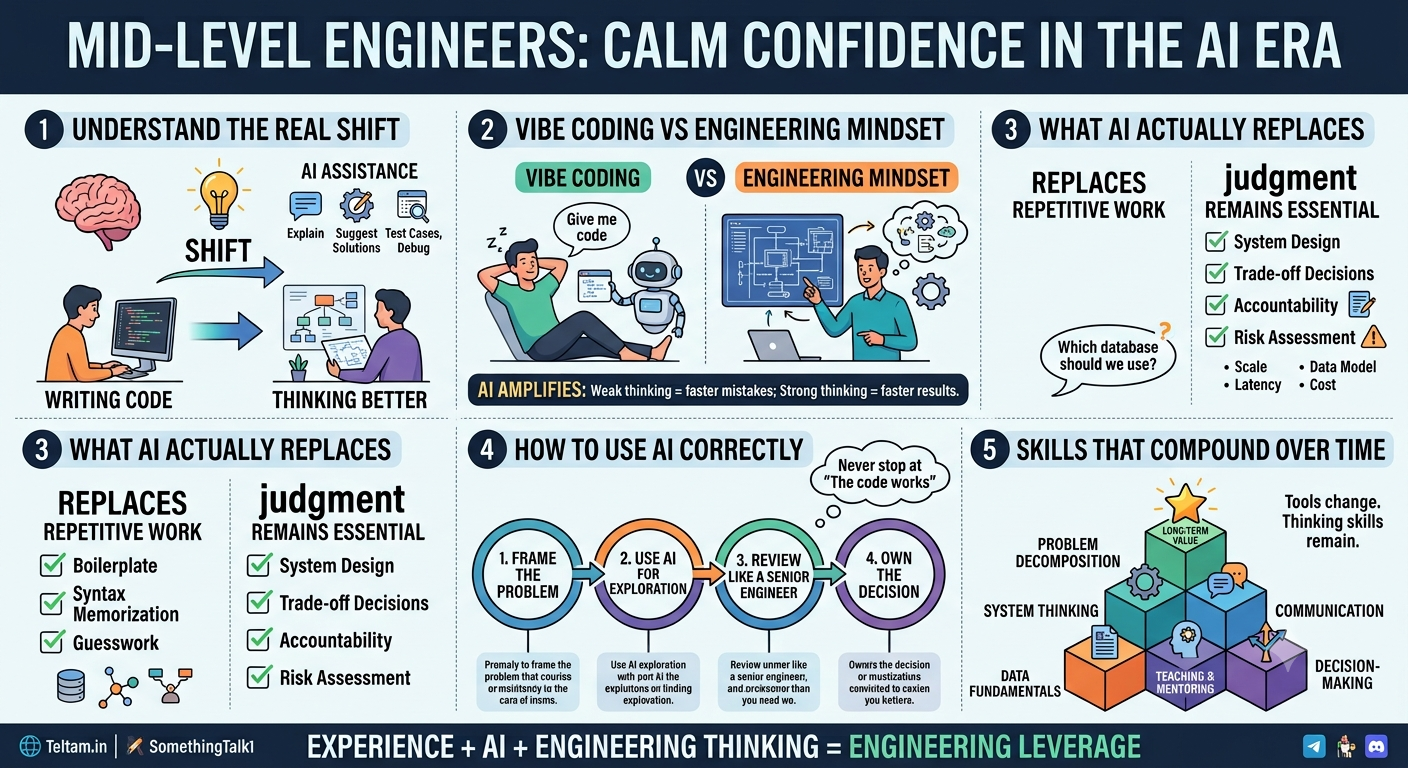
Introduction: Noise vs Reality
Artificial Intelligence is everywhere today.
Social media is filled with bold statements:
- “AI will replace engineers.”
- “Just learn a few AI tools and you’re safe.”
- “Coding is dead.”
For mid-level engineers, especially those with several years of professional experience, these statements can create confusion and anxiety.
But the reality is more practical.
AI is not replacing engineering. AI is changing how engineering work is done.
This blog takes a calm and practical approach to understanding that change. The goal is not to create fear or hype, but to understand what is changing, what remains important, and how engineers can continue growing in the AI era.
Step 1: Understand the Real Shift
Before AI became widely available, engineers spent a significant amount of time manually writing code, searching for solutions, reading documentation, and solving repetitive implementation problems.
Today, AI can assist with many of these activities.
It can:
- Generate code
- Explain unfamiliar code
- Create examples
- Suggest solutions
- Generate test cases
- Help with documentation
- Assist with debugging
This means the nature of engineering work is gradually shifting.
Earlier
Understand → Design → Write Code → Debug → Test
Today
Understand → Design → Ask AI → Review → Test → Improve
The difference is important.
AI can speed up execution, but it does not automatically provide understanding.
The engineer still needs to know what the system is supposed to achieve and whether the generated solution is appropriate.
The shift is from writing more code to thinking better about problems.
Step 2: Vibe Coding vs Engineering Mindset
One of the biggest discussions around AI-assisted development is vibe coding.
Vibe coding generally means describing what you want and allowing AI to generate much of the implementation.
This can be useful, but it becomes dangerous when developers stop thinking critically about the generated output.
Vibe Coding
A typical approach might look like:
Prompt → Generate → Copy → Run
It can work well for:
- Prototypes
- Simple applications
- Boilerplate
- Small scripts
- Experiments
But the approach can become problematic when the system becomes complex.
Engineering Mindset
An engineering-focused approach looks more like:
Problem → Requirements → Architecture → AI Assistance → Review → Testing → Deployment
The focus is not simply on getting code.
The focus is on understanding:
- Data flow
- System behavior
- Edge cases
- Performance
- Security
- Scalability
- Failure scenarios
AI can help with implementation, but the engineer remains responsible for the final solution.
The Key Difference
Vibe coding asks:
“Give me code for this.”
Engineering thinking asks:
“Help me understand the problem, evaluate the possible approaches, and then implement the right solution.”
AI amplifies the approach you already have.
- Weak thinking → faster mistakes
- Strong thinking → faster results
Step 3: What AI Actually Replaces
Let's be honest.
AI does reduce the need for some types of work.
For example:
- Repetitive coding
- Boilerplate generation
- Syntax memorization
- Basic documentation
- Simple transformations
- Guess-based trial and error
These activities can often be accelerated significantly with AI.
But there are areas where engineering judgment remains essential.
AI does not automatically replace:
- System design
- Trade-off decisions
- Business understanding
- Data interpretation
- Complex debugging
- Risk assessment
- Accountability
Consider a simple question:
“Which database should we use?”
Generating database configuration is relatively easy.
Deciding whether the database is appropriate for the application's:
- Scale
- Data model
- Latency requirements
- Consistency requirements
- Security needs
- Cost constraints
is an engineering decision.
If your value comes only from writing syntax, the changing nature of AI should concern you.
If your value comes from understanding problems and designing reliable solutions, AI can become an advantage.
Step 4: Why Mid-Level Engineers Still Matter
Mid-level engineers occupy an important position in software teams.
They have usually gained experience with:
- Programming fundamentals
- Real-world systems
- Production issues
- Business requirements
- Team collaboration
- Debugging
- Technical constraints
They have also seen something that beginners may not have experienced yet:
Things break.
A demo may work perfectly.
Production can still fail because of:
- Unexpected data
- High traffic
- Network problems
- Database bottlenecks
- Incorrect assumptions
- Security issues
- Integration failures
This experience is valuable.
AI can act like a junior engineering assistant that never gets tired.
It can generate ideas, code, explanations, and alternatives.
But someone still needs to:
- Ask the right questions
- Validate the output
- Understand the consequences
- Decide what should reach production
The engineer remains responsible.
Step 5: How to Use AI Correctly
AI becomes much more valuable when engineers use it as part of a structured workflow.
1. Frame the Problem Clearly
Before opening an AI tool, understand the problem.
Ask yourself:
- What is the goal?
- What inputs are available?
- What output is required?
- What constraints exist?
- What data is involved?
- What could go wrong?
A poorly defined problem usually produces a poorly defined AI request.
2. Use AI for Exploration
Instead of immediately asking AI to generate the final implementation, use it to explore possibilities.
Ask questions such as:
- “What approaches can solve this problem?”
- “What are the advantages and disadvantages of each approach?”
- “What could become a bottleneck?”
- “What edge cases should I consider?”
- “What security risks should I check?”
This changes AI from a simple code generator into a thinking assistant.
3. Review Like a Senior Engineer
Never stop at:
“The code works.”
Ask:
- Does it handle edge cases?
- Will it work with large datasets?
- Is it secure?
- Is it maintainable?
- Is it unnecessarily complex?
- What happens when a dependency fails?
- Is the performance acceptable?
A successful test case does not automatically mean a successful production system.
4. Own the Decision
Avoid saying:
“AI wrote it.”
Instead, your mindset should be:
“AI helped generate the solution. I reviewed it, tested it, and chose this approach.”
That difference represents engineering ownership.
AI can assist with implementation.
You own the decision.
Step 6: Skills That Will Compound Over Time
Technology tools will continue changing.
The skills behind good engineering will remain valuable.
Focus on developing:
Problem Decomposition
Learn how to break large problems into smaller, manageable components.
System Thinking
Understand how different parts of an application interact.
Data Fundamentals
Understand how data is collected, stored, transformed, and used.
Communication
A technically correct solution is not enough if you cannot explain it to your team or stakeholders.
Teaching and Mentoring
The ability to explain concepts and guide others becomes increasingly valuable as your experience grows.
Decision-Making
Learn to evaluate trade-offs rather than searching for a single “perfect” technology.
These skills compound with experience.
Tools change. Thinking skills remain.
AI Should Increase Your Leverage
The goal of AI adoption should not be:
“How can I make AI do everything?”
A better question is:
“How can AI help me become more effective?”
For example, an engineer might use AI to:
- Generate a first draft
- Explore alternative implementations
- Explain unfamiliar technologies
- Create test scenarios
- Summarize documentation
- Automate repetitive work
The engineer then applies experience and judgment to evaluate the result.
This creates a productive relationship:
Human judgment + AI capability = Engineering leverage
What Mid-Level Engineers Should Do Now
There is no need to panic.
There is also no reason to ignore AI.
A practical approach is:
Learn AI
Understand the fundamentals of:
- Generative AI
- Large language models
- Prompting
- Context
- AI agents
- AI-assisted development
Use AI
Start with practical tasks in your daily workflow.
Strengthen Engineering
Continue improving:
- Programming
- Databases
- APIs
- System design
- Testing
- Security
- Cloud fundamentals
Build Real Projects
Do not learn AI only through tutorials.
Use it to solve actual problems and understand where it helps and where it fails.
Final Thoughts: Calm Confidence Beats Panic
Mid-level engineers are not becoming irrelevant.
But complacency is dangerous.
The answer is not to ignore AI.
The answer is also not to blindly depend on it.
The strongest approach is to combine:
Experience + AI + Engineering Thinking
AI can make implementation faster.
Engineering thinking makes the implementation meaningful, reliable, and useful.
The future belongs to engineers who can understand problems, work with AI, evaluate its output, and make responsible technical decisions.
AI may change the tools we use, but engineering thinking determines how effectively we use them.
Learn AI.
Use AI.
But protect and strengthen the engineering mindset that makes you valuable in the first place.
Calm confidence beats panic.
This blog is part of the learning journey through Teltam.in and SomethingTalk1, focused on AI foundations, engineering thinking, practical learning, and long-term professional growth.
Comments (0)
No comments yet. Be the first to share your thoughts!
Join the Conversation
Please log in to your Teltam account to post a comment on this article.
Log In to Comment