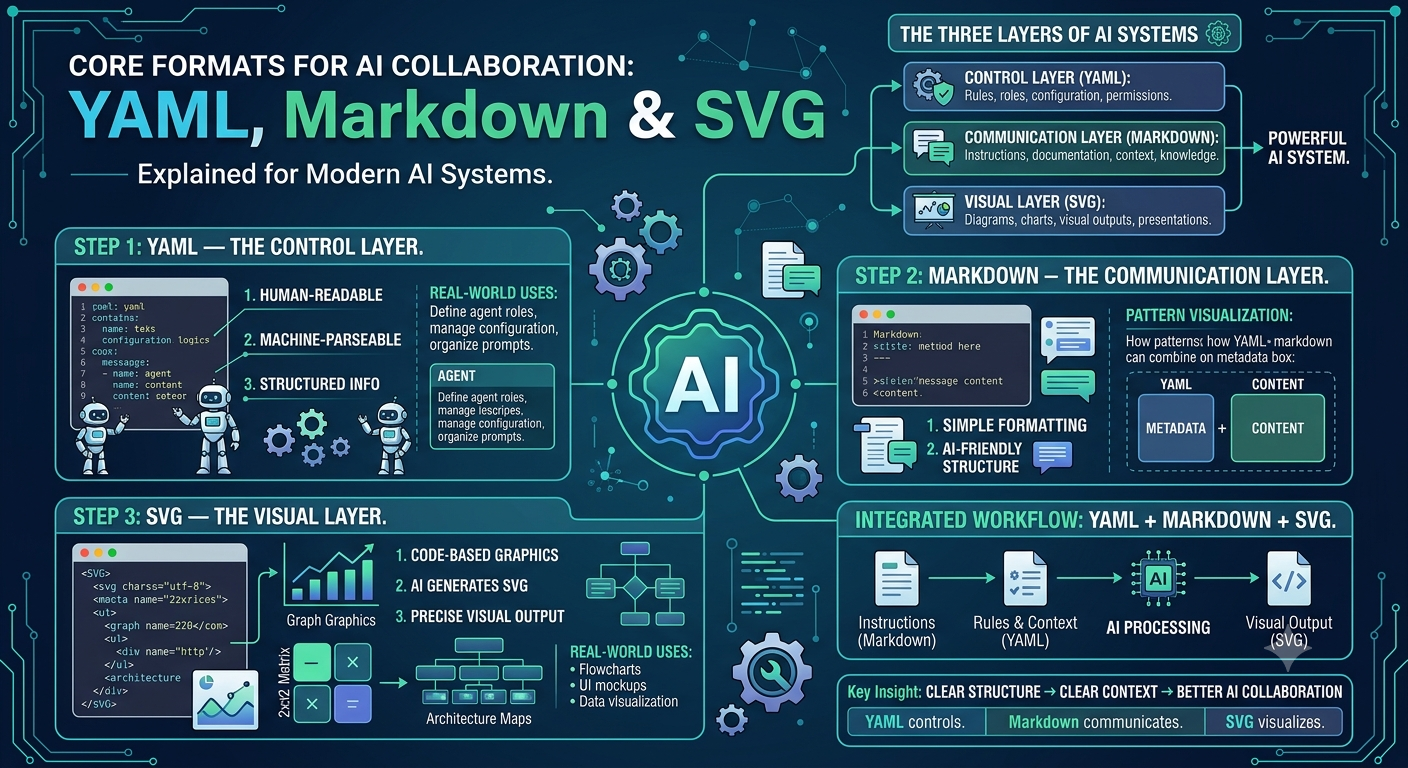
Core Formats for AI Collaboration: YAML, Markdown & SVG Explained for Modern AI Systems
The Hidden Foundation Behind Modern AI Systems
When people talk about AI, they usually focus on models, prompts, APIs, and tools.
But behind effective AI systems, something more fundamental is happening.
AI needs structure.
AI needs memory.
AI needs context.
AI needs a clear way to communicate.
A powerful model alone does not guarantee a powerful AI system. The way information is organized and communicated can have a major impact on the quality of the results.
A key idea discussed in a recent session by Balaji Viswanathan was that modern AI systems increasingly depend on three important formats:
YAML + Markdown + SVG
These formats can be viewed as three complementary layers:
| FormatLayerMain Purpose | ||
| YAML | Control Layer | Rules, configuration, roles, permissions |
| Markdown | Communication Layer | Instructions, documentation, context |
| SVG | Visual Layer | Diagrams, charts, visual outputs |
Let's understand each one step by step.
Step 1: YAML — The Control Layer
Think of YAML as the configuration or control center of an AI system.
YAML stands for YAML Ain't Markup Language and is commonly used for storing structured configuration data.
One of its biggest advantages is readability.
Unlike JSON, YAML does not require large numbers of curly braces and quotation marks. It uses indentation to represent structure, making it relatively easy for humans to read and edit.
Why Is YAML Useful for AI Systems?
1. Human-Readable
YAML is designed to be easy for humans to understand.
For example:
agent:
  name: Code Reviewer
  role: reviewer
  permissions:
    - read
    - analyze
The structure is immediately visible.
2. Machine-Parseable
Although YAML is easy for humans to read, software can also parse it and use the information programmatically.
This makes it useful for AI applications where configuration needs to be shared between humans and software.
3. Useful for Structured Information
YAML can organize information into a hierarchy.
For example:
project:
  name: AI Assistant

agent:
  role: reviewer
  temperature: 0.2

permissions:
  read_files: true
  write_files: false
This provides a clean way to describe how an AI system should operate.
Real-World Uses of YAML
YAML can be used for:
-
Defining agent roles
-
Managing configuration
-
Storing structured context
-
Defining permissions
-
Organizing prompt-related settings
-
Describing workflows
-
Configuring AI tools
For example, an organization could define different AI agents:
agents:

  coder:
    role: Code Generator
    permission: write

  reviewer:
    role: Code Reviewer
    permission: read

  tester:
    role: Testing Agent
    permission: execute_tests
Each agent has a clearly defined responsibility.
Simple Mental Model
YAML = Control Center
Diagram 1: AI Collaboration Layers
                  ┌─────────────────────────┐
                  │       YAML (.yaml)      │
                  │       CONTROL LAYER     │
                  │ Rules • Prompts •       │
                  │ Permissions • Config    │
                  └────────────┬────────────┘
                               │
                               ▼
                  ┌─────────────────────────┐
                  │     Markdown (.md)      │
                  │   COMMUNICATION LAYER    │
                  │ Docs • Instructions •   │
                  │ Context • Knowledge      │
                  └────────────┬────────────┘
                               │
                               ▼
                  ┌─────────────────────────┐
                  │       SVG (.svg)        │
                  │     VISUAL LAYER         │
                  │ Diagrams • Charts •      │
                  │ Visual Presentations     │
                  └─────────────────────────┘
These three formats can work together to create a structured environment for humans and AI agents.
Step 2: Markdown — The Communication Layer
If YAML represents control, Markdown represents communication.
Markdown is a lightweight text-formatting language that is widely used for documentation, technical writing, notes, and AI instructions.
For example:
# Code Review Instructions

## Role

You are a senior software reviewer.

## Tasks

- Check the code for bugs.
- Identify security issues.
- Suggest improvements.
- Do not modify the original code.
The format is simple but highly structured.
Why Is Markdown Important for AI?
Simple Formatting
Markdown provides an easy way to structure information using:
-
Headings
-
Lists
-
Tables
-
Code blocks
-
Links
-
Bold and italic text
For example:
## Security Review

Check the following:

- Authentication
- Authorization
- Input validation
- Data protection
AI-Friendly Structure
Large Language Models frequently process structured text, and Markdown provides clear boundaries between different pieces of information.
Instead of sending an unorganized paragraph, developers can create sections such as:
Role
Instructions
Context
Constraints
Examples
Expected Output
This makes the information easier to understand and maintain.
Universal Usage
Markdown is used across many areas, including:
-
Software documentation
-
Technical notes
-
README files
-
AI instructions
-
Knowledge bases
-
Project documentation
-
Internal engineering guides
YAML + Markdown: A Powerful Combination
One particularly useful pattern is combining YAML metadata with Markdown content.
For example:
---
title: AI Code Reviewer
role: reviewer
permissions: read-only
---

# Instructions

Review the submitted code.

Check for:

- Bugs
- Security issues
- Performance problems

Do not modify the original source code.
The YAML section provides metadata and configuration.
The Markdown section provides instructions and content.
This creates a simple separation:
YAML = What the system is and how it should behave
Markdown = What the system needs to know and do
Simple Mental Model
Markdown = Conversation Layer
Step 3: SVG — The Visual Layer
Now we come to one of the most interesting formats: SVG.
SVG stands for Scalable Vector Graphics.
Unlike a traditional raster image, SVG describes graphics using structured elements.
That makes SVG particularly interesting for AI-generated visual content.
Why Is SVG Useful?
1. Code-Based Graphics
An SVG file contains structured information describing shapes, text, paths, and other visual elements.
For example:
image
This means a visual can be created and modified programmatically.
2. AI Can Generate SVG
Because SVG is structured, AI systems can generate diagrams and other visual content through code.
An AI agent can potentially create:
-
Architecture diagrams
-
Flowcharts
-
Process diagrams
-
Charts
-
UI mockups
-
Infographics
3. Precise Visual Output
SVG provides control over elements such as:
-
Position
-
Size
-
Text
-
Shapes
-
Connections
-
Alignment
This makes it useful when precise visual layouts are required.
Real-World Uses of SVG
SVG can be useful for:
-
Architecture diagrams
-
Workflow diagrams
-
Competitive analysis
-
Data visualization
-
UI mockups
-
Presentation graphics
-
Technical illustrations
Simple Mental Model
SVG = Visualization Layer
Diagram 2: How AI Uses These Formats Together
                         USER INPUT
                             │
                             ▼
                  ┌──────────────────────┐
                  │   Markdown (.md)     │
                  │                      │
                  │ Instructions         │
                  │ Context              │
                  │ Documentation        │
                  └──────────┬───────────┘
                             │
                             ▼
                  ┌──────────────────────┐
                  │     YAML (.yaml)     │
                  │                      │
                  │ Rules                │
                  │ Configuration        │
                  │ Roles & Permissions  │
                  └──────────┬───────────┘
                             │
                             ▼
                  ┌──────────────────────┐
                  │    AI Processing     │
                  │                      │
                  │   LLM / AI Agent    │
                  └──────────┬───────────┘
                             │
                             ▼
                  ┌──────────────────────┐
                  │      SVG (.svg)      │
                  │                      │
                  │ Diagrams             │
                  │ Charts               │
                  │ Visual Results       │
                  └──────────────────────┘
The basic flow is:
Instructions → Context & Rules → AI Processing → Visual Output
Step 4: Why Structure Matters for AI
One of the biggest lessons from modern AI development is that communication quality matters.
Consider two prompts.
Unstructured Prompt
Analyze our competitors and create something useful.
The AI has very little information about:
-
The objective
-
The target audience
-
The expected output
-
The evaluation criteria
-
The available context
Now consider a structured approach.
ROLE:
You are a market research analyst.

OBJECTIVE:
Analyze competing forecasting products.

TARGET:
CFOs in large organizations.

OUTPUT:
Create a 2x2 competitive positioning matrix.

AXIS X:
Organization Size

AXIS Y:
Market Maturity
The second approach gives the AI significantly more structure.
This is why formats such as YAML and Markdown can become important building blocks for AI systems.
Step 5: Real Example — Competitive Analysis Sprint
Let's consider a practical example.
Imagine a company wants to build a competitive analysis tool for a forecasting product that uses enterprise data and targets CFOs.
The AI system needs to:
-
Understand the task.
-
Understand the industry.
-
Understand the target customer.
-
Analyze competitors.
-
Organize the findings.
-
Produce a visual representation.
This is where the three formats can work together.
Markdown Provides the Instructions
For example:
# Competitive Analysis

Analyze forecasting platforms targeting CFOs.

Focus on:

- Enterprise capabilities
- Forecasting features
- Data integration
- AI capabilities
- Market positioning
YAML Provides Structured Context
industry: Enterprise Software

target_customer: CFO

product_category: Forecasting

analysis_type: Competitive Analysis

output:
  format: 2x2 Matrix
  x_axis: Organization Size
  y_axis: Market Maturity
AI Processes the Information
The AI system combines:
Instructions + Context + Data
and performs the analysis.
SVG Produces the Visualization
The final result could be a 2×2 competitive positioning matrix.
                 MARKET MATURITY
                       HIGH
                        │
                        │     Competitor A
                        │
                        │              Competitor B
                        │
                        │
                        │
                        │
                        │
                        │ Competitor C
                        │
                        └────────────────────────────
                           SMALL              LARGE
                              ORGANIZATION SIZE
The visual representation can then be generated as an SVG.
Step 6: The Three-Layer AI Model
We can summarize the entire concept using three layers.
┌─────────────────────────────────────────────┐
│                 VISUAL LAYER                │
│                    SVG                      │
│                                             │
│         Diagrams • Charts • Visuals         │
└──────────────────────┬──────────────────────┘
                       │
                       ▼
┌─────────────────────────────────────────────┐
│              COMMUNICATION LAYER            │
│                  Markdown                   │
│                                             │
│       Instructions • Context • Docs         │
└──────────────────────┬──────────────────────┘
                       │
                       ▼
┌─────────────────────────────────────────────┐
│                 CONTROL LAYER               │
│                    YAML                     │
│                                             │
│       Rules • Roles • Config • Access       │
└─────────────────────────────────────────────┘
Together, these layers provide a structured environment for AI collaboration.
Step 7: AI Collaboration Is More Than Prompting
A common misconception is that AI engineering is simply about writing better prompts.
But modern AI systems are becoming more complex.
They may involve:
-
Multiple agents
-
External tools
-
Databases
-
APIs
-
Knowledge bases
-
Structured configuration
-
Documentation
-
Visual outputs
-
Automated workflows
As complexity increases, simply writing a prompt is not enough.
Developers need ways to organize the entire AI environment.
This is where structured formats become valuable.
The Communication Problem in AI
A powerful model can still produce poor results if the information supplied to it is unclear.
Think of AI as an extremely capable collaborator.
If you give a human engineer vague requirements, they may produce the wrong solution.
The same principle applies to AI systems.
A better approach is:
Clear Structure → Clear Context → Better AI Collaboration
This is why the design of AI instructions and information architecture deserves as much attention as the model itself.
Key Insight
One important takeaway from the session was:
Communication with AI is often underestimated.
The quality of an AI system depends not only on the intelligence of its model but also on how effectively information is communicated to it.
If you know:
what to ask → how to structure it → what context to provide → what output to expect
AI becomes much more useful.
YAML vs Markdown vs SVG
| FormatPrimary RoleBest Used For | ||
| YAML | Control | Rules, configuration, roles, permissions |
| Markdown | Communication | Instructions, documentation, context |
| SVG | Visualization | Diagrams, charts, visual outputs |
A simple way to remember them is:
YAML controls.
Markdown communicates.
SVG visualizes.
Why These Formats Matter for AI Engineers
If you are building AI systems, learning only Python and APIs is not enough.
You also need to understand how information flows through your system.
For example:
Human
  │
  ▼
Instructions
  │
  ▼
Markdown
  │
  ▼
YAML Configuration
  │
  ▼
AI Agent
  │
  ▼
Processing
  │
  ▼
SVG / Structured Output
  │
  ▼
Human
This creates a continuous loop between human instructions, machine processing, and understandable output.
Final Thoughts
Most people think AI success depends primarily on:
-
Models
-
APIs
-
Tools
-
Computing power
But building effective AI systems requires more than selecting a powerful model.
It requires structure, clarity, context, and communication.
Three formats provide a useful mental framework:
YAML
Structure and control
Markdown
Communication and context
SVG
Visualization and presentation
Together, they can form an important part of the information layer surrounding modern AI applications.
The bigger lesson is simple:
Don't think about AI only as a model. Think about the entire system that communicates with, controls, and presents the model.
If you are building AI agents, copilots, RAG systems, or AI-powered products, start thinking beyond code.
Start thinking about formats, structure, context, and communication.
That is where effective AI engineering begins.
Comments (0)
No comments yet. Be the first to share your thoughts!
Join the Conversation
Please log in to your Teltam account to post a comment on this article.
Log In to Comment