Introduction: Starting an AI Career in 2026
Artificial Intelligence is transforming almost every industry. From healthcare and finance to software development, AI skills are becoming increasingly important for future careers.
For students, this creates exciting opportunities. However, with so many AI technologies and learning resources available, knowing where to start can be confusing.
This guide provides a simple, step-by-step roadmap for students who want to start building an AI career in 2026.
Step 1: Learn Programming Fundamentals
The first step toward an AI career is learning programming fundamentals.
Python is widely used in AI, machine learning, and data science, making it a practical language for beginners to start with.
Focus on these topics:
- Python basics
- Variables, conditions, and loops
- Functions and modules
- Lists, tuples, sets, and dictionaries
- Basic data structures
- Working with datasets
- Basic statistics
Do not rush into advanced AI concepts before becoming comfortable with programming. Strong fundamentals make it easier to understand machine learning and AI systems later.
Step 2: Build Data and Machine Learning Skills
Once you understand programming, the next step is learning how computers identify patterns from data.
Start by understanding basic machine learning concepts such as:
- Supervised learning
- Classification
- Regression
- Training and testing data
- Model evaluation
You can then explore popular machine learning and deep learning frameworks such as TensorFlow and Keras.
Start with small problems before moving to complex models. For example, you could build a simple house-price prediction model or analyze a small dataset.
Step 3: Use AI Tools for Learning
AI tools can become useful learning assistants when used correctly.
For example:
- ChatGPT can help explain difficult concepts, generate examples, debug code, and create practice exercises.
- Perplexity AI can help with research and technical explanations.
Instead of simply asking AI to give you an answer, use it to understand why the answer works.
Ask follow-up questions, request examples, and try implementing the solution yourself. This turns AI from an answer generator into a learning assistant.
Step 4: Build Real AI Projects
Learning concepts is important, but building projects is where your knowledge becomes practical experience.
Start with projects that match your current skill level.
Beginner-friendly AI project ideas include:
- AI chatbot
- Recommendation system
- Image classification model
- Sentiment analysis application
- Simple prediction system
As your skills improve, make your projects more realistic by adding a database, API, web interface, authentication, deployment, or monitoring.
A good project should demonstrate not only that you can train a model, but also that you understand how to build an application around it.
Step 5: Build Your Portfolio
After completing projects, organize your work into a professional portfolio.
Your portfolio can include:
- Project descriptions
- GitHub repositories
- Technologies used
- Problem statements
- Implementation details
- Results and screenshots
- Live project demonstrations
Instead of listing only technologies, explain what problem you solved and how you solved it.
Step 6: Prepare for AI Career Opportunities
Once you have developed your technical skills and portfolio, start preparing for career opportunities.
Focus on:
- Building a strong resume
- Preparing for technical interviews
- Practicing Python and SQL
- Understanding machine learning fundamentals
- Improving problem-solving skills
- Preparing your project explanations
Career platforms can also help students identify skill gaps and improve their preparation. Platforms such as teltam.in provide tools including AI Career Copilot, Resume Scorer, and AI Personal Assistant.
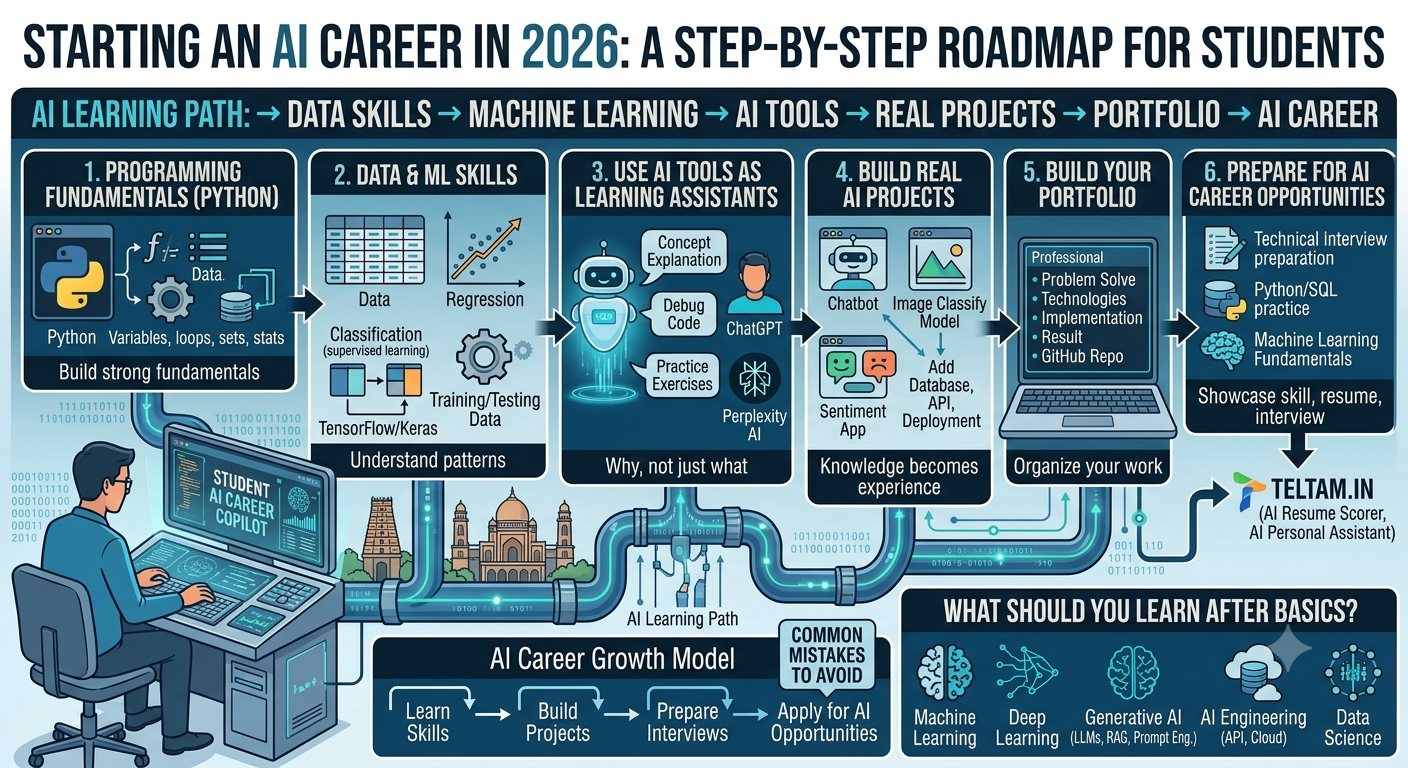
AI Learning Path
Programming → Data Skills → Machine Learning → AI Tools → Real Projects → Portfolio → AI Career
This represents a practical progression for students beginning their AI journey.
AI Career Growth Model
Learn Skills
↓
Build Projects
↓
Create Portfolio
↓
Prepare for Interviews
↓
Apply for AI Opportunities
Following this progression makes the learning process more structured and achievable.
What Should You Learn After the Basics?
After building a strong foundation, you can choose a specialization based on your interests.
- Machine Learning: Focus on models, data, and prediction.
- Deep Learning: Explore neural networks, computer vision, and advanced models.
- Generative AI: Learn LLMs, prompt engineering, RAG, and AI applications.
- AI Engineering: Learn APIs, deployment, cloud platforms, evaluation, and production systems.
- Data Science: Focus on data analysis, statistics, visualization, and predictive modeling.
You do not need to learn everything at once. Build your foundation first and specialize gradually.
Common Mistakes Students Should Avoid
- Trying to learn every AI technology simultaneously
- Skipping programming fundamentals
- Watching tutorials without building projects
- Copying AI-generated code without understanding it
- Building projects without documenting them
- Ignoring interview preparation
The goal is not to learn every tool. The goal is to understand the fundamentals and apply them to real problems.
Final Thoughts
AI is one of the most exciting and rapidly evolving technology fields. Students do not need to master everything immediately.
Start with programming fundamentals, develop your data and machine learning knowledge, use AI tools as learning assistants, and build real-world projects.
Then turn those projects into a portfolio and prepare for career opportunities.
The journey can be summarized simply:
Learn → Practice → Build → Deploy → Showcase → Apply
With consistent learning and practical experience, students can gradually develop the skills needed to pursue careers in the AI industry.
Comments (0)
No comments yet. Be the first to share your thoughts!
Join the Conversation
Please log in to your Teltam account to post a comment on this article.
Log In to Comment