AI Agents Explained – How Autonomous AI Systems Think, Plan, and Act
Artificial Intelligence is moving beyond simply answering questions.
Modern AI systems can now plan tasks, use tools, remember context, make decisions, and take actions. These systems are commonly known as AI agents.
But what exactly makes an AI system an agent?
This blog explains AI agents from an engineering perspective — without unnecessary hype.
What Is an AI Agent?
An AI agent is a software system that can understand a goal, reason about the required steps, use available tools, and take actions to achieve that goal.
A traditional AI application might simply:
- Receive an input
- Process the input
- Return an output
An AI agent goes further.
It can:
- Understand the objective
- Break the objective into smaller tasks
- Decide what action to take
- Use external tools
- Observe the result
- Adjust its approach
An AI agent is not just answering. It is working toward a goal.
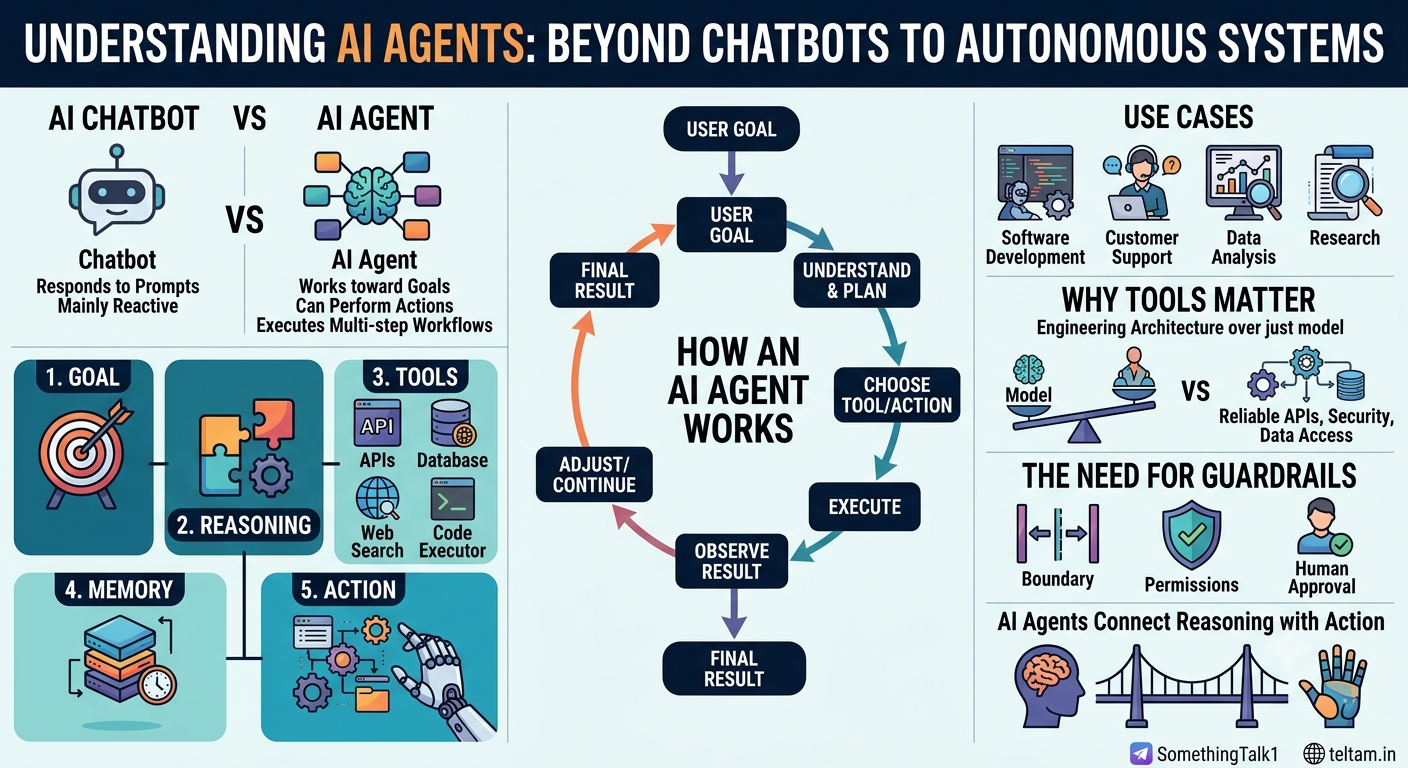
AI Chatbot vs AI Agent
Chatbots and AI agents may look similar from the outside, but their internal behavior can be very different.
| Chatbot | AI Agent |
|---|---|
| Responds to prompts | Works toward goals |
| Usually produces text | Can perform actions |
| Limited workflow | Can execute multi-step workflows |
| May not use external tools | Can use APIs, databases, and applications |
| Mostly reactive | Can be goal-oriented |
The important difference is not simply whether an AI system uses a large language model.
The difference is how the system operates around the model.
The Core Components of an AI Agent
A practical AI agent can be understood as a combination of several components.
1. Goal
Every agent needs an objective.
For example:
- Analyze a sales report
- Research a topic
- Schedule a meeting
- Monitor a system
- Generate a business report
Without a clear goal, autonomous behavior has no meaningful direction.
2. Reasoning
The agent needs to determine what should happen next.
For a complex task, the system may break the problem into smaller steps.
For example:
- Understand the request
- Collect required information
- Analyze the information
- Generate a result
- Validate the result
3. Tools
One of the most important capabilities of an AI agent is tool usage.
An agent can potentially interact with:
- Web search systems
- Databases
- APIs
- Calculators
- Code execution environments
- Business applications
This allows the AI system to move from generating information to performing useful operations.
4. Memory
Agents may need information from previous interactions or previous steps of a task.
Memory can help an agent maintain:
- Conversation context
- Previous actions
- User preferences
- Task history
- Important information retrieved during execution
Memory becomes especially important for long-running workflows.
5. Action
After deciding what needs to happen, the agent must perform an action.
For example, it might:
- Call an API
- Query a database
- Create a document
- Send information to another system
- Run a piece of code
This action capability is what makes agent-based systems different from simple question-answering applications.
How an AI Agent Works
A simplified agent workflow looks like this:
User Goal → Understand → Plan → Choose Tool/Action → Execute → Observe Result → Adjust/Continue → Final Result
The important idea is the feedback loop.
The agent does not necessarily perform one action and stop. It can observe what happened and determine what to do next.
A Simple Real-World Example
Imagine asking an AI agent:
"Analyze this month's sales and prepare a summary of the major problems."
A traditional chatbot may explain how to analyze sales data.
An agent could potentially:
- Access the sales database
- Retrieve the relevant records
- Analyze sales trends
- Identify unusual patterns
- Compare current performance with previous periods
- Generate a summary
The difference is simple:
Chatbot → explains the task.
Agent → can participate in performing the task.
Where AI Agents Can Be Used
AI agents can be useful in many areas.
Software Development
AI agents can assist with:
- Debugging
- Testing
- Documentation
- Code generation
- Development workflows
Customer Support
Agents can understand customer requests and perform predefined actions, such as retrieving information or updating records.
Data Analysis
AI agents can retrieve data, analyze business information, identify patterns, and prepare reports.
Research
Agents can collect information from different sources, organize findings, and help create structured research outputs.
Business Automation
AI agents can connect multiple systems and automate multi-step business workflows.
IT Operations
Agents can monitor systems, identify specific events, and trigger predefined responses.
Why Tools Matter More Than Just the Model
A powerful language model alone does not automatically create a powerful agent.
The surrounding engineering architecture matters.
An agent may require:
- Reliable APIs
- Secure authentication
- Database access
- Permission management
- Error handling
- Monitoring
- Human approval mechanisms
This is where engineering thinking becomes critical.
The model provides intelligence. The system provides capability.
Why AI Agents Need Guardrails
Autonomy introduces new risks.
If an AI system can take actions, engineers must carefully control what it is allowed to do.
Important safeguards include:
- Permission boundaries
- Input validation
- Output validation
- Human approval for sensitive actions
- Logging and monitoring
- Rate limits
- Failure recovery
An agent should not have unlimited access simply because it is capable of using tools.
More autonomy requires more engineering discipline.
AI Agents Are Not Magic
There is a tendency to describe AI agents as completely autonomous digital employees.
In reality, useful agents depend on carefully designed systems.
The quality of an agent depends on:
- The quality of the underlying model
- The quality of available data
- The tools it can access
- The workflow design
- The quality of instructions
- The safety controls
Therefore, building an agent is not simply about connecting an AI model to a button.
It is a system engineering problem.
The Future of AI Applications
Traditional applications are mostly designed around fixed workflows.
AI agents introduce a more flexible approach where systems can interpret goals and dynamically determine the next step.
This could change how we build:
- Business automation systems
- Developer tools
- Research platforms
- Personal productivity applications
- Enterprise software
However, the goal should not be maximum autonomy.
The goal should be useful, reliable, and controllable autonomy.
What Engineers Should Learn
If you want to work with AI agents, learning only prompting is not enough.
A strong foundation includes:
- Python or another programming language
- APIs and web services
- Databases
- Basic AI and machine learning concepts
- Prompt and context design
- System architecture
- Authentication and security
- Testing and monitoring
The future of AI engineering will involve connecting intelligence with reliable software systems.
Final Thought
AI agents represent an important shift in how we think about software.
Instead of applications simply waiting for commands, systems can increasingly understand goals, reason about tasks, use tools, and participate in workflows.
But the real advantage does not come from autonomy alone.
It comes from combining:
- AI intelligence
- Good data
- Reliable tools
- Strong engineering
- Human oversight
AI agents are powerful because they connect reasoning with action.
Understand the foundation first. Build the autonomy carefully.
Comments (0)
No comments yet. Be the first to share your thoughts!
Join the Conversation
Please log in to your Teltam account to post a comment on this article.
Log In to Comment