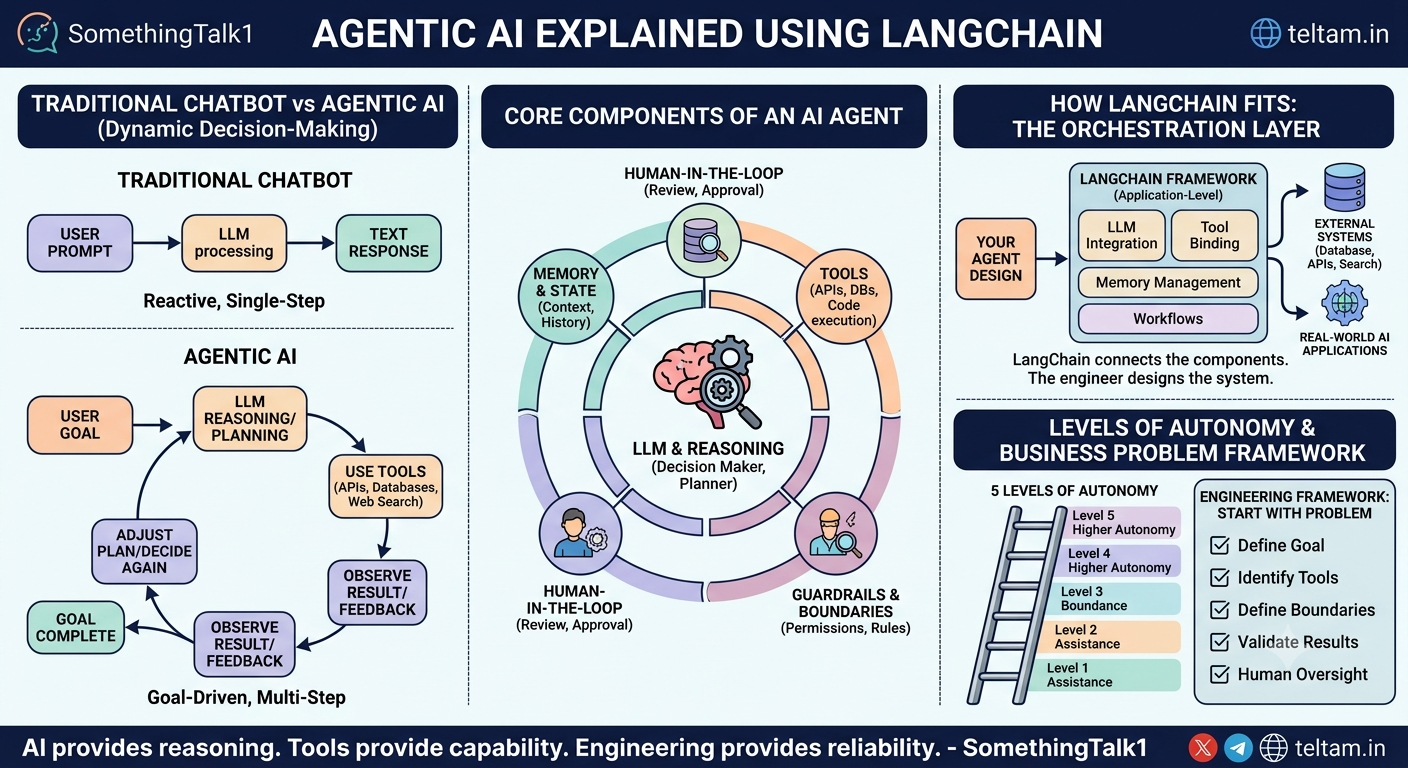
gentic AI Explained Using LangChain
Introduction: Why Agentic AI Feels Confusing Today
If you follow AI discussions today, especially on social media and technology communities, you will often hear terms such as Agentic AI, AI agents, LangChain agents, autonomous AI, and AI workflows.
Some people describe Agentic AI as AI that can completely think and work on its own. Others consider it just another AI trend.
The reality is more practical.
Agentic AI is not magic. It is an engineered approach for building AI systems that can plan, take actions, observe results, and decide what to do next within defined boundaries.
In this blog, we will understand:
- What Agentic AI really means
- How it differs from chatbots and workflows
- The core components of an AI agent
- Where LangChain fits into the architecture
- How a practical agentic workflow works
- Why enterprises are cautious about autonomous systems
- How engineers should approach Agentic AI
No hype. No unnecessary complexity. Just practical engineering clarity.
What Is Agentic AI?
Agentic AI refers to AI systems that can work toward a goal by dynamically deciding what actions should happen next.
An agent can potentially:
- Break a goal into smaller steps
- Decide what action to take
- Use external tools
- Call APIs or databases
- Observe the results
- Adjust its approach
- Stop when the task is complete
A useful way to think about Agentic AI is:
Agentic AI is AI with controlled decision-making capability inside an engineered system.
The word controlled is important.
An agent does not need unlimited autonomy. In real applications, its capabilities should be restricted by permissions, business rules, validation, and safety controls.
Agentic AI vs Chatbots vs Workflows
Agentic AI is often confused with ordinary chatbots and automated workflows. They are related, but they operate differently.
| System | How It Works |
|---|---|
| Chatbot | Responds to user input |
| Workflow | Follows predefined steps |
| Agentic AI | Dynamically decides the next step based on context |
A chatbot might answer:
"How can I generate a sales report?"
A workflow might execute:
Get data → Calculate metrics → Generate report
An agentic system could determine that it first needs to retrieve sales data, decide which tool to use, inspect the result, perform additional analysis if required, and then generate the report.
The major difference is dynamic decision-making.
Core Components of Agentic AI
Agentic AI is not a single model or library.
It is a system design pattern that combines several components.
1. LLM or Reasoning Component
The language model acts as the decision-making component of the system.
It can help:
- Understand the user's objective
- Interpret available information
- Select an appropriate action
- Generate responses
- Determine whether additional steps are required
However, an LLM alone does not make a complete agent.
2. Tools
Tools allow an agent to interact with the outside world.
Examples include:
- APIs
- Databases
- Web search
- Calculators
- Code execution
- Internal business applications
- File systems
This is where an AI system moves beyond simply generating text.
For example:
LLM → "I need sales information."
Tool → Queries the sales database.
LLM → "The data shows a significant decline. I need to analyze the previous month."
The agent can then continue the workflow.
3. Memory and State
An agent may need to remember information during a task.
This can include:
- Conversation context
- Previous actions
- Tool results
- Intermediate information
- Task state
Memory becomes particularly useful when an agent performs multiple steps.
4. Guardrails
More autonomy means more responsibility.
Guardrails can define:
- What the agent is allowed to do
- Which tools it can access
- What information it can retrieve
- Which actions require approval
- When the agent must stop
For example, an agent may be allowed to prepare a financial report but not automatically publish it.
5. Human-in-the-Loop
Some actions should require human approval.
A practical enterprise system might work like:
Agent → Prepare action → Human review → Approval → Execute
This allows organizations to benefit from AI while maintaining control over sensitive decisions.
A Simple Agentic AI Architecture
A simplified architecture can be represented as:
User Request
↓
Agent / LLM
↓
Decide Next Action
↓
Tool Execution
↓
Observe Result
↓
Validate Output
↓
Continue or Stop
↓
Final Result
The important part is the feedback loop.
The agent does not necessarily perform one action and immediately finish.
It can:
Decide → Act → Observe → Decide Again
This loop is one of the key ideas behind agentic systems.
Where Does LangChain Fit?
LangChain is often associated with Agentic AI, but it is important to understand its actual role.
LangChain is a framework for building applications around language models and connecting them with tools, workflows, and other components.
Using LangChain does not automatically make an application intelligent or autonomous.
Instead, it can help engineers organize the components required to build an AI application.
A simplified view is:
Your Agent Design
↓
LangChain / Orchestration Layer
↓
LLM + Tools + State
↓
External Systems
LangChain can help with things such as:
- Connecting models with tools
- Structuring agent workflows
- Managing interactions between components
- Building tool-calling applications
- Creating application-level orchestration
But LangChain does not automatically guarantee:
- Correct decisions
- Secure tool access
- Accurate outputs
- Business logic
- Protection from hallucinations
Those remain engineering responsibilities.
LangChain helps connect the components. The engineer is responsible for designing the system.
A Realistic Agentic AI Example Using LangChain
Consider a business assistant that needs to prepare a monthly sales report.
The user asks:
"Prepare this month's sales performance report."
A possible agentic workflow could look like this.
Step 1: Understand the Request
The agent identifies that it needs sales information for the current month.
Step 2: Determine the Required Action
The agent decides that it needs to access a database.
Step 3: Use a Tool
The system calls a database tool to retrieve the required records.
Step 4: Observe the Result
The agent receives the database output.
Step 5: Validate
The application checks whether:
- Required fields exist
- Data is in the expected format
- The result is usable
Step 6: Analyze
The agent can summarize:
- Total sales
- Major changes
- Trends
- Significant patterns
Step 7: Generate a Draft
The agent prepares the report.
Step 8: Human Review
Before publishing or sending the report, a person reviews it.
The overall flow becomes:
User → Agent → Database Tool → Result → Validation → Analysis → Report Draft → Human Review
Notice that the AI does not need unlimited control.
The system can remain goal-oriented while still being controlled.
Why Enterprises Are Careful With Agentic AI
Agentic systems introduce additional risks because they can perform actions rather than simply generate responses.
1. Hallucinations
If an agent makes an incorrect assumption, that mistake can affect later steps.
2. Security
Giving an AI system access to databases, APIs, or internal applications requires carefully designed permissions.
3. Cost
Multiple model calls and tool interactions can increase operational costs.
4. Observability
Engineers need to understand what happened when an agent produces an unexpected result.
5. Accountability
When an AI system performs an action, organizations need clear responsibility and approval mechanisms.
Because of these concerns, real-world systems often use:
- Restricted permissions
- Validation
- Monitoring
- Approval checkpoints
- Logging
- Failure recovery
This is not a weakness of Agentic AI.
It is good engineering.
Agentic AI Is Not the Same as Full Autonomy
One of the biggest misconceptions is that an AI agent must operate completely independently.
That is not necessary.
There can be different levels of autonomy.
Level 1: AI Assistance
The AI suggests what to do.
Level 2: Tool-Assisted AI
The AI can use approved tools.
Level 3: Controlled Agent
The AI can decide between predefined actions.
Level 4: Human-Approved Agent
The AI prepares actions, but sensitive operations require approval.
Level 5: Higher Autonomy
The system can execute more actions independently within strict boundaries.
The appropriate level depends on the application's risk.
For a simple internal productivity tool, more automation may be acceptable.
For financial, security, healthcare, or other sensitive systems, stronger controls may be necessary.
How Senior Engineers Should Think About Agentic AI
For experienced engineers, learning Agentic AI should not mean memorizing every framework or chasing every new demo.
Instead, focus on system design.
Ask questions such as:
- What problem is the agent solving?
- Why does the system need an agent?
- Which decisions can AI make?
- Which decisions must remain deterministic?
- What tools should the agent access?
- What happens when a tool fails?
- What happens when the model is wrong?
- Where should human approval be required?
- How will the system be monitored?
This way of thinking is more valuable than simply knowing a framework's syntax.
What Not to Do
Avoid building an agent simply because "agents are trending."
Do not assume:
- More autonomy always means a better system
- More tools always make an agent more capable
- A framework automatically solves reliability problems
- AI-generated decisions are always correct
- A successful demo is automatically production-ready
A good engineering principle is:
Use autonomy where it creates value, not where it creates unnecessary risk.
What To Do Instead
Start with a specific business problem.
Then determine:
1. The Goal
What exactly should the system accomplish?
2. The Tools
What external systems does it actually need?
3. The Decision Boundaries
Which decisions can AI make?
4. The Validation
How will you verify the results?
5. The Failure Handling
What happens when the AI or a tool fails?
6. Human Oversight
Which actions require approval?
This approach produces systems that are much easier to understand, test, and maintain.
Agentic AI vs Traditional Automation
Traditional automation is usually deterministic.
For example:
Step 1 → Step 2 → Step 3 → Step 4
The developer defines the sequence.
Agentic systems introduce flexibility.
The system may determine:
Goal → Decide → Tool → Observe → Decide Again
This flexibility can be useful when the exact path cannot be known in advance.
However, flexibility also creates complexity.
Therefore, engineers should not replace every workflow with an agent.
Sometimes a simple workflow is the better solution.
When Should You Use an Agent?
An agent can be useful when:
- The task involves multiple possible paths
- The next action depends on previous results
- Multiple tools may be required
- The input is variable
- The workflow requires contextual decisions
A traditional workflow may be better when:
- The steps are predictable
- Rules are deterministic
- The process is highly regulated
- Reliability is more important than flexibility
- There is no meaningful decision-making requirement
The best architecture is not always the most sophisticated one.
Choose the simplest architecture that solves the problem reliably.
The Engineering Mindset Behind Agentic AI
The most important skill in Agentic AI is not knowing a particular framework.
It is understanding how to combine:
AI + Data + Tools + Logic + Security + Monitoring + Human Oversight
An agent without reliable tools is limited.
An agent without guardrails can be risky.
An agent without monitoring is difficult to operate.
An agent without a clear business goal may simply add unnecessary complexity.
The real value comes from putting all these pieces together correctly.
Final Thoughts
Agentic AI is real, but it should not be treated as magic.
At its core, it is about creating AI-powered systems that can:
- Understand goals
- Make controlled decisions
- Use tools
- Observe results
- Continue or stop based on context
LangChain can help engineers build and orchestrate these systems, but the framework itself is not the intelligence.
The intelligence comes from the model.
The capability comes from the tools.
The reliability comes from engineering.
And the responsibility comes from the people designing and operating the system.
The future of Agentic AI is not about removing engineers. It is about building better systems with AI.
If you are learning Agentic AI, start with the fundamentals:
Understand the problem → Design the workflow → Add tools → Define boundaries → Validate results → Monitor the system.
That is how Agentic AI moves from an exciting concept to a practical engineering capability.
Explore more practical AI learning and engineering insights at Teltam.in.
Comments (0)
No comments yet. Be the first to share your thoughts!
Join the Conversation
Please log in to your Teltam account to post a comment on this article.
Log In to Comment