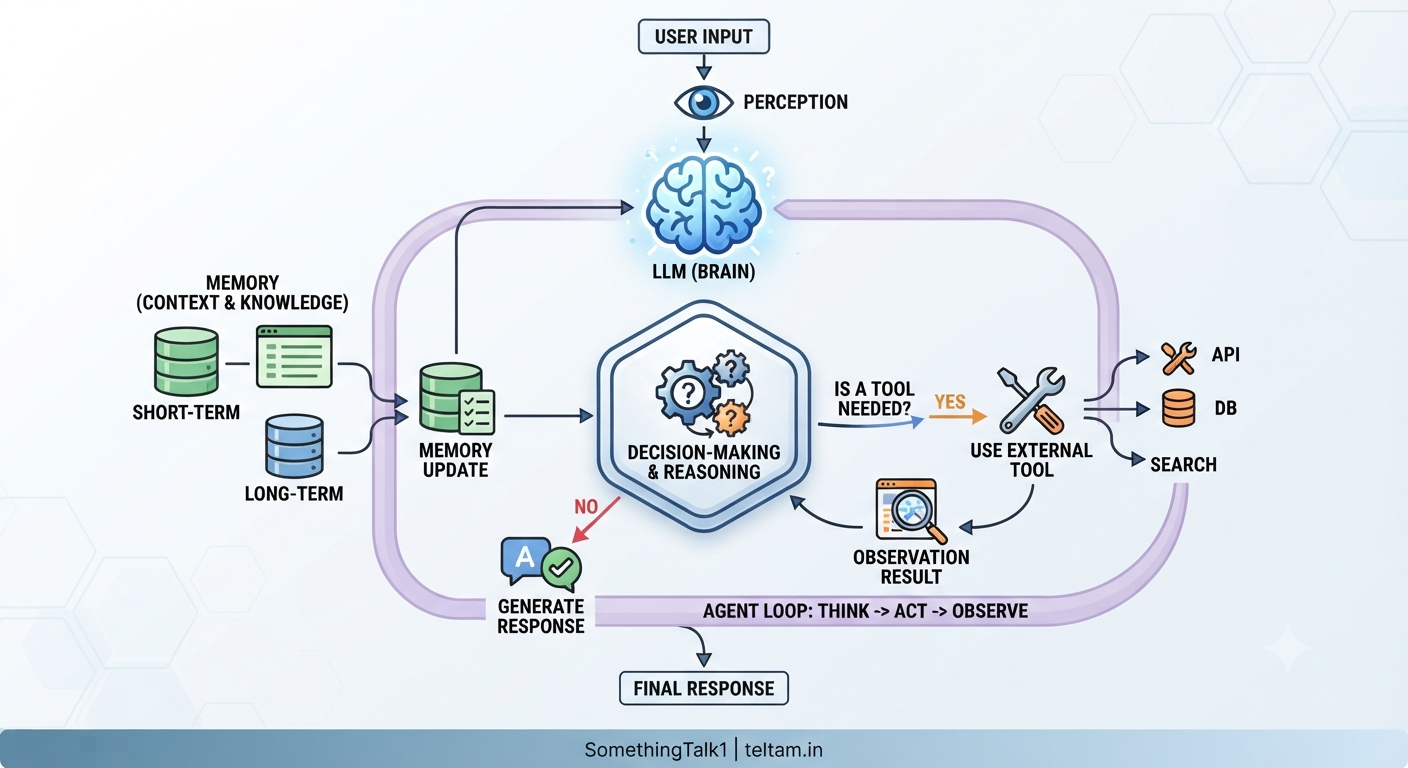
Agentic AI Explained: Core Concepts, ReAct, Tools, Memory & LLM Integration
Introduction
Agentic AI represents the next evolution of Artificial Intelligence.
Traditional AI systems typically receive an input and generate an output.
For example:
User Prompt
     ↓
AI Model
     ↓
Response
Agentic AI goes beyond this simple interaction.
An AI agent can potentially:
-
Understand information
-
Reason about a problem
-
Decide what to do next
-
Use external tools
-
Observe the results
-
Continue working toward a goal
Instead of simply generating a response, an AI agent can follow a sequence of actions to complete a task.
In this guide, we will explore:
-
The core concepts of Agentic AI
-
The Agent Loop
-
The ReAct framework
-
LLM integration
-
Tools and tool usage
-
Short-term and long-term memory
-
How all these components work together
What Is Agentic AI?
Agentic AI refers to AI systems designed to work toward a goal by combining intelligence, decision-making, tools, and actions.
A traditional AI interaction may look like this:
Input → AI → Output
An Agentic AI system can follow a more dynamic process:
Input → Think → Decide → Act → Observe → Repeat → Final Result
The important difference is that the system can perform multiple steps instead of producing only one immediate response.
Core Concepts of Agentic AI
Agentic AI is built around several fundamental components.
These components define how an AI agent understands information and works toward a goal.
1. Perception
Perception is how the agent receives information.
The information may come from:
-
A user
-
A database
-
An API
-
A file
-
Another software system
-
The surrounding environment
For example:
A user asks, "What is the weather today?"
The agent receives this request as input.
2. Reasoning
Reasoning helps the agent determine what should happen next.
The agent analyzes the available information and decides:
-
What is the goal?
-
What information is required?
-
Which action should be taken?
-
Does it need to use a tool?
For example:
"The user wants current weather information, so I need to retrieve recent weather data."
Reasoning helps guide the next step.
3. Action
After deciding what to do, the agent can perform an action.
Actions may include:
-
Calling an API
-
Searching a database
-
Using a calculator
-
Reading a file
-
Running a function
For example:
Call a weather service to retrieve current weather information.
4. Memory
Memory allows an AI agent to maintain useful context.
Memory can help the agent remember:
-
Previous conversations
-
Important user information
-
Results from earlier tasks
-
Relevant knowledge stored for later use
Memory helps make the agent more context-aware.
The Agent Loop: Think → Act → Observe
One of the most important ideas in Agentic AI is the Agent Loop.
An agent does not always complete a task in a single step.
Instead, it may work through a repeated process.
Observation
     ↓
Thought
     ↓
Action
     ↓
Observation
     ↓
Repeat
This loop allows the agent to:
-
Understand the current situation
-
Decide what to do
-
Take an action
-
Observe the result
-
Decide whether another action is required
This process is the foundation of many agentic systems.
The ReAct Framework
Reasoning + Acting
The ReAct framework combines reasoning and actions.
The name ReAct comes from:
Reason + Act
The basic workflow looks like this:
Step 1: Thought
The AI analyzes the problem and determines what needs to happen next.
Step 2: Action
The agent selects and uses a tool or function.
Step 3: Observation
The agent receives the result of the action.
Step 4: Repeat
If the task is not complete, the agent continues the process.
ReAct Flow Diagram
User Input
     ↓
Thought
(Reasoning)
     ↓
Action
(Tool Call)
     ↓
Observation
(Result)
     ↓
Repeat if Needed
     ↓
Final Answer
The agent continues this loop until it has enough information or has completed the required task.
Example: Using ReAct
Imagine a user asks:
"What is the current weather?"
The agent could follow this process:
Thought
"I need current weather information."
Action
Use a weather API.
Observation
The weather tool returns the requested information.
Final Answer
The agent processes the information and provides a response to the user.
The important concept is:
The agent uses information from its actions to determine what to do next.
Adding an LLM to Agentic AI
A Large Language Model (LLM) acts as the intelligence component of an AI agent.
You can think of it as:
LLM = The Brain of the Agent
The LLM helps the agent:
-
Understand user input
-
Interpret instructions
-
Analyze information
-
Determine possible next steps
-
Select actions
-
Generate responses
Without an intelligence component, a system cannot dynamically understand and reason about tasks.
Role of the LLM
The LLM typically helps with three major tasks.
1. Understanding Input
The LLM interprets the user's request.
For example:
"Find information about a topic and summarize it."
The LLM needs to understand:
-
What information is required
-
What the user expects
-
What actions may be necessary
2. Decision-Making
The LLM can help determine:
What should happen next?
For example:
User Request
     ↓
LLM Understands Request
     ↓
Does the Agent Need a Tool?
     ↓
Yes → Select Tool
No  → Generate Response
3. Generating Responses
After receiving information from tools or memory, the LLM processes the available context and generates a useful response.
Step-by-Step LLM Integration
Step 1: Choose an LLM
The first step is selecting the language model that will provide the intelligence for the agent.
Examples include:
-
GPT models
-
Open-source LLMs
The selected model should be capable of understanding instructions and processing relevant context.
Step 2: Define the Prompt Structure
The prompt provides instructions for how the agent should behave.
A structured prompt may include:
-
Agent instructions
-
Task objectives
-
Available tools
-
Memory context
-
Rules and limitations
For example:
You are an AI assistant.

Your goal is to help solve the user's request.

Available tools:
- Search Tool
- Calculator Tool

Use a tool when necessary.
Use the result to provide the final answer.
Clear instructions help guide the behavior of the agent.
Step 3: Enable Decision-Making
The agent needs a process for determining what should happen next.
The system can be designed to follow a structured flow:
Understand Request
       ↓
Analyze Available Information
       ↓
Decide Next Action
       ↓
Use Tool if Required
       ↓
Process Result
       ↓
Continue or Respond
The LLM acts as the decision-making component within this workflow.
Key Insight
Without an LLM, the agent has limited intelligence and flexibility.
With an LLM, the system can better understand requests and help determine the next action.
Adding Tools to Agentic AI
Tools allow an AI agent to interact with external systems.
Without tools, an LLM is mainly limited to processing the information available within its context.
With tools, an AI agent can perform additional actions.
Examples of Tools
An AI agent may use:
-
APIs
-
Search tools
-
Databases
-
Calculators
-
File systems
-
External applications
For example:
Weather API
Retrieve weather information.
Database
Retrieve stored information.
Calculator
Perform mathematical calculations.
File System
Read or process files.
Tool Usage Flow
User Query
     ↓
LLM Understands Request
     ↓
LLM Decides Which Tool Is Needed
     ↓
Tool Execution
     ↓
Result Returned
     ↓
LLM Processes Result
     ↓
Final Response
This allows the agent to combine language understanding with external capabilities.
Step-by-Step Tool Integration
Step 1: Define the Tools
Create the functions, APIs, or services the agent can use.
For example:
Calculator Tool
Weather Tool
Search Tool
Database Tool
Step 2: Register the Tools
Make the available tools accessible to the agent.
The agent needs information about:
-
What each tool does
-
When it should be used
-
What inputs the tool requires
Step 3: Allow the Agent to Select a Tool
The agent analyzes the user request and determines whether a tool is required.
For example:
User: "Calculate 25 × 48."
The agent recognizes that a calculator can help with this task.
Step 4: Execute the Tool
The selected tool performs the required action.
25 × 48
   ↓
Calculator Tool
   ↓
Result
Step 5: Process the Result
The result is returned to the agent.
The LLM processes the result and generates a response for the user.
Adding Memory to Agentic AI
Memory helps AI agents maintain context.
Without memory, every interaction may need to be treated independently.
With memory, an agent can use relevant information from previous interactions.
Memory can make agents:
-
More context-aware
-
More personalized
-
Better able to maintain continuity
Types of Memory
1. Short-Term Memory
Short-term memory stores information relevant to the current conversation or task.
It is typically temporary.
Example
User: My goal is to learn AI.

Later...

User: What is my goal?

Agent:
Your goal is to learn AI.
The agent uses information from the current conversation.
2. Long-Term Memory
Long-term memory stores information for future retrieval.
It may be stored in:
-
Databases
-
Vector databases
-
Other persistent storage systems
The agent can retrieve relevant information when needed.
Memory Flow Diagram
User Input
     ↓
Check Current Context
     ↓
Retrieve Relevant Long-Term Memory
     ↓
Combine Relevant Information
     ↓
Send Context to LLM
     ↓
Generate Response
     ↓
Store Useful Information
The goal is not necessarily to send all stored information to the LLM.
Instead, the system retrieves information that is relevant to the current task.
Step-by-Step Memory Integration
Step 1: Implement Short-Term Memory
Use conversation history to maintain context during the current interaction.
For example:
-
Previous messages
-
Current task information
-
Recent tool results
Step 2: Add Long-Term Memory
Store important information for later retrieval.
This may involve a vector database.
Examples include:
-
FAISS
-
Pinecone
Step 3: Retrieve Relevant Context
When the user asks a question, the system can search for information relevant to the request.
This is often based on semantic similarity.
The goal is:
Retrieve relevant information instead of retrieving everything.
Step 4: Provide Context to the LLM
The relevant information is combined with the user's request.
User Query
     +
Relevant Memory
     +
Agent Instructions
     ↓
LLM
     ↓
Response
This can improve the relevance of the response.
Example: Memory in Action
Imagine a user previously told the agent:
"My goal is to become an AI Engineer."
Later, the user asks:
"What is my goal?"
The agent can:
-
Search relevant memory
-
Retrieve the stored information
-
Use the retrieved context
-
Generate an accurate response
Memory helps maintain continuity across interactions.
Putting Everything Together
An Agentic AI system combines multiple components.
LLM
↓
Brain and Decision-Making

Tools
↓
Actions and External Capabilities

Memory
↓
Context and Information Retrieval

Agent Loop
↓
Repeated Decision and Action Process
Together, these components create an agent capable of working through tasks step by step.
Complete Agentic AI Architecture
                User Input
                    ↓
              Perception
                    ↓
              LLM (Brain)
                    ↓
            Decision-Making
                    ↓
         ┌──────────────────┐
         │ Is a Tool Needed?│
         └──────────────────┘
              ↓        ↓
             Yes       No
              ↓        ↓
         Use Tool    Generate
              ↓      Response
          Observation
              ↓
          Memory Update
              ↓
        Continue or Finish
This represents the general idea behind an Agentic AI system.
The Four Core Building Blocks
A simple way to remember Agentic AI is:
LLM → Brain
Provides language understanding and decision-making.
Tools → Actions
Allow the agent to interact with external systems.
Memory → Context
Helps the agent maintain and retrieve relevant information.
ReAct → Control Loop
Provides a structured process for reasoning, acting, and observing results.
Together:
LLM + Tools + Memory + Agent Loop = Agentic AI System
Why Agentic AI Matters
Traditional AI systems mainly focus on generating responses.
Agentic systems can support workflows that involve multiple steps.
For example:
Goal
 ↓
Understand the Task
 ↓
Plan Actions
 ↓
Use Tools
 ↓
Observe Results
 ↓
Continue if Required
 ↓
Complete the Task
This approach can help developers build AI systems capable of handling more complex workflows.
Important Considerations
Agentic AI systems are powerful, but they also require careful design.
Developers need to consider:
-
Tool permissions
-
Memory management
-
Error handling
-
Validation
-
Security
-
Human oversight
An agent should not automatically be given unlimited access to every tool or system.
Good Agent design includes clear boundaries and controls.
Conclusion
Agentic AI represents an important shift in how intelligent systems can be designed.
Instead of simply generating responses, AI agents can work through tasks by combining:
-
Perception
-
Reasoning
-
Actions
-
Memory
-
LLM intelligence
-
External tools
The ReAct approach provides a structured process:
Think → Act → Observe → Repeat
When combined with LLMs, tools, and memory, this approach can support AI systems capable of working through complex tasks step by step.
The core idea is simple:
An AI Agent combines intelligence with the ability to take actions.
Final Takeaway
Remember the four major components:
LLM
↓
Brain

Tools
↓
Actions

Memory
↓
Context

ReAct
↓
Control Loop
Together, they form the foundation of an Agentic AI system.
As Agentic AI continues to evolve, understanding these core concepts will become increasingly important for developers, AI engineers, and organizations building intelligent systems.
Closing
Want to learn more about:
-
Artificial Intelligence
-
Generative AI
-
Large Language Models
-
AI Agents
-
Agentic AI
-
Prompt Engineering
-
AI System Design
Follow for more educational content.
YouTube: SomethingTalk1
Website: teltam.in
Comments (0)
No comments yet. Be the first to share your thoughts!
Join the Conversation
Please log in to your Teltam account to post a comment on this article.
Log In to Comment