The Real Value of AI: Beyond Quick Drafts and Shiny Tools
Artificial Intelligence has moved rapidly from an experimental technology to a mainstream topic in boardrooms, startups, classrooms, and everyday work.
Tools such as ChatGPT, GitHub Copilot, Replit, and AI-assisted coding platforms have created exciting possibilities—from generating content in seconds to prototyping software faster than ever.
But there is an important question we need to ask:
Does using AI automatically mean less effort and shorter project timelines?
Not necessarily.
AI is powerful, but AI is not magic. Its real value comes from how thoughtfully we use it, how well we integrate it into existing workflows, and how closely we align it with actual business goals.
The Illusion of Instant Productivity
When people see ChatGPT generate an essay or code within seconds, it is easy to assume that an entire project can now be completed dramatically faster.
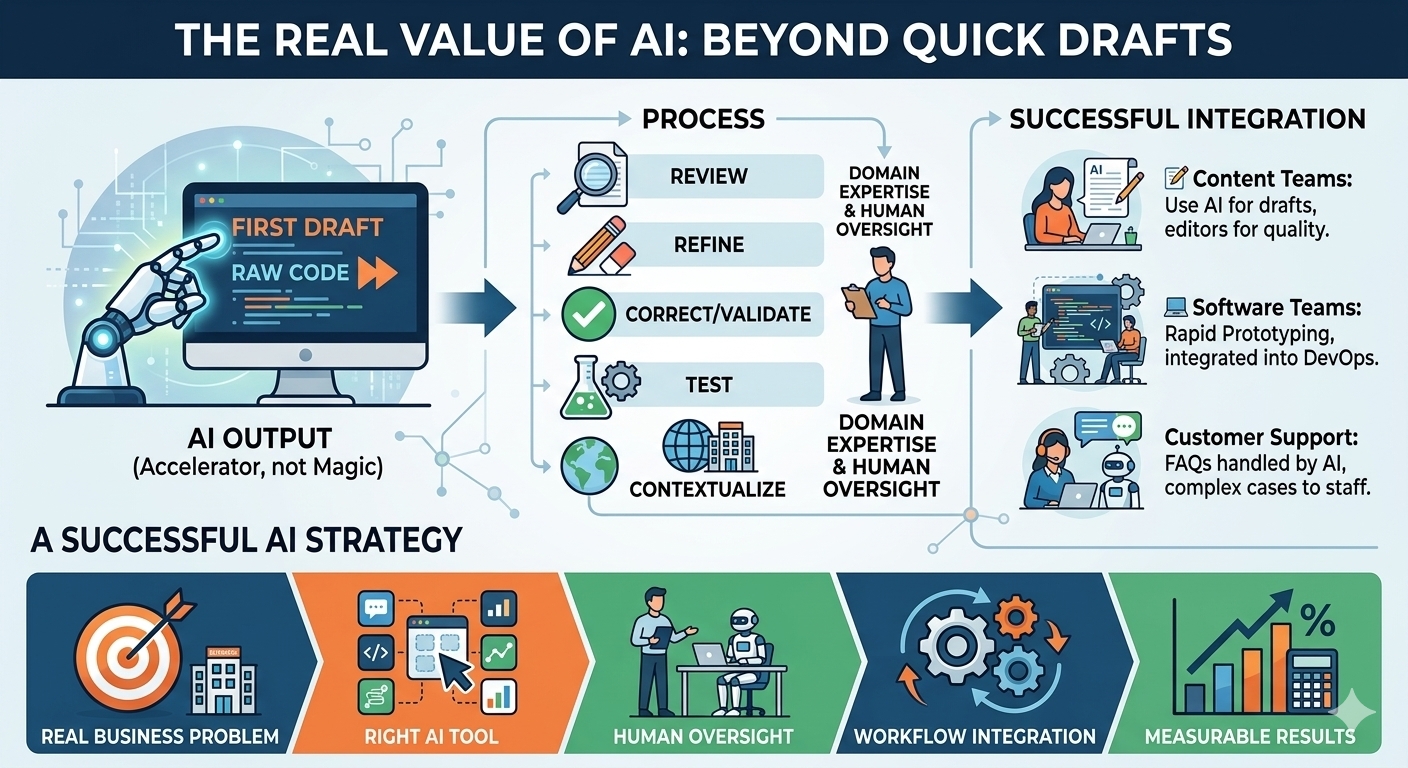
In reality, AI often provides a:
First Draft → Starting Point → Productivity Accelerator
The generated output may still need to be:
- Reviewed
- Refined
- Corrected
- Tested
- Contextualized
- Validated by a human
Without proper human oversight and domain expertise, AI-generated output may not meet the required quality standards or business requirements.
The Reality
AI can reduce effort in some areas, but it can also introduce new work around learning, adaptation, review, and validation.
Organizations that expect AI to automatically cut project timelines in half without changing their workflows may end up disappointed.
Vibe Coding & Replit: A New Mindset
AI-assisted coding and platforms such as Replit can significantly improve the development experience.
They can help developers:
- Reduce setup friction
- Experiment quickly
- Generate code
- Prototype ideas
- Get instant feedback
But there is a catch.
AI-Assisted Coding Requires a Different Mindset
Developers need to learn how to:
Work with AI → Prompt effectively → Review suggestions → Accept or reject intelligently
This creates a new learning curve.
Those who develop these skills can improve their speed and creativity, while those expecting completely plug-and-play productivity may become frustrated.
AI Doesn't Replace the Developer
Vibe coding is not simply about replacing developers.
Instead, AI can act as an interactive development partner, helping with repetitive tasks, boilerplate code, and rapid prototyping.
Like any skill, effective AI-assisted coding requires practice and patience.
The Need for Mindful AI Integration
The real value of AI becomes clearer when it is integrated thoughtfully into existing workflows.
For example:
✍️ Content Teams
Use AI to create first drafts while editors handle final review and quality control.
💻 Software Teams
Use AI-assisted platforms for rapid prototyping while integrating the resulting work into standard development and DevOps processes.
💬 Customer Support
Use AI assistants to handle frequently asked questions while routing complex cases to trained support staff.
The key is not simply using AI.
The key is:
Evaluate → Adjust → Integrate → Measure
AI adoption should always be connected to clear business objectives.
The Danger of Throwing AI Everywhere
One of the biggest risks of AI adoption is “shiny object syndrome.”
This happens when organizations try to introduce AI into every process simply because AI is popular.
The result can be:
- Broken workflows
- Frustrated employees
- Unclear responsibilities
- Wasted resources
- Disappointed leadership
And when expectations are not met, organizations may abandon AI initiatives completely.
AI Is a Tool, Not a Magic Solution
Instead of asking:
“Where can we use AI?”
Organizations should ask:
“Where can AI create real value?”
This small change in thinking can make a major difference.
So, Where Does AI Create Real Value?
The goal should not be to use AI everywhere.
The goal should be to use AI where it genuinely improves the way people work.
A successful AI strategy should focus on:
Real Business Problem
↓
Right AI Tool
↓
Human Oversight
↓
Workflow Integration
↓
Measurable Results
This approach helps organizations move beyond experimentation and toward sustainable AI adoption.
AI as a Partner, Not a Shortcut
AI is not simply about shrinking timelines.
Its greater value lies in rethinking workflows, augmenting human effort, and creating more space for creativity and strategic thinking.
Tools such as ChatGPT, Replit, and AI-assisted coding platforms can be transformative—but only when they are used with the right mindset.
The organizations that succeed in the AI era will be those that adopt AI:
Thoughtfully. Strategically. Patiently.
Rather than chasing shortcuts, they will focus on sustainable integration, aligning AI with real business objectives and empowering people to work alongside it.
Final Thoughts
The real value of AI isn't measured by how quickly it can generate a piece of text or code.
It is measured by what happens after that first output.
Can your team evaluate it?
Can you improve it?
Can you integrate it into your workflow?
Can it solve a genuine business problem?
When AI is treated as a collaborator rather than a quick-fix solution, its true potential begins to unfold.
AI isn't about replacing effort. It's about making human effort more valuable.
Comments (0)
No comments yet. Be the first to share your thoughts!
Join the Conversation
Please log in to your Teltam account to post a comment on this article.
Log In to Comment