Introduction
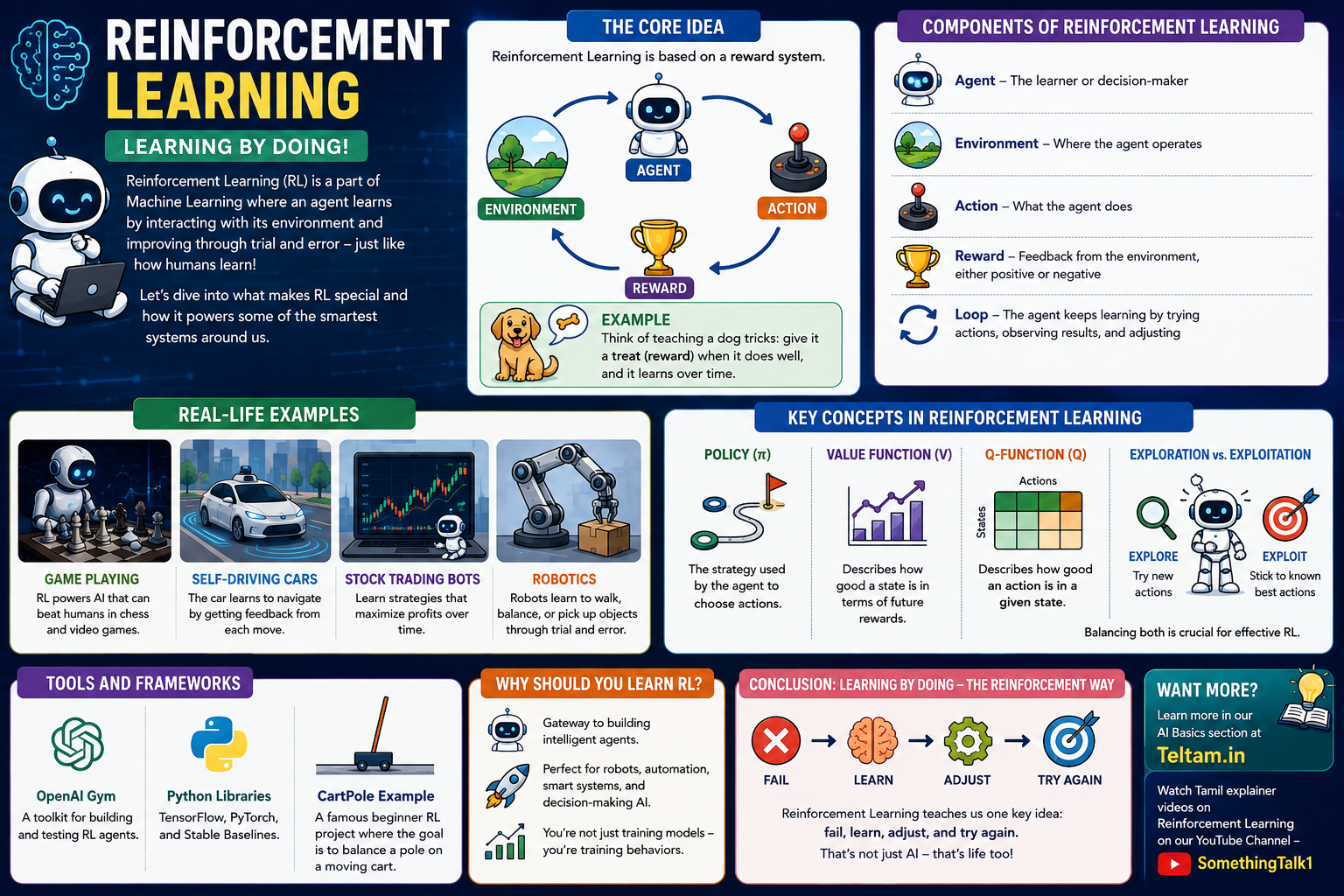
Reinforcement Learning (RL) is a part of Machine Learning where an agent learns by interacting with its environment and improving through trial and error – just like how humans learn!
Let’s dive into what makes RL special and how it powers some of the smartest systems around us.
The Core Idea
Reinforcement Learning is based on a reward system.
The agent takes an action, receives feedback from the environment, and uses that feedback to improve its future decisions.
Components of Reinforcement Learning
- Agent – The learner or decision-maker.
- Environment – Where the agent operates.
- Action – What the agent does.
- Reward – Feedback from the environment, either positive or negative.
- Loop – The agent keeps learning by trying actions, observing results, and adjusting.
Example
Think of teaching a dog tricks.
When the dog performs a trick correctly, you give it a treat (reward). Over time, the dog learns which actions lead to rewards.
Reinforcement Learning works in a similar way. The agent learns from feedback and gradually improves its behavior.
Real-Life Examples
Reinforcement Learning is used in several real-world applications:
- Game Playing – RL powers AI that can learn strategies for chess and video games.
- Self-Driving Cars – RL can help autonomous systems learn navigation and decision-making through feedback.
- Stock Trading Bots – RL can be used to learn strategies that aim to maximize returns over time.
- Robotics – Robots can learn to walk, balance, or pick up objects through trial and error.
Key Concepts in Reinforcement Learning
Policy (π)
A policy is the strategy used by the agent to choose actions.
Value Function (V)
The value function describes how good a state is in terms of its expected future rewards.
Q-Function (Q)
The Q-function describes how good a particular action is when taken in a given state.
Exploration vs. Exploitation
The agent needs to decide between:
- Exploration – Trying new actions to discover potentially better strategies.
- Exploitation – Choosing actions that are already known to produce good results.
Balancing exploration and exploitation is crucial for effective Reinforcement Learning.
Tools and Frameworks
You can try Reinforcement Learning using:
- OpenAI Gym – A toolkit for building and testing RL agents.
- Python Libraries – TensorFlow, PyTorch, and Stable Baselines can be used for Reinforcement Learning projects.
- CartPole Example – A famous beginner RL project where the goal is to balance a pole on a moving cart.
Why Should You Learn Reinforcement Learning?
Reinforcement Learning is a gateway to building intelligent agents.
If you’re excited about robots, automation, smart systems, and decision-making AI, RL is a path worth exploring.
With RL, you're not just training models – you're training behaviors.
Conclusion: Learning by Doing – The Reinforcement Way
Reinforcement Learning teaches us one key idea:
Fail → Learn → Adjust → Try Again
The agent learns from its experiences, improves its decisions, and gradually becomes better at achieving its goals.
That’s not just AI – that’s life too!
Want More?
Learn more in our AI Basics section at Teltam.in.
Watch Tamil explainer videos on Reinforcement Learning on our YouTube Channel – SomethingTalk1.
Comments (0)
No comments yet. Be the first to share your thoughts!
Join the Conversation
Please log in to your Teltam account to post a comment on this article.
Log In to Comment