AI and Jobs in 2025: Opportunities, Risks & Skills for the Future
Introduction
Artificial Intelligence (AI) is no longer just a futuristic concept. It is already transforming workplaces around the world.
From chatbots and coding assistants to automation and advanced data analytics, AI is changing how people work, which skills are in demand, and how businesses operate.
But is AI only replacing jobs?
Not necessarily.
AI is also creating new career opportunities and entirely new types of roles. The key for professionals is to understand these changes and prepare for an increasingly AI-powered workplace.
The Positive Side: New Opportunities in 2025
AI is automating many repetitive tasks, but at the same time, it is creating opportunities for people who can develop, manage, understand, and implement AI systems.
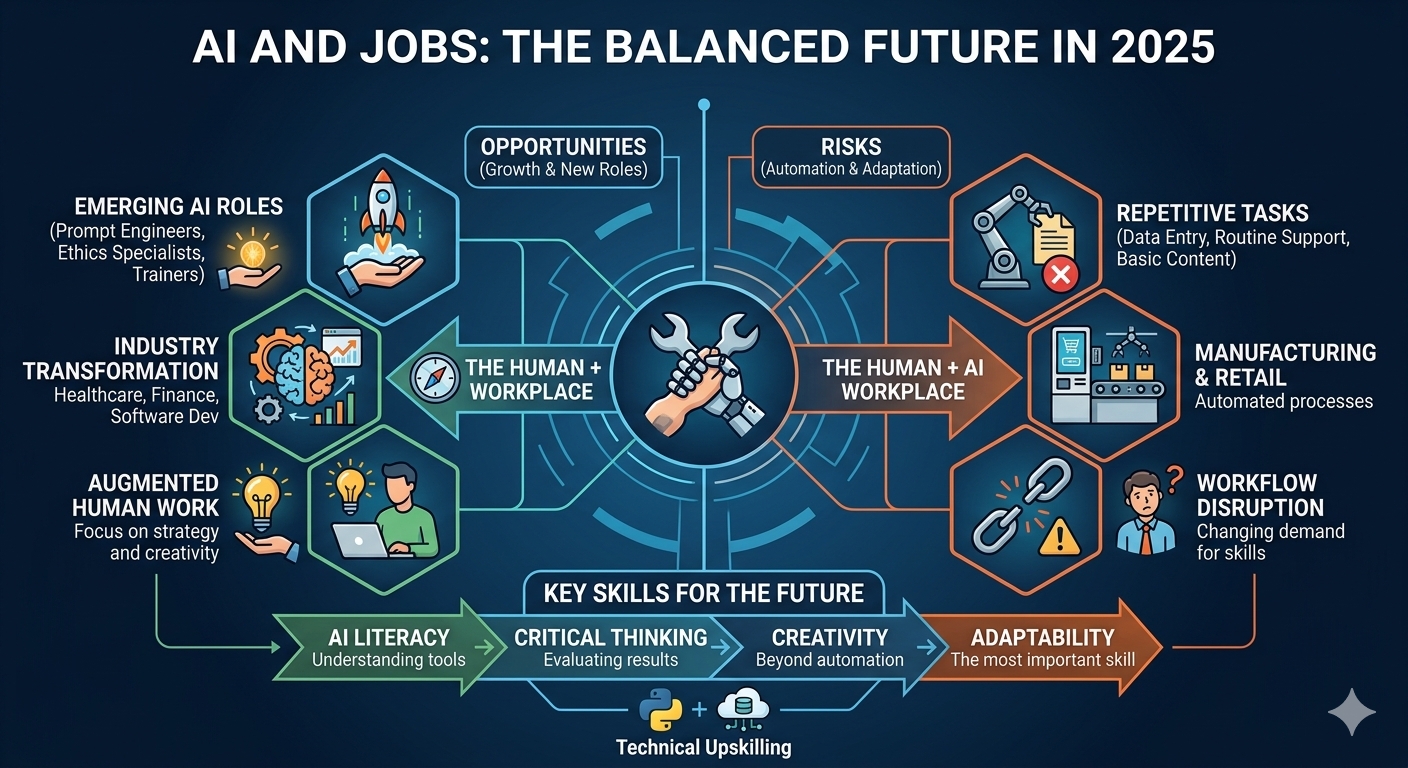
Emerging AI Job Roles
Some roles gaining importance include:
- AI Prompt Engineers – Design effective prompts to get better results from AI systems.
- Data Annotators – Prepare and label high-quality data used to train AI models.
- AI Ethics Specialists – Help ensure that AI systems are fair, transparent, and responsible.
- AI Trainers & Consultants – Help organizations understand, adopt, and integrate AI into their workflows.
These roles demonstrate how the growth of AI is creating demand for both technical and non-technical AI skills.
How AI Is Transforming Different Industries
AI is having an impact across a wide range of industries.
Healthcare
AI is being used for:
- AI-assisted diagnosis
- Patient monitoring
- Drug discovery
Finance
AI can support:
- Fraud detection
- Algorithmic trading
- Risk management
Education
AI-powered platforms can provide personalized learning experiences and AI-assisted tutoring.
Software Development
AI coding tools such as GitHub Copilot, Cursor, and AI-assisted development workflows are changing how developers write, test, and understand code.
The Risks: What Jobs Are at Stake?
While AI creates new opportunities, automation may reduce the demand for certain repetitive roles.
Some areas likely to experience significant change include:
- Repetitive Office Tasks – Data entry, basic reporting, and routine customer support.
- Retail and Cashier Roles – Automated billing and self-checkout systems.
- Basic Content Writing – AI tools can generate simple and repetitive content.
- Manufacturing – Robotics and automation can reduce the need for some manual tasks.
However, this does not necessarily mean that these jobs will disappear completely.
Instead, many roles may change significantly, with employees working alongside AI tools rather than performing every task manually.
Skills You Need to Stay Relevant
As AI changes the workplace, continuously developing your skills becomes increasingly important.
1. AI Literacy
You don't necessarily need to become an AI engineer.
Understanding how AI tools work, what they can do, and how to use them effectively can already provide a valuable advantage.
2. Critical Thinking
AI can generate information and suggestions, but people still need to evaluate results, identify mistakes, and make important decisions.
3. Creativity
Creative thinking allows professionals to develop ideas and solutions that go beyond repetitive automation.
4. Communication & Collaboration
Human-centered skills such as communication, teamwork, and collaboration remain important even when AI becomes part of everyday workflows.
5. Technical Upskilling
For those interested in technology careers, skills such as:
- Python
- Machine Learning
- Cloud Computing
- Data Analytics
can provide a strong foundation for working with AI.
The Balanced Future: Humans + AI
AI should not be viewed simply as a threat or a solution to everything.
It is a tool.
The professionals who benefit most from AI will likely be those who learn how to work with AI rather than compete against it.
The future is not necessarily AI replacing humans. It is increasingly about humans using AI to work more effectively.
Just as computers transformed workplaces and created new industries in previous decades, AI is creating new opportunities while changing existing roles.
The most important skill is adaptability.
How Can You Prepare for the AI-Powered Workplace?
You can start preparing today with a few simple steps:
- Learn AI fundamentals and understand the basics.
- Experiment with AI tools relevant to your field.
- Improve your technical skills if you're interested in AI-related careers.
- Develop critical thinking and communication skills.
- Build practical projects to demonstrate what you have learned.
- Keep learning as AI technologies continue to evolve.
You don't need to become an AI expert overnight. Start small and build your knowledge step by step.
Comments (0)
No comments yet. Be the first to share your thoughts!
Join the Conversation
Please log in to your Teltam account to post a comment on this article.
Log In to Comment